Why Smart People Still Believe in God
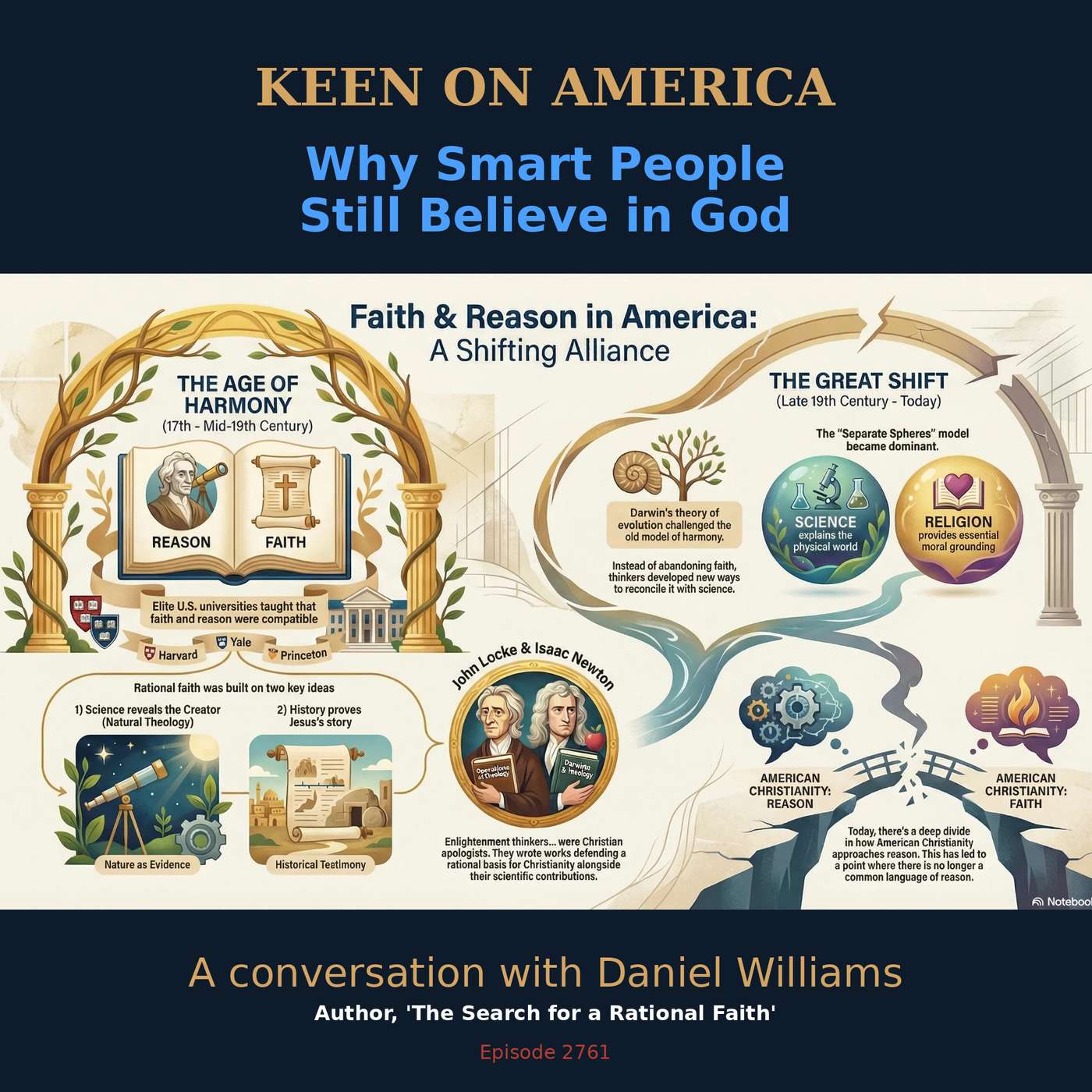
If Darwin’s evolutionary theories couldn’t kill America’s faith in God, then what could? That’s the message in Daniel K. William’s new book, The Search for a Rational Faith. Americans, Williams argues, have always sought to combine scientific knowledge with Christian apologetics. From the Founding Puritans to John Adams, Harriet Beecher and Martin Luther King, Americans have clung to the idea that enlightenment doesn’t undermine faith. That’s why thoughtful people - or, at least, thoughtful Americans - believe in God. “Without religion as a moral constraint, any sort of moral anarchy would be theoretically possible. In the world of the atomic bomb, there had to be some form of transcendent thinking,” Williams argues. “Religion has not been simply an anti-liberal reactionary force, but actually has been central to the American story and to America’s human rights project.”
Keen On America is a reader-supported publication. To receive new posts and support my work, consider becoming a free or paid subscriber.
This is a public episode. If you'd like to discuss this with other subscribers or get access to bonus episodes, visit keenon.substack.com/subscribe
How to direct the power of digital technology into economic and political progress: Simon Johnson on what we can learn from our 1000-year struggle over technology and prosperity to make our age of Generative AI more equitable
On the science of failing well: Amy Edmondson explains why we need to take smart risks which will result in more, rather than fewer, failures
Don't Look Away: Alexander Batthyany on terminal lucidity, the "soul" and our final journey when we cross over the border from life to death
Extremely Socially Online: Taylor Lorenz on the untold story of fame, influence, and power on the internet
How to break free of "equality feminism": Marcie Bianco on the lie of equality and the feminist fight for freedom
Taming the Street then and now: Diana Henriques on the New Deal, FDR's fight to regulate American capitalism and its relevance in Joe Biden's America today
Was Richard Nixon really a Southern Californian paragon of cheerfulness , hard work and decency? Paul Carter's defense of the only US President born and raised in California
The Dirty Secrets of our Material World: Ed Conway on the six physical commodities underpinning the global extractive economy
An Un-Whitewashed Story of America: Michael Harriot on AF History, Black Twitter and how he "discovered" America at 8.00 pm on November 4, 1980
Eight great non-fiction reads for the Fall: LA Times book critic Bethanne Patrick on new books about video-gaming writers, Roman emperors, Rastafarian fathers, Jerusalem murders, American guns and the genealogy of the female body
Why money now is the most valuable commodity in Silicon Valley: Keith Teare explains how cash has become king for both tech investors and entrepreneurs
When fictional characters turn out to be more authentic than real people: Lang Leav on anti Asian racism in Australia and her love of the early internet as a place where she could escape how she looks
How Bill Clinton betrayed progressive ideas and capitulated to the right: Nelson Lichtenstein on the failure of the Clinton presidency and the transformation of American capitalism