Why This Might Be Robert Redford's Most Prescient Movie
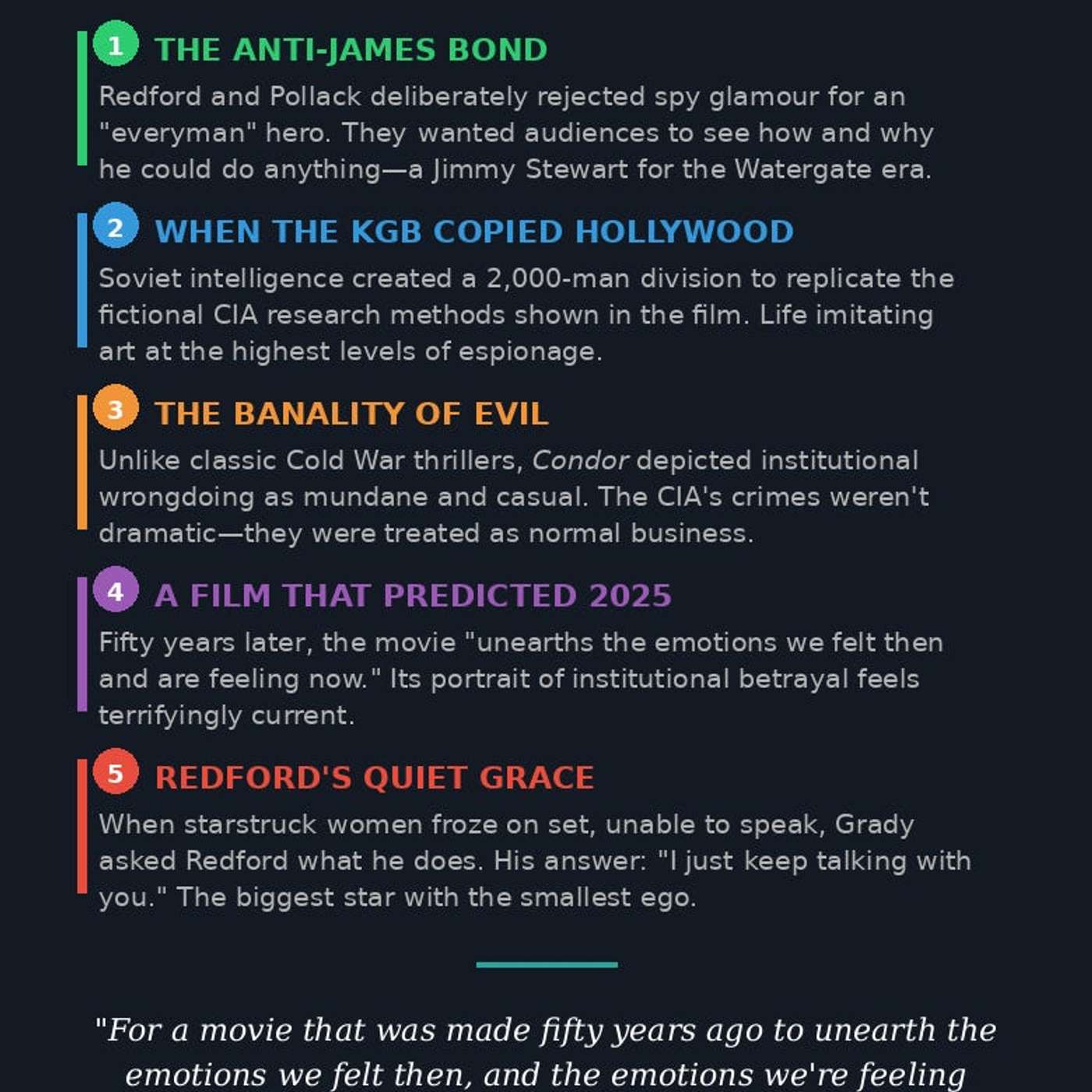
We all have our own favorite Robert Redford movie. But what's Redford’s most prescient film about today’s America? His Seventies trilogy about American politics — The Candidate, Three Days of the Condor and All the President's Men — are all, in their own profound ways, lasting meditations on the United States. But of the three, it might be Sydney Pollack's Three Days of the Condor (1975) which has the eeriest relevance to contemporary America. For James Grady, whose equally classic 1974 thriller Six Days of the Condor inspired the movie, Three Days of the Condor speaks to both the all-encompassing paranoia and isolation of our age. It's the anti-James Bond film for our anti-James Bond age. "For a movie that was made fifty years ago to unearth the emotions we felt then, and the emotions we're feeling now — that's extraordinary," James Grady says. Yes. After a half century, the Condor has landed.
Keen On America is a reader-supported publication. To receive new posts and support my work, consider becoming a free or paid subscriber.
This is a public episode. If you'd like to discuss this with other subscribers or get access to bonus episodes, visit keenon.substack.com/subscribe
Eyeless in Digital Gaza: Eryk Salvaggio sifts through the debris of our AI age in which we can no longer trust anything we see
What it's like to be a Russian these days: Marzio G. Mian ventures behind the new Iron Curtain to find caviar, counterculture and a reborn cult of Stalin
Why Impeachment remains an Indelible Stain on the Presidencies of Nixon, Clinton and Trump: Michael J. Gerhardt's guide for engaged citizens to the the law of Presidential impeachment
How to break out of the tyranny of the travel search box: Rafat Ali on the impact of AI on the travel industry
Why OpenAI has an Uber problem
Why OpenAI has an Uber problem: Tim O'Reilly explains how all successful companies depend on successful ecosystems
A former mobster's history of organized crime in America
A former mobster reveals the history of organized crime in America: Louis Ferrante charts the meteoric rise of the Mafia from 1860s Sicily to 1960s America
We've Been Here Before: Alix Olson and Alex Zamalin offer both radically new and historically trusted strategies for resisting neo-liberalism
On our nostalgia for vinyl records and authoritative political leaders
Why predicting the future of tech is for fools: Keith Teare looks back at 2023 and gives some hints as to what might happen in 2024
Digging into the crate of Roman history: Hari Kunzru on our nostalgia for vinyl records and the reappearance of ethnic nationalism in Italy
How everyone, even Benjamin Netanyahu, has a soul: Noa Yedlin explains why literary humor isn't a funny thing and imagines the kind of character Netanyahu might be in a novel