Why This Might Be Robert Redford's Most Prescient Movie
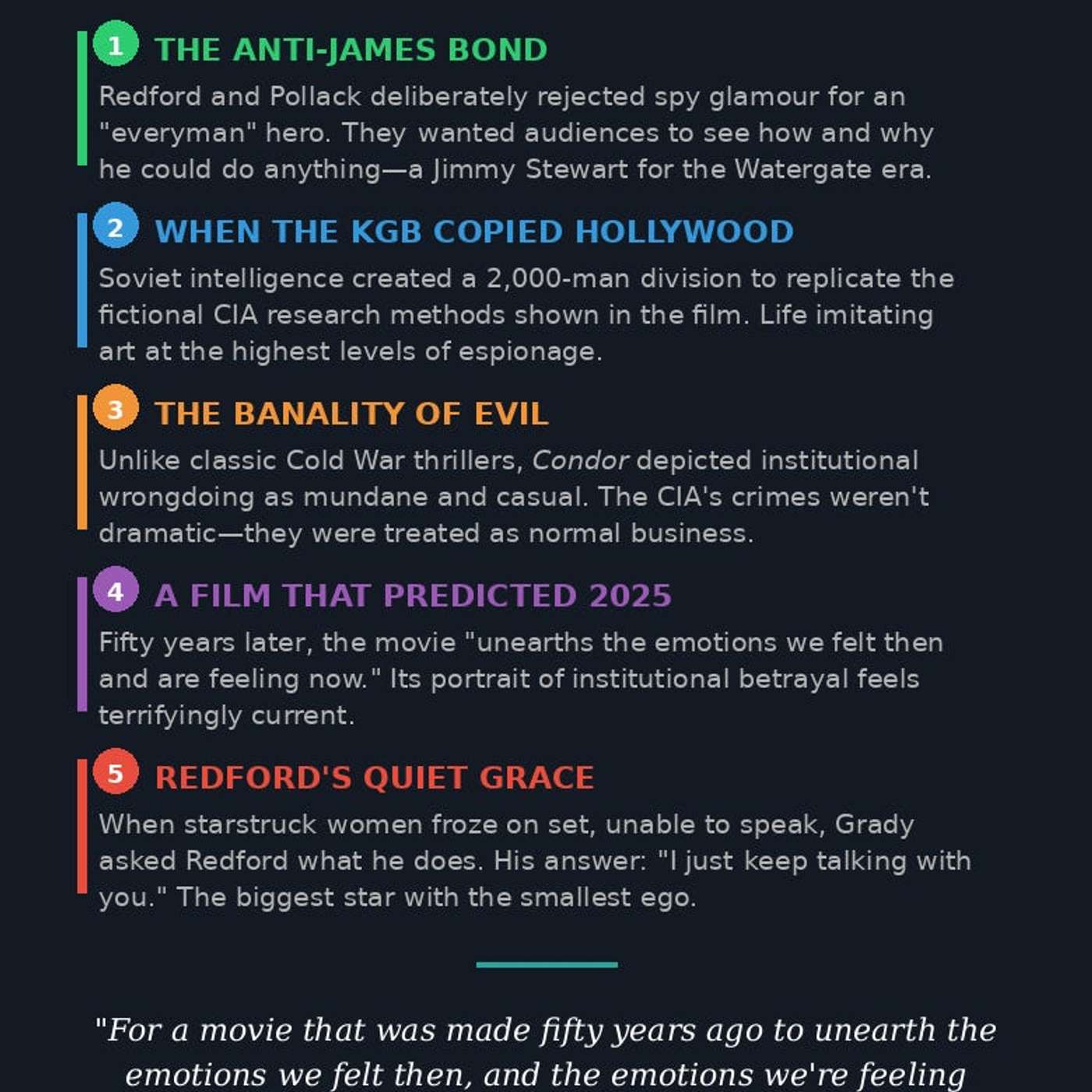
We all have our own favorite Robert Redford movie. But what's Redford’s most prescient film about today’s America? His Seventies trilogy about American politics — The Candidate, Three Days of the Condor and All the President's Men — are all, in their own profound ways, lasting meditations on the United States. But of the three, it might be Sydney Pollack's Three Days of the Condor (1975) which has the eeriest relevance to contemporary America. For James Grady, whose equally classic 1974 thriller Six Days of the Condor inspired the movie, Three Days of the Condor speaks to both the all-encompassing paranoia and isolation of our age. It's the anti-James Bond film for our anti-James Bond age. "For a movie that was made fifty years ago to unearth the emotions we felt then, and the emotions we're feeling now — that's extraordinary," James Grady says. Yes. After a half century, the Condor has landed.
Keen On America is a reader-supported publication. To receive new posts and support my work, consider becoming a free or paid subscriber.
This is a public episode. If you'd like to discuss this with other subscribers or get access to bonus episodes, visit keenon.substack.com/subscribe
Imagine an AI that customizes a musical soundtrack of our lives: Niclas Molinder on the opportunities and threats that AI offers the creative community
AI as our Guttenberg moment: Moritz Schularick, the President of the Kiel Institute for the World Economy, on the economic significance of today's AI revolution
AI as our Oppenheimer moment: Benedikt Franke, CEO of the Munich Security Conference, on the geo-political significance of today's AI revolution
One year that changed the world: Ludwig Ensthaler on the short but revolutionary history of Generative AI
There will be no stock market on a dead planet: Sandrine Dixson-Decleve on how to transform extractive capitalism into a regenerative model of equitable economic progress
Why truthful stories about nature should have neither beginnings nor endings: Martin Puchner on telling circular environmental stories
Why there is hope in the soil: Jan-Gisbert Schultze on the transformational promise of regenerative agriculture
What, exactly, is circular economics? Martjin Lopes Cardozo on the current state of the circular economy
The Age of the Sustainable City: Ian Goldin on how to make the 21st century city the heart of a new circular economy
Trust and the Tokenization of Value: Rachel O'Dwyer on the future of money in our age of the digital platform
Containing and Controlling AI: Mustafa Suleyman on how to strengthen the nation-state in the coming wave of radical technological disruption
Silicon Valley's Destruction of Reality: Jonathan Taplin on how 4 tech billionaires are selling us a fantasy future of the Metaverse, Mars, and Crypto
I Must Resist: Michael G. Long celebrates the political and personal bravery of Bayard Ruskin on the 60th anniversary of the March on Washington