
Why This Might Be Robert Redford's Most Prescient Movie
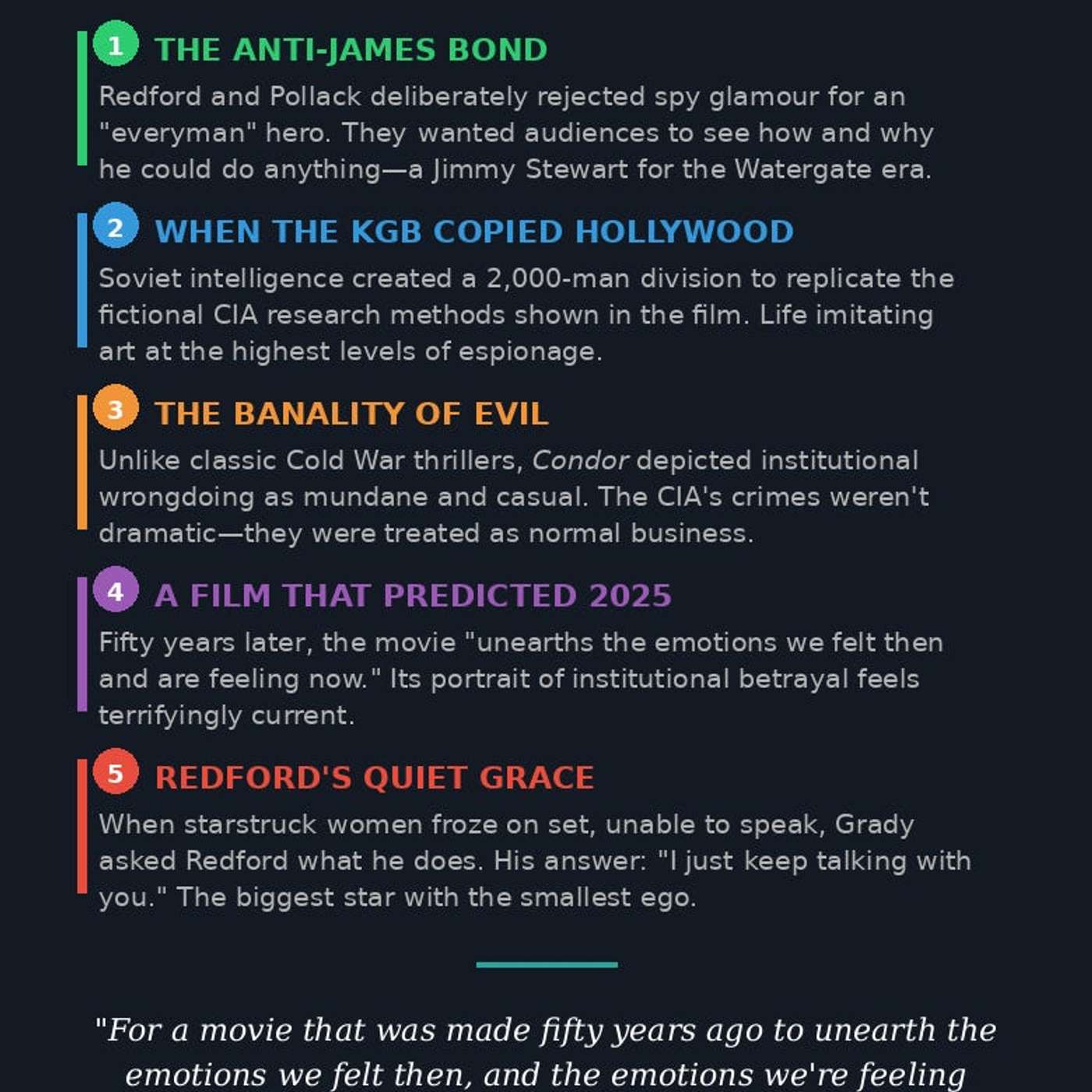
We all have our own favorite Robert Redford movie. But what's Redford’s most prescient film about today’s America? His Seventies trilogy about American politics — The Candidate, Three Days of the Condor and All the President's Men — are all, in their own profound ways, lasting meditations on the United States. But of the three, it might be Sydney Pollack's Three Days of the Condor (1975) which has the eeriest relevance to contemporary America. For James Grady, whose equally classic 1974 thriller Six Days of the Condor inspired the movie, Three Days of the Condor speaks to both the all-encompassing paranoia and isolation of our age. It's the anti-James Bond film for our anti-James Bond age. "For a movie that was made fifty years ago to unearth the emotions we felt then, and the emotions we're feeling now — that's extraordinary," James Grady says. Yes. After a half century, the Condor has landed.
Keen On America is a reader-supported publication. To receive new posts and support my work, consider becoming a free or paid subscriber.
This is a public episode. If you'd like to discuss this with other subscribers or get access to bonus episodes, visit keenon.substack.com/subscribe
A 21st Century Money Revolution: Richard Duncan outlines the monetary policy that can make America great again
Celebrating International Women's Month: Tiffany Shlain on the history of feminism, tree rings and "Dendrofemonology"
The Power of Wonder: Monica C. Parker on the extraordinary emotion that can change the way we live, learn and work
The Death of American Politics: Peter Wehner on retribution, vengeance, forbearance and healing in Trump's America
Playing God: Mary Jo McConahay on why American Catholic Bishops are a threat to democracy
Bootstrapped: Alissa Quart on why we need to liberate ourselves from the "American Dream"
More Than a Glitch: Meredith Broussard confronts race, gender and ability bias in tech
A Murderous Women's History Month: Patti McCracken on some early 20th century Hungarian women who poisoned 160 men (plus a few females)
On Human Agency and the Language of Grief: Colin Campbell explains why grieving is the quintessential human activity
Are Mindfulness and Yoga the Luxuries of a Privileged Class? Susan Verde on childhood trauma, positive self-acceptance and her journey of healing
The (a)Morality of War: Ian Buruma on how some people actively collaborated with evil during World War II
The Silicon Valley Bank apocalypse: That Was the Week's Keith Teare on the death (and resurrection?) of SVB
What Gives You the Right? Jean Hanff Korelitz on Philip Roth, "The Human Stain" and a novelist's "right" to tell other people's stories