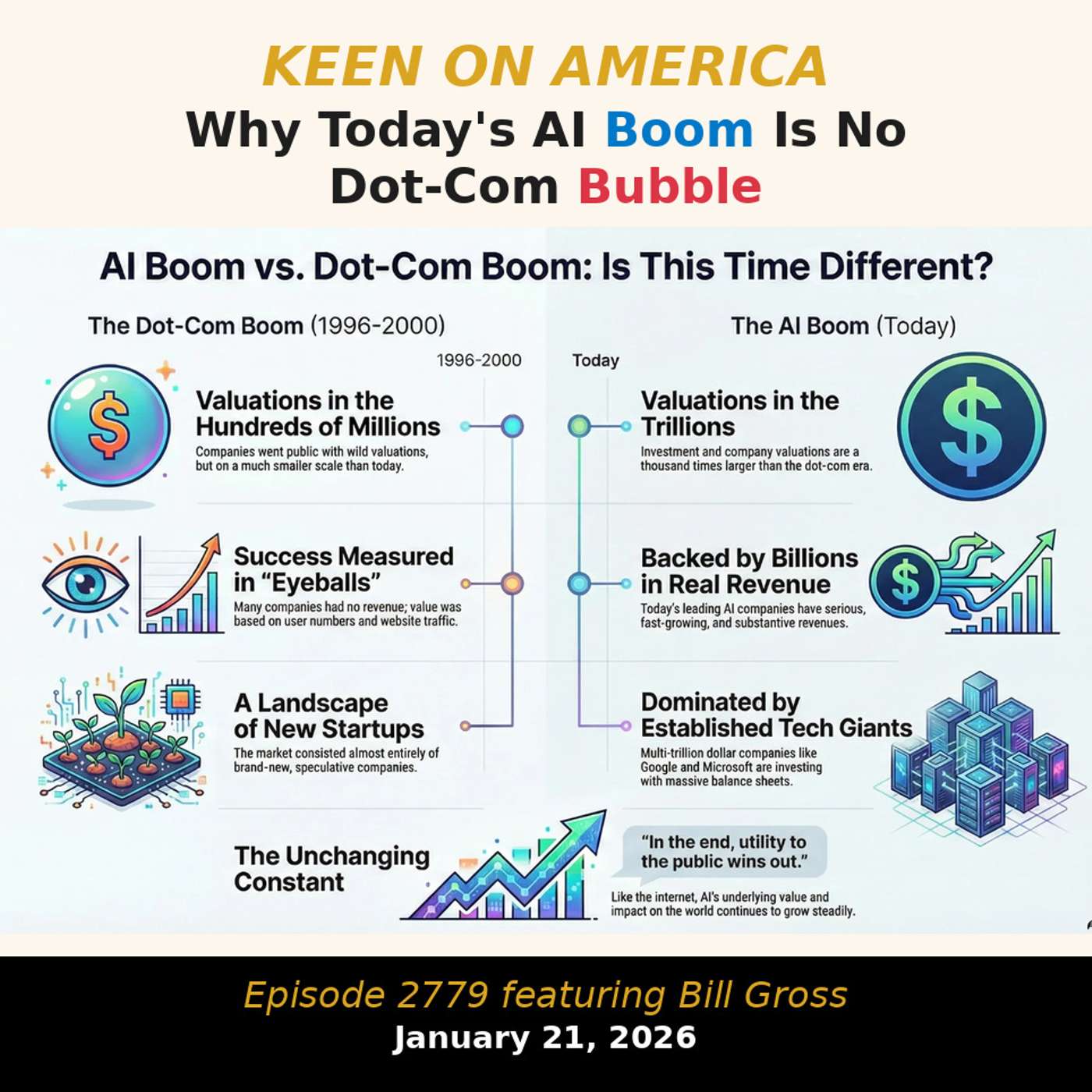

Why Today's AI Boom Is No Dot-Com Bubble
Few people experienced the Dot-Com bubble with more vertiginous intensity than Bill Gross, the Pasadena-based founder of Idealab and many many other internet startups over the last 30 years. So when I sat down with Gross at DLD, I couldn’t resist opening with the boom/bubble gambit. How, I asked him, does today’s AI hysteria compare with the Web 1.0 madness of the Nineties? While Gross - whose current ProRata.ai play is focused on protecting creativity in the age of generative AI - doesn’t believe that today’s boom is akin to the Dot-Com bubble, there are similarities. We are at what Gross calls a “Napster moment” in terms of making the big LLMs accountable for all the content they are illegally crawling (ie: stealing). And to get beyond this moment, he says, everyone from Google and OpenAI to Perplexity and Anthropic, needs to move to a “Spotify model” that fairly shares revenue with the human creators of knowledge.
Keen On America is a reader-supported publication. To receive new posts and support my work, consider becoming a free or paid subscriber.
This is a public episode. If you'd like to discuss this with other subscribers or get access to bonus episodes, visit keenon.substack.com/subscribe
Toby Walsh: If Our Superpower Is Human Empathy, Then Why the Hell Are We Trying to Teach Computers To Be Empathetic?
Richard Hasen: Can American Democracy Be Fixed By Making Political Speech More Expensive?
Ken Auletta: What Does the Harvey Weinstein Story Tell Us About the Culture of Silence in Hollywood and America?
Charles Sabel: To Fix the Climate We Need to Rewire the Economy, Our Democracy, and Our Brains
Michael Fertik: On Washington Irving, John Muir, Philip Dick, Jonathan Haidt and what America Has Uniquely Got Going For It
Aviva Rahmani: Why Telling Effective Stories About the Environment Requires Not Just Words But Also Visual Images and Even Music
Daniel S. Moak: Why America's Current War on Schools Is the Result of Fifty Years of Failed Federal Educational "Reforms"
Ed Yong: Why Perceiving Animal Senses Makes Us Empathetic Not Only to Other Creatures But Also to Each Other
Daniel Silva on How to Write a Bestselling Literary Spy Novel Every Year
Elisabeth Leake on How the Soviet and American Invasions of Afghanistan Are Comparable
Daniel Drezner on the End of Donald Trump, Green Tech, Apocalyptic Zombies: Why Americans Should Be Cheerful About the Future
Marianne Lewis: How Life's Toughest Problems Are Most Effectively Confronted By "Both/And Thinking"
Jason Kander: A Disturbing Autobiography From One of America's Most Candid Ex-Politicians and Soldiers