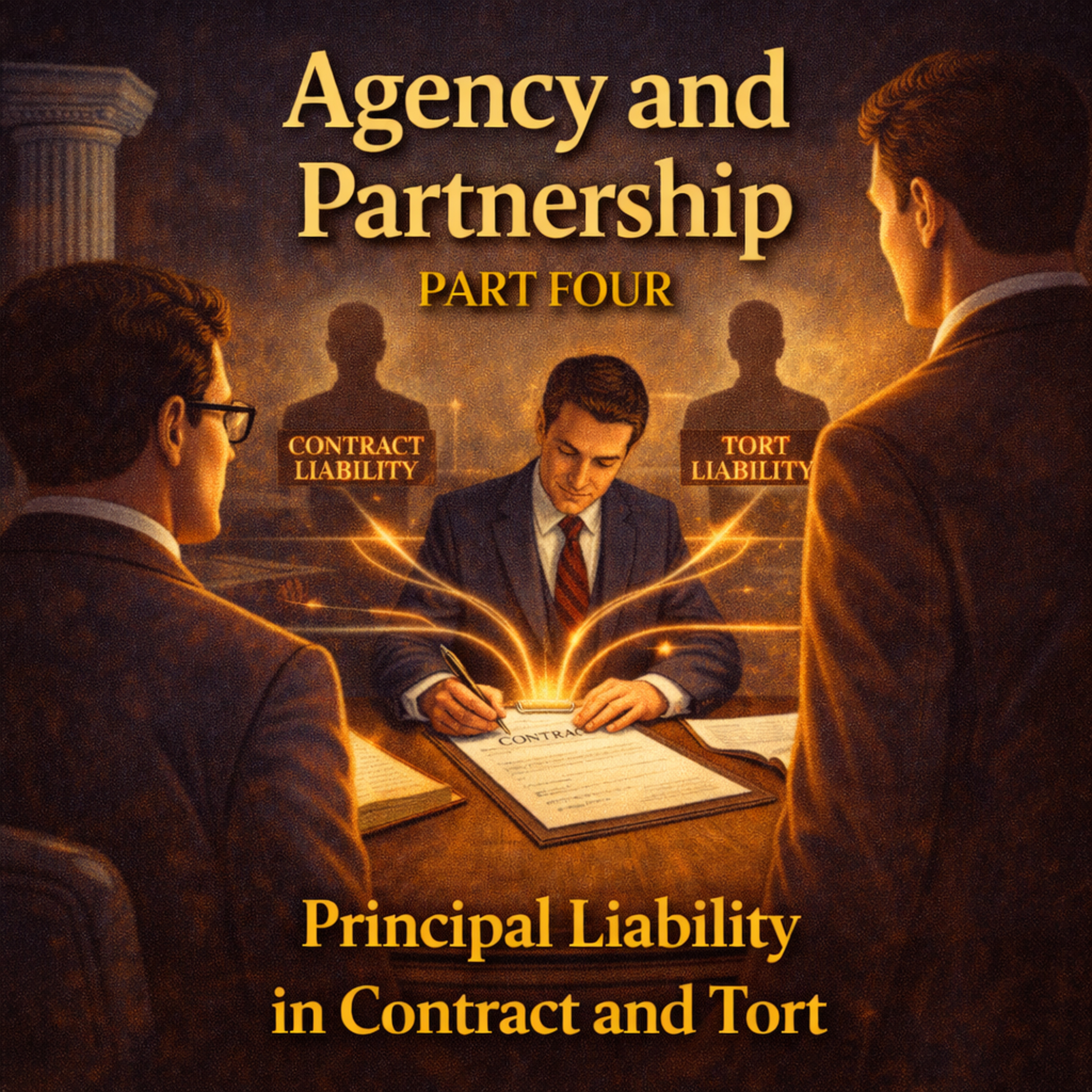
Understanding Principal Liability: A Deep Dive into Agency Law
This conversation delves into the complexities of principal liability in agency law, covering contractual and tort liability, the role of independent contractors, and the implications of modern technology such as AI. The discussion emphasizes the importance of understanding authority, the distinctions between actual and apparent authority, and the legal principles governing vicarious liability. It also highlights the evolving landscape of agency law in the context of AI agents and their potential impact on liability.
In the intricate world of agency law, understanding principal liability is crucial. This area of law is not just about assigning blame but about determining who bears the financial burden when things go awry in business relationships. Let's explore the key concepts and cases that shape this field.
The Core Concepts: Principal liability revolves around two main paths: contracts and torts. The central question in contracts is whether the agent had authority. Authority can be actual, based on the internal relationship between principal and agent, or apparent, based on the principal's actions towards third parties. In torts, the focus shifts to the doctrine of respondeat superior, which holds employers liable for their employees' actions within the scope of employment.
Key Cases and Doctrines: The Mill Street Church of Christ v. Hogan case illustrates implied actual authority, where past conduct and job necessity justified an agent's actions. Meanwhile, the Watteau v. Fenwick case introduces inherent agency power, holding principals liable for agents' usual business acts, even if expressly forbidden.
Modern Implications: As we move into an era of AI agents, traditional doctrines face new challenges. The control test becomes complex when dealing with autonomous systems. The inherent agency power doctrine might see a resurgence as AI takes on roles traditionally held by human agents.
Conclusion: Understanding principal liability requires a grasp of authority, control, and the evolving landscape of agency law. As technology advances, these principles will continue to adapt, shaping the future of legal responsibility.
Subscribe now to stay updated on the latest in agency law and its implications in the modern world.
Takeaways
The entire analysis hinges on one single word, authority.
Authority is a tree with very specific branches.
Actual authority is about the internal perspective between principal and agent.
Implied actual authority acknowledges the reality of job requirements.
Apparent authority focuses on what the third party believes.
An agent cannot bootstrap their own authority.
The principal is liable for torts committed by employees under respondeat superior.
Independent contractors generally do not create liability for the principal.
Exceptions to independent contractor liability include inherently dangerous activities.
The rise of AI agents raises new questions about liability and control.
principal liability, agency law, contractual liability, tort liability, independent contractors, authority, apparent authority, ratification, respondeat superior, AI agents