Constitutional Law - Mastering Article III Justiciability: The Gatekeepers of the Federal Courts

Constitutional Law - Mastering Article III Justiciability: The Gatekeepers of the Federal Courts

Author: The Law School of America March 30, 2026 Duration: 1:05:01

This episode breaks down the foundational tools that courts use to determine whether they can hear a case, focusing on the critical "gatekeeping" doctrines of Article III jurisdiction. Whether you're prepping for the bar exam or trying to understand how judicial power operates, this guide provides clarity on the mechanics that restrict or enable courts to intervene.

Most cases seem straightforward — until you realize the real gatekeeping happens long before the merits are even addressed. This episode pulls back the curtain on the hidden machinery of the federal judiciary, revealing the strict, mechanical guardrails that determine which cases reach the courtroom—and which are turned away. A surprising scenario: a factory stops polluting just before a trial, but the case is dismissed because the dispute is no longer "live." How do courts guard against such procedural tricks? The answer lies in understanding the four core deadbolts of Article 3: standing, ripeness, mootness, and political questions.

You'll discover why the Supreme Court refuses to hear politically charged gerrymandering cases, but rigorously vets racial gerrymandering, thanks to clear standards like strict scrutiny. We break down the three-pronged test for standing—injury, causation, redressability—and how courts reject hypothetical injuries, such as the infamous taxpayer standing loophole. We reveal why timing matters so much, with concrete examples from Roe v. Wade and modern administrative challenges, illustrating how courts weed out cases that are moot or too early.

Why does all this matter? Because without mastering these procedural gates, even the most compelling constitutional arguments are worthless if the case isn’t deemed justiciable. The real power lies in controlling access, preventing the judiciary from overreach while safeguarding legitimacy. Perfect for law students, bar exam takers, or anyone curious about the unseen limits that uphold the rule of law.

This episode equips you with a step-by-step protocol—the Dean’s Checklist—to analyze any constitutional challenge with laser precision. By understanding how courts evaluate justiciability, you gain the strategic advantage of knowing exactly what questions to ask—and when to walk away. If you want to see through the procedural labyrinth that guards American constitutional law, this is your essential guide.

Whether you're preparing for finals or keen to decode Supreme Court decisions in the news, mastering these "gatekeepers" transforms legal theory into strategic mastery. Listen now to unlock the secrets behind the courtroom doors—and learn how the judiciary's strict boundaries protect the delicate balance of American power.

Ever wondered how the law really works but felt intimidated by dense textbooks and jargon? Law School, from The Law School of America, is here to change that. This podcast approaches legal education like a series of engaging conversations, breaking down the foundational principles of the American legal system into clear, manageable segments. Each episode focuses on a specific concept or area, building your comprehension step-by-step without overwhelming you. You'll hear straightforward explanations that connect theory to real-world application, making complex topics accessible whether you're a student, a professional in a related field, or simply a curious citizen. The goal is to demystify the law, transforming it from an abstract subject into a practical understanding you can use. By consistently tuning in, you gradually construct a solid framework of legal knowledge. This isn't about quick tricks; it's about dedicated, cumulative learning. The structure of the podcast is designed for steady progress, allowing listeners to absorb information at their own pace and truly integrate it. Think of it as an audio companion for your intellectual journey into jurisprudence, offering clarity and insight one episode at a time.
Author: Language: en-us Episodes: 100

Law School
Podcast Episodes
Family Law Part Two - Divorce, Annulment, and Separation [not-audio_url] [/not-audio_url]

Duration: 40:08
This conversation delves into the complexities of family law, specifically focusing on the dissolution of marriage. It covers essential topics such as jurisdiction, grounds for divorce, annulment, legal separation, and t…
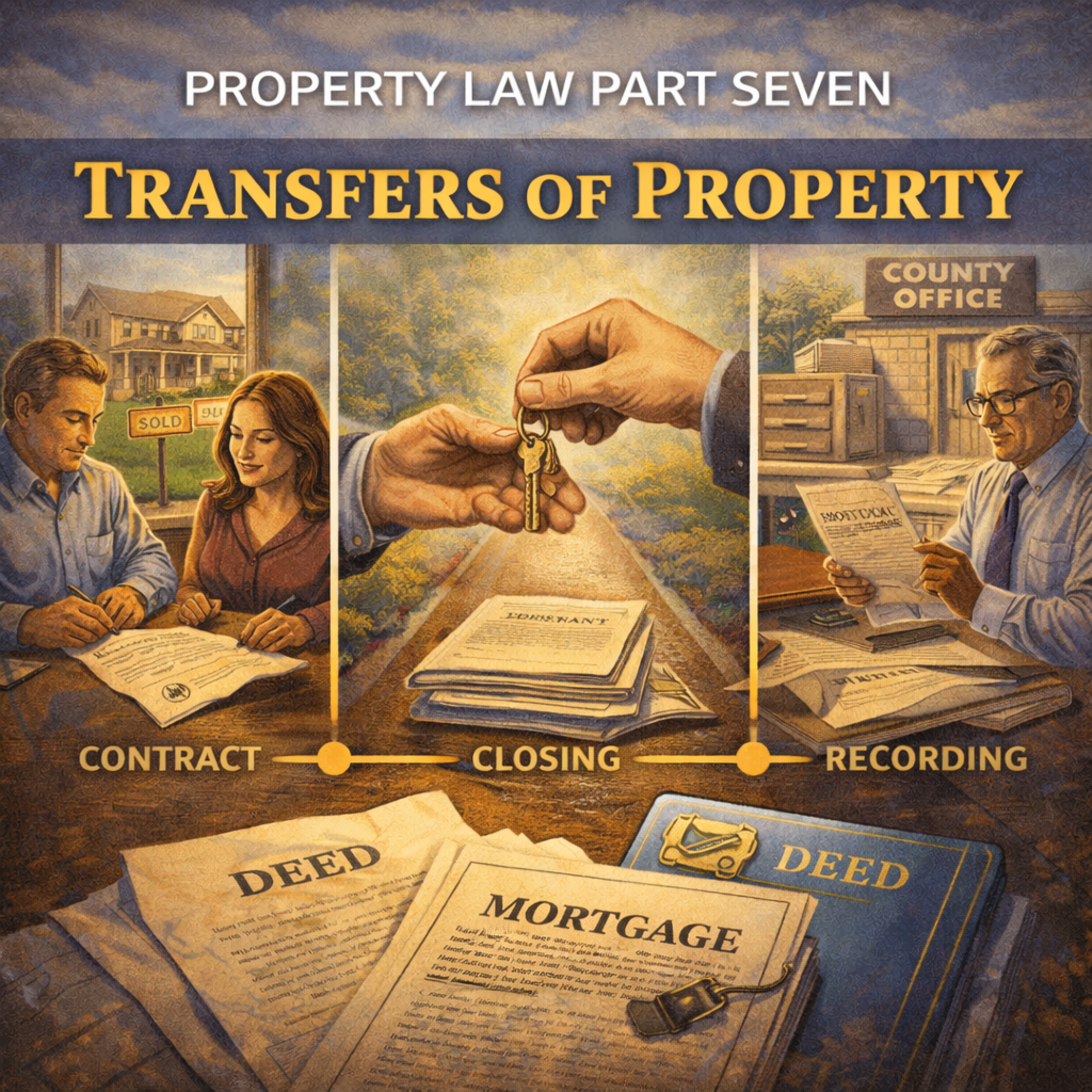
Property Law Part Seven: Transfers of Property [not-audio_url] [/not-audio_url]

Duration: 47:17
This conversation delves into the intricate life cycle of real estate transactions, exploring the various phases from contract signing to closing and recording. It emphasizes the importance of understanding the chronolog…
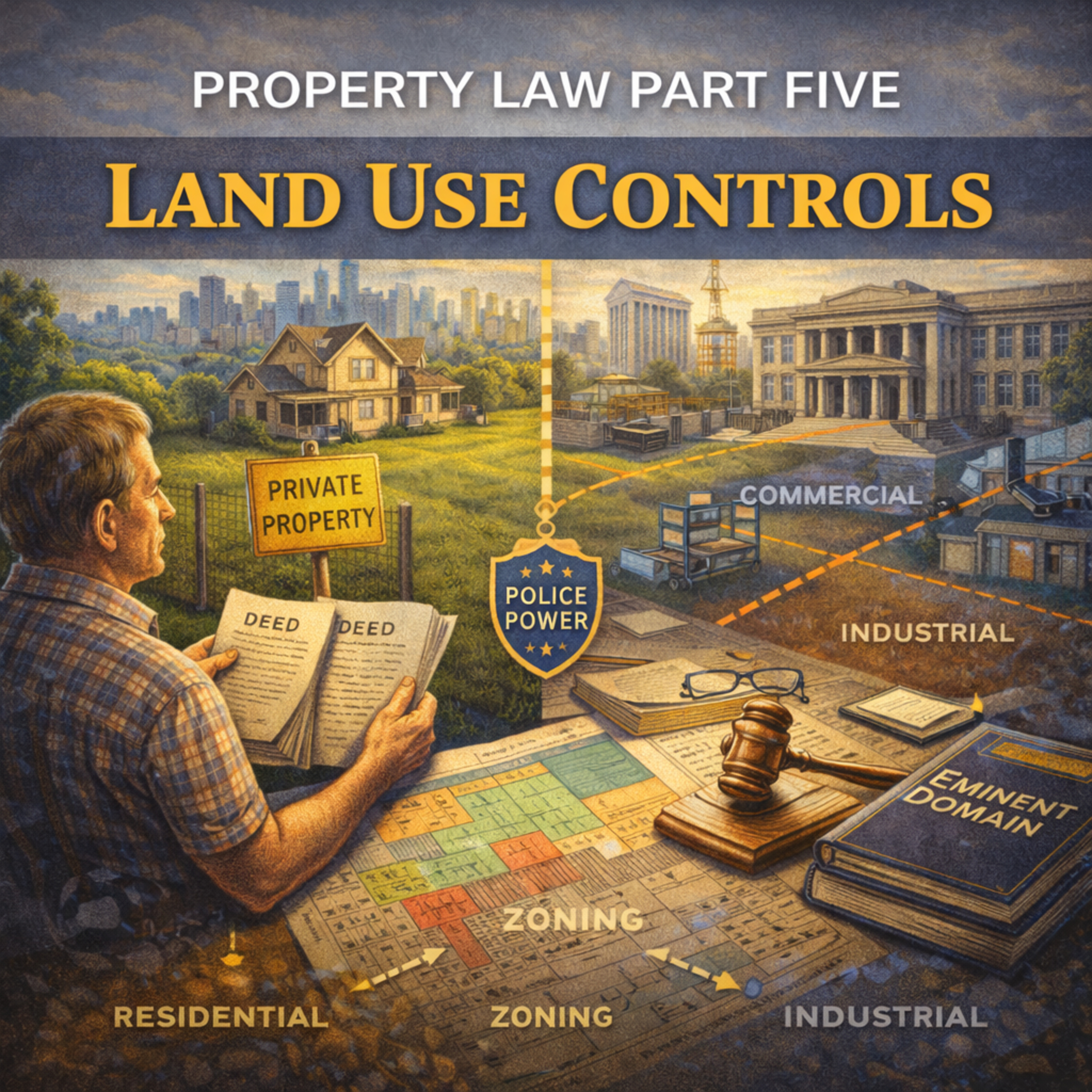
Property Law Part Five: Land Use Controls [not-audio_url] [/not-audio_url]

Duration: 50:06
This conversation delves into the complexities of land use controls, focusing on the interplay between individual property rights and government regulations. It explores the concept of police power, zoning laws, eminent…
Property Law Part Four: Landlord–Tenant Law [not-audio_url] [/not-audio_url]

Duration: 54:12
Property Law Chapter Four: Landlord–Tenant LawThis conversation delves into the complexities of landlord-tenant law, exploring the evolution of property law, the various types of leasehold estates, and the rights and res…
Property Law Part Three: Concurrent Ownership [not-audio_url] [/not-audio_url]

Duration: 41:40
Most people assume owning property together is simple—until the law reveals its chaotic, high-stakes complexity. If you think co-ownership is just "my house or yours," think again. One wrong step or misunderstood rule ca…
Property Law Part Two: Estates and Future Interest [not-audio_url] [/not-audio_url]

Duration: 50:39
This conversation delves into the complexities of property law, focusing on estates and future interests. It explores the foundational concepts of ownership, the intricacies of defeasible fees, life estates, and the rule…