Theoretical Models of the Corporation
Scholars debate the fundamental nature of the public corporation through several lenses:
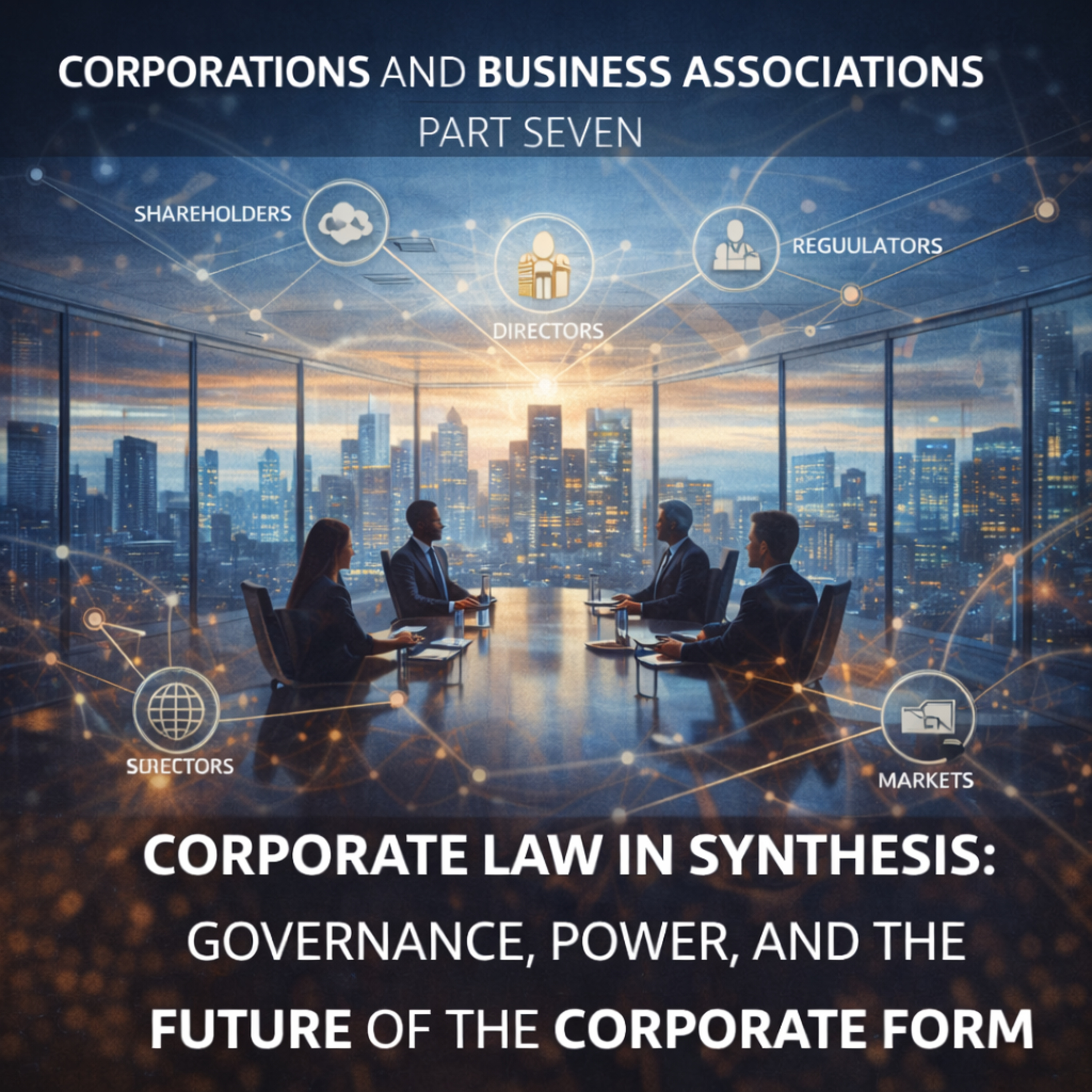
The Principal-Agent vs. Team Production Models: The traditional "principal-agent" model views shareholders as owners who hire managers (agents) to maximize their wealth. In contrast, the "Team Production Theory" suggests the corporation is a "mediating hierarchy". In this model, stakeholders like shareholders, employees, and creditors voluntarily yield control over their firm-specific investments to an independent board of directors to coordinate production and prevent wasteful "rent-seeking" or "shirking".
The Efficiency vs. Power Models: Adherents to the "efficiency model" view the firm as a "nexus of contracts" where market forces naturally select governance structures that minimize transaction costs. Conversely, the "power model" depicts the firm as an organic institution where management holds a strategic position and uses tools like board representation to legitimate its own autonomy and discretion.
Fiduciary Duties and the Business Judgment Rule
Corporate management is constrained and protected by specific legal doctrines:
Fiduciary Obligations: Directors owe a triad of duties: good faith, loyalty, and due care. While these are often described as running to shareholders, case law clarifies that these duties are primarily owed to the corporate entity itself.
Presumption of Regularity: The Business Judgment Rule creates a strong presumption that directors act on an informed basis and in the honest belief that their actions serve the corporation’s best interests. This rule effectively insulates directors from personal liability for bad business decisions unless a plaintiff proves fraud, self-dealing, or gross negligence in the decision-making process.
Derivative Suits: Shareholders may sue on the corporation's behalf for breaches of duty, but procedural barriers—such as the "demand" requirement—ensure these suits remain a "safety valve" rather than a tool for direct shareholder control.
Limited Liability
A cornerstone of the corporate form is limited liability, which stipulates that shareholders are generally not personally responsible for corporate debts beyond their initial investment.
Justification: This status encourages risk-taking and large-scale capital formation.
Critique and Externalities: Critics argue that limited liability encourages excessive risk-taking and allows corporations to "socialize" losses, such as environmental damage from fossil fuel production. Some propose redefining this status for sectors that generate significant negative externalities to ensure investors have "skin in the game".
Regulatory Dynamics and Legitimacy
The sources highlight an increasing convergence between corporate governance and public government institutional features.
Federal vs. State Rulemaking: The SEC provides broad federal disclosure regulations, while the Delaware Court of Chancery often fills gaps through case-by-case transactional jurisprudence. Laws like Sarbanes-Oxley (2002) and Dodd-Frank (2010) have further federalized governance by imposing standards for director independence, audit committees, and whistleblower protections.
Legitimacy through Process: Corporate legitimacy is increasingly derived from procedural mechanisms common in democratic states, such as the separation of powers, transparency (disclosure), and ethics codes.
Case Study: Government as Regulator-Shareholder
The Bank of America (BOA)-Merrill Lynch merger during the 2008 financial crisis serves as a case study for the "shotgun wedding" dynamic. When the federal government acts as both a regulator and a powerful shareholder, traditional fiduciary analysis becomes strained. In the BOA case, the Treasury effectively compelled the merger by threatening to remove the board, highlighting a "post-bailout reality" where corporate decision-making is a coordinated public-private process rather than a purely private affair.