Criminal Law Day Seven: The Weight of Justice (Theories and Allocation of Punishment)

Criminal Law Day Seven: The Weight of Justice (Theories and Allocation of Punishment)

Author: The Law School of America April 26, 2026 Duration: 50:39

This episode explores the complex architecture of criminal law and punishment, dissecting philosophical foundations, systemic mechanics, and empirical realities that shape how justice is administered. Aimed at law students and policymakers, it clarifies how different theories of punishment interact and conflict within the legal system—and what that means for fair, effective justice.

Most criminal justice systems are built on conflicting philosophies—retribution, deterrence, incapacitation, and rehabilitation—each pulling in different directions, yet our prisons operate as if they’re perfectly aligned. But what if the entire system is a fragile clash of ideas, incapable of delivering true justice? This episode takes you inside the mind of the “criminal law machine,” revealing how these foundational theories shape every punishment and why understanding their tension is crucial for anyone grappling with the morality and mechanics of justice.

We begin with a shocking empirical study: a child’s academic scores drop by nearly 5% simply because a classmate’s parent is sent to prison. This sets the stage for a deep dive into how the ripple effects of incarceration harm society beyond the prison walls—an urgent reminder of the human collateral involved in every legal decision. From there, explore the meticulous architecture of criminal liability—how actus reus, mens rea, and causation are engineered to assign guilt—culminating in the ultimate question: why does the state have the moral authority to imprison?

The core of this episode unpacks the four competing philosophies of punishment. Retribution, rooted in balancing the moral ledger, demands proportionality based on objective harm and moral blameworthiness—yet struggles to account for offenders’ mental states or social context. Deterrence, aiming to prevent future crimes through fear, relies on the rational actor model, which empirical data overwhelmingly discredits—especially for populations impaired by trauma or substance abuse. Incapacitation offers a brute-force safety net, but risks turning into preventive detention based on biased risk assessments that embed socioeconomic biases and cognitive distortions like the fundamental attribution error. Finally, rehabilitation envisions a therapeutic cure, recognizing the potential for human change, but faces political backlash and societal skepticism.

But here’s the twist: these conflicting goals can’t peacefully coexist. That’s where limiting retributivism comes in—a master framework that acts as a gatekeeper, setting objective boundaries so sentences stay within morally justifiable margins. Within these bounds, the system then fine-tunes punishments using a hybrid approach that balances fairness with utility, ensuring similar crimes receive similar sentences and that harsher punishments are justified and not excessive. This delicate engineering—embodying concepts like the parsimony principle—aims to reconcile the warring philosophies, but the question remains: is this system resilient or fundamentally fragile?

To close, we confront a provocative future: could an AI judge, free from human cognitive biases, flawlessly execute this complex synthesis of justice? Or is the moral weight of human judgment irreplaceable? As criminal justice looms at the intersection of machine learning, societal values, and empirical realities, this episode invites you to reconsider what true fairness looks like—and whether the current “machine” we’ve built is sturdy enough to deliver it.

Perfect for law students, policymakers, or anyone seeking clarity on the philosophical underpinnings of modern justice, this episode reveals that behind every prison sentence lies a complex, often contradictory web of ideas—an imperfect machine trying to do its best, but perhaps always wobbling on the edge of collapse.



Ever wondered how the law really works but felt intimidated by dense textbooks and jargon? Law School, from The Law School of America, is here to change that. This podcast approaches legal education like a series of engaging conversations, breaking down the foundational principles of the American legal system into clear, manageable segments. Each episode focuses on a specific concept or area, building your comprehension step-by-step without overwhelming you. You'll hear straightforward explanations that connect theory to real-world application, making complex topics accessible whether you're a student, a professional in a related field, or simply a curious citizen. The goal is to demystify the law, transforming it from an abstract subject into a practical understanding you can use. By consistently tuning in, you gradually construct a solid framework of legal knowledge. This isn't about quick tricks; it's about dedicated, cumulative learning. The structure of the podcast is designed for steady progress, allowing listeners to absorb information at their own pace and truly integrate it. Think of it as an audio companion for your intellectual journey into jurisprudence, offering clarity and insight one episode at a time.
Author: Language: en-us Episodes: 100

Law School
Podcast Episodes
Torts Day Three: The "Mountain" of Negligence [not-audio_url] [/not-audio_url]

Duration: 1:01:53
In this episode, we explore the fundamental doctrines of negligence—the most crucial foundation of personal injury law—and decode how courts determine fault through duty and breach analysis. Whether you're a law student,…
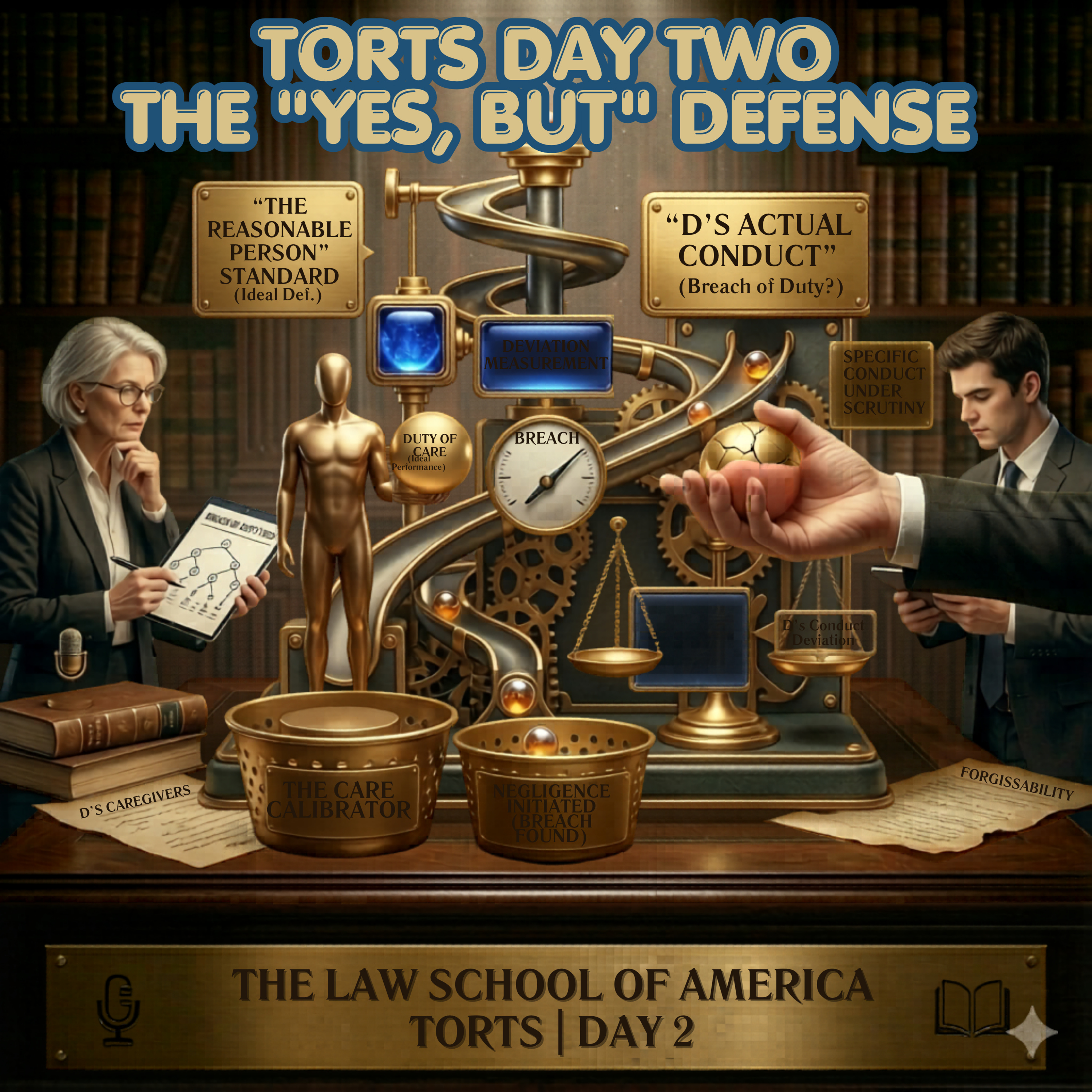
Torts Day Two: The "Yes, But" Defense [not-audio_url] [/not-audio_url]

Duration: 1:03:03
In this episode, we delve into the strategic complexity of affirmative defenses in tort law. Understanding how and when these shields apply can turn a losing case into a victory, or vice versa. We explore key defenses li…
Torts Day One: The Power of Intent [not-audio_url] [/not-audio_url]

Duration: 58:52
This episode breaks down the core principles of intentional torts, from the foundational engine of volitional acts and intent to the nuanced doctrine of transferred intent. Whether you're preparing for law school exams o…
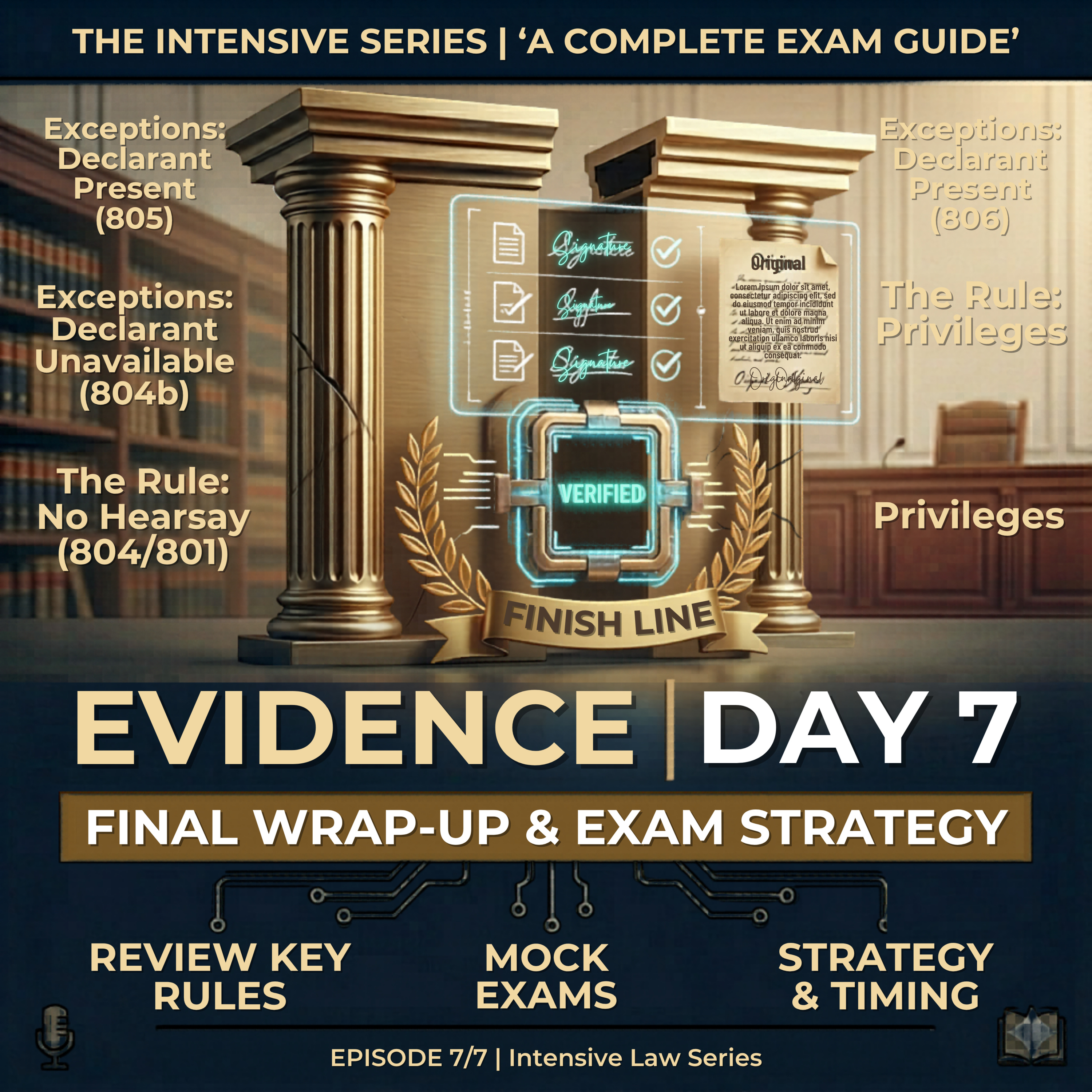
Evidence Day Seven: The Vault and the Final Machine [not-audio_url] [/not-audio_url]

Duration: 1:26:54
Prepare for your next exam or courtroom with a systematic framework that demystifies the complexity of evidence law. In this episode, we dissect the layered process of evaluating evidence—from privileges and presumptions…
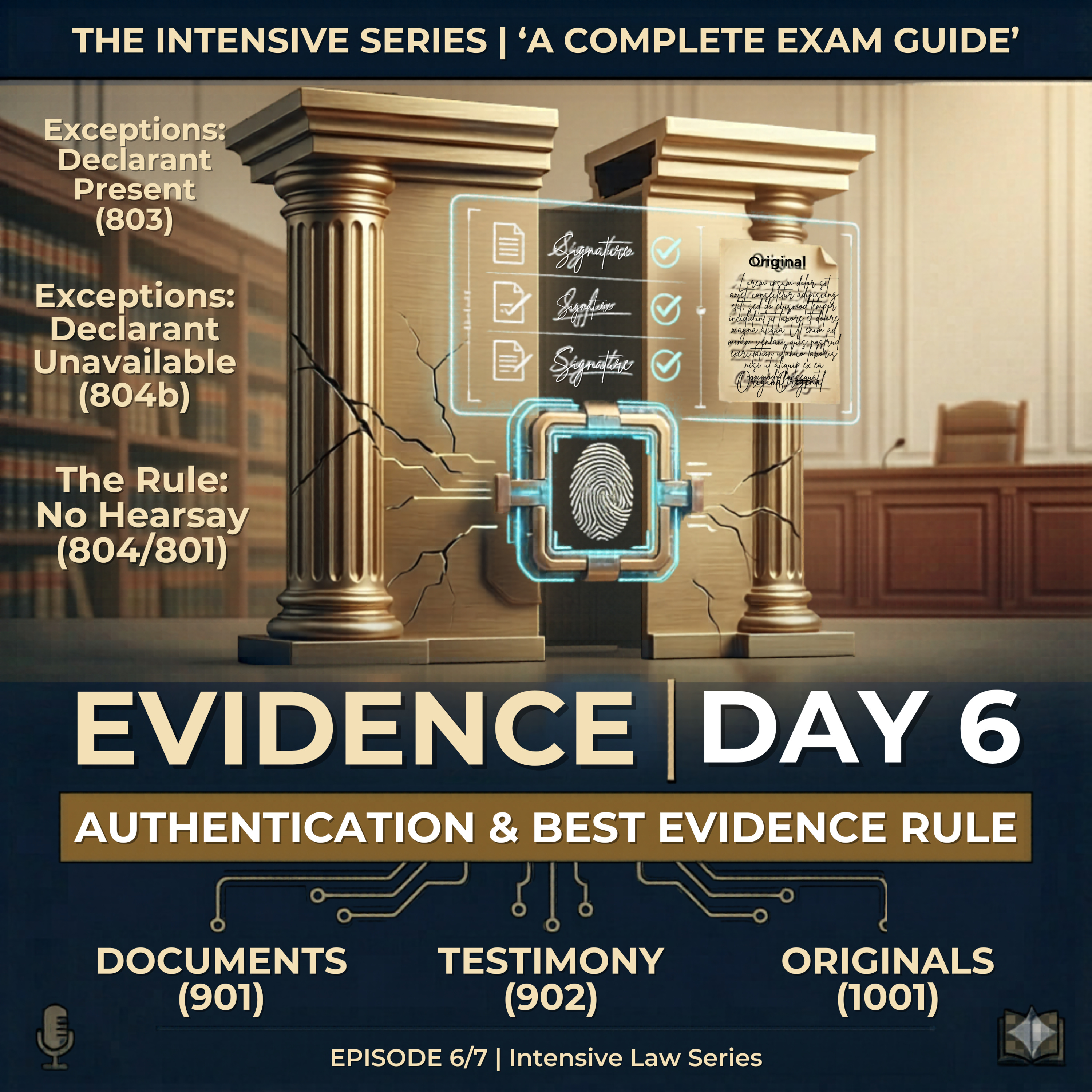
Evidence Day Six: The Container and the Key [not-audio_url] [/not-audio_url]

Duration: 57:07
This episode takes you through the rigorous process of introducing physical evidence in court, breaking down complex rules with clear analogies and real-world examples. Whether you're preparing for the bar exam or seekin…
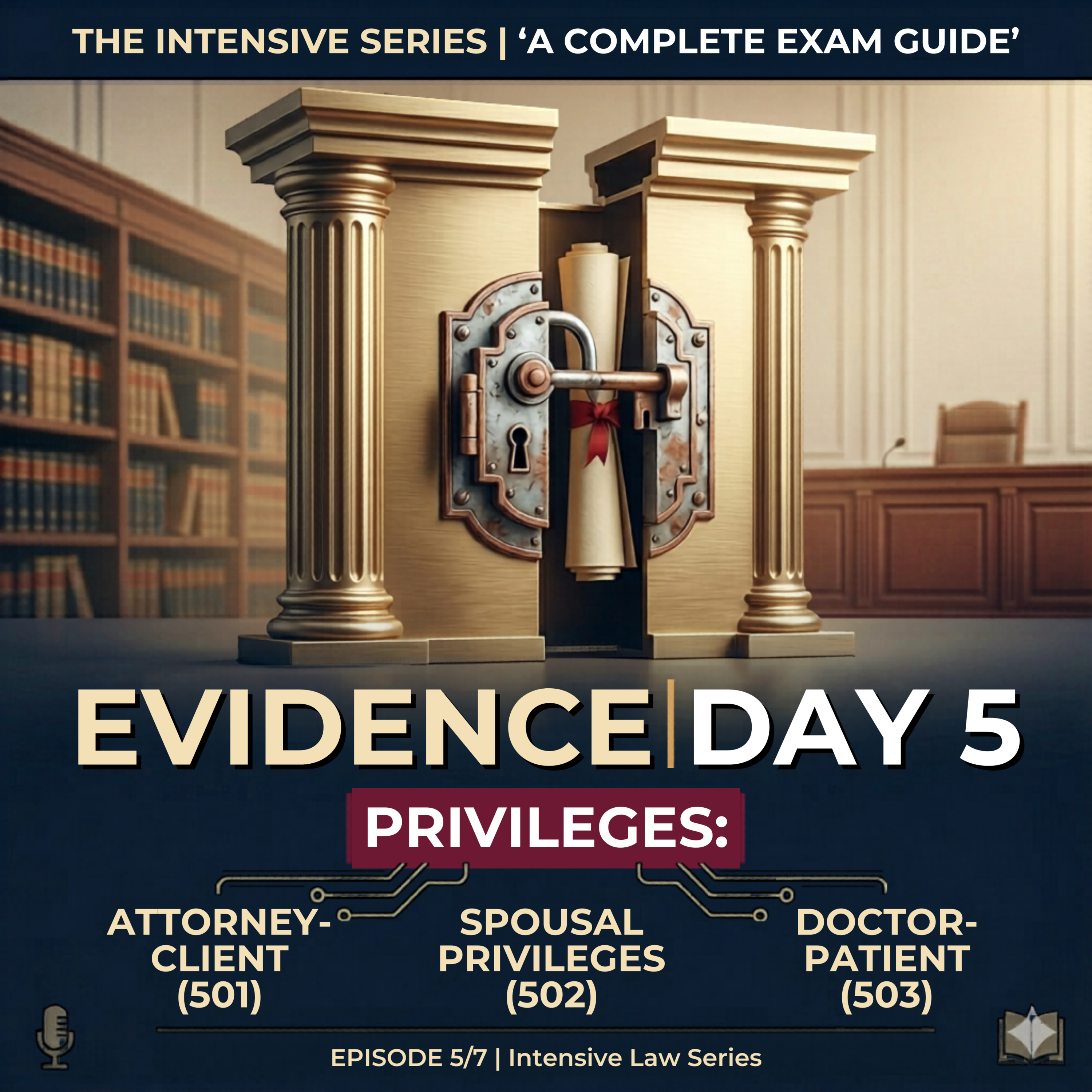
Evidence Day Five: The Hearsay Exceptions [not-audio_url] [/not-audio_url]

Duration: 1:07:12
In this deep dive into evidence law, we explore how courts differentiate between trustworthy and unreliable out-of-court statements through rules, doctrines, and constitutional safeguards. If you're preparing for a law e…
Evidence Day Four: The Hearsay Gauntlet [not-audio_url] [/not-audio_url]

Duration: 1:01:34
In this episode, we demystify the complex world of hearsay evidence, turning what often feels like an insurmountable maze into a clear, actionable framework. Whether you're a law student, a lawyer, or just a curious mind…
Evidence Day Three: The Witness Clinic [not-audio_url] [/not-audio_url]

Duration: 1:06:48
In this episode, we delve into the foundational pillars of witness testimony, unraveling the complexities of competency, memory, and the art of impeachment. Designed to equip law students and future lawyers, this session…
Evidence Day Two: The Character Assassination Clinic [not-audio_url] [/not-audio_url]

Duration: 1:01:41
In this episode, we explore the intricate landscape of character evidence within U.S. law, emphasizing how rules and exceptions are designed to balance fairness with societal interests. Whether you're a law student or a…