Understanding the Shields of Justice: When Law Balances Morality and Reality
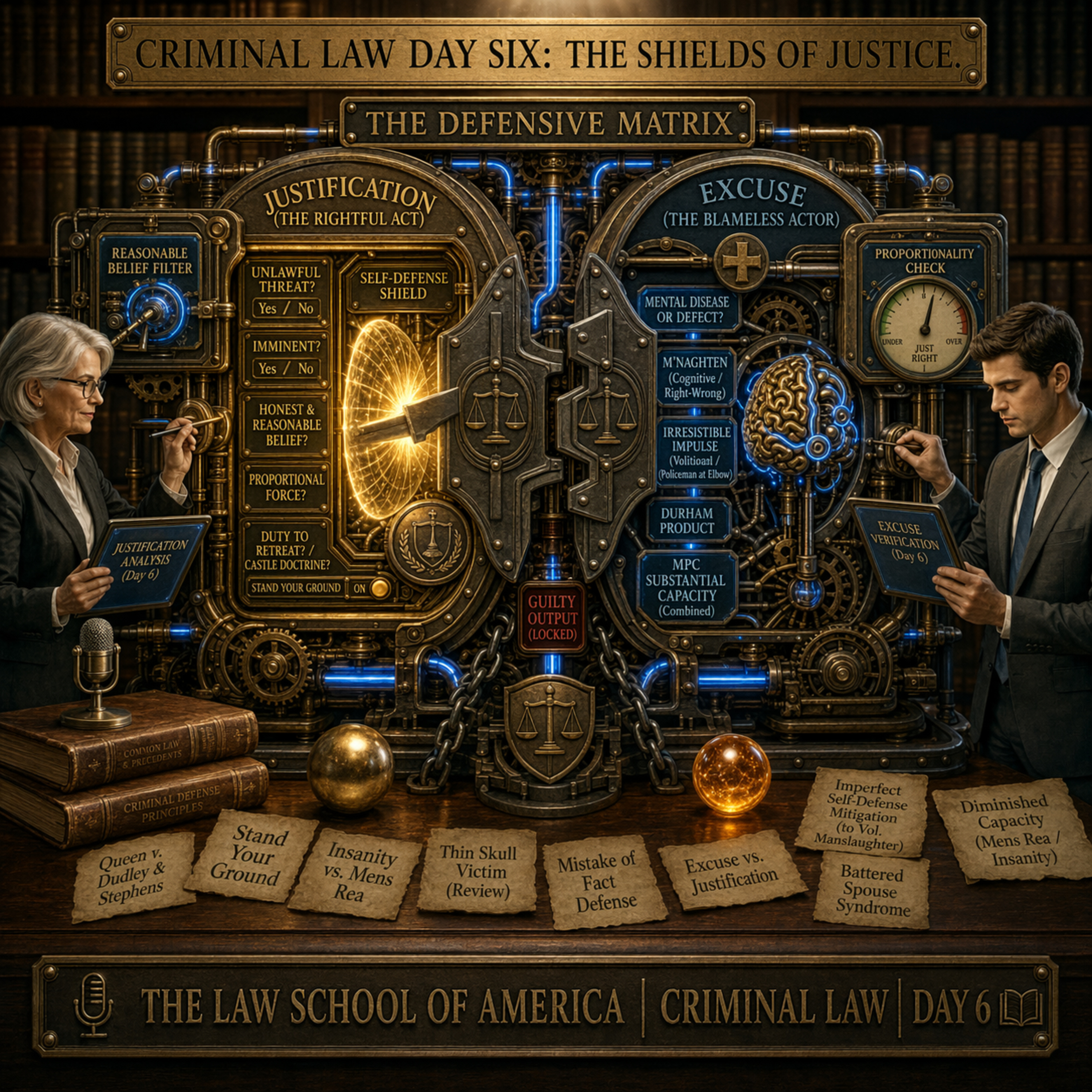
This episode delves into the foundational distinctions in criminal law—justification vs. excuse—and how they affect real-world justice. Whether you're prepping for law school or seeking a clearer view of how society handles moral dilemmas, this discussion unpacks complex doctrines with clarity and practical insights.
Most legal defenses hinge on challenging the act or the intent—that is, until you understand the profound difference between justification and excuse. In this episode, we take you behind the scenes of criminal law’s most powerful shields—those built on morality, context, and human complexity. Whether you’re caught in a life-or-death self-defense scenario or grappling with the gray areas of mental illness, understanding when and how the law forgives or absolves you can change everything.
Imagine walking down a dark street and facing an attacker; your instinct to strike may be justified if your life is at immediate risk. But what if your response is based on a skewed perception brought on by paranoia? Or consider helping someone in a life-threatening situation—when do acts of aid become protected defenses, and when do they turn into reckless crimes? We break down key legal mechanisms—justification defenses like self-defense, necessity, and defense of others—and see how the law evaluates these scenarios through objective standards, psychological realities, and societal priorities.
You’ll discover how the law’s sharp focus on objective facts can clash with the complex internal realities of human psychology—especially when mental illness or external coercion are involved. We explore groundbreaking shifts, such as the evolving standards for insanity—from the rigid McNaughton rule to the nuanced Model Penal Code—highlighting how neuroscience and brain imaging threaten to rewrite these ancient lines of responsibility. We also dissect the controversial boundary where necessity stops and murder begins, illustrated by the infamous lifeboat case where moral and legal claims collide.
This episode is perfect for students, legal professionals, or anyone invested in the moral heartbeat of justice. It reveals how society’s laws are not just rules but reflections of shared moral choices—balancing the chaos of human instinct with the need for order and responsibility. As neuroscience pushes into uncharted territory, ask yourself: when the hardware of the brain is broken, how responsible can we really be? Think about the future of culpability, and prepare to see justice—and yourself—through a sharper lens.
In this episode:
The core difference between justification and excuse defenses, and why it matters both in court and in moral philosophy
How objective circumstances can turn a criminal act into a socially endorsed act through justification defenses like self-defense and necessity
The internal, psychological focus of excuse defenses including insanity, duress, and intoxication, and their legal standards
Detailed exploration of the four major insanity tests—McNaughton, irresistible impulse, Durham, and MPC—and their evolution
The procedural mechanics of shifting burdens of proof in affirmative defenses and expert psychiatric testimony's role
Critical assessments of legal thresholds, from imminent threats in self-defense to the line dividing culpability and lack of control via neuroscience prospects
Why law emphasizes that some behaviors—like killing innocents—are unacceptable regardless of circumstances, illustrated through famous cases like Dudley and Stevens' lifeboat dilemma