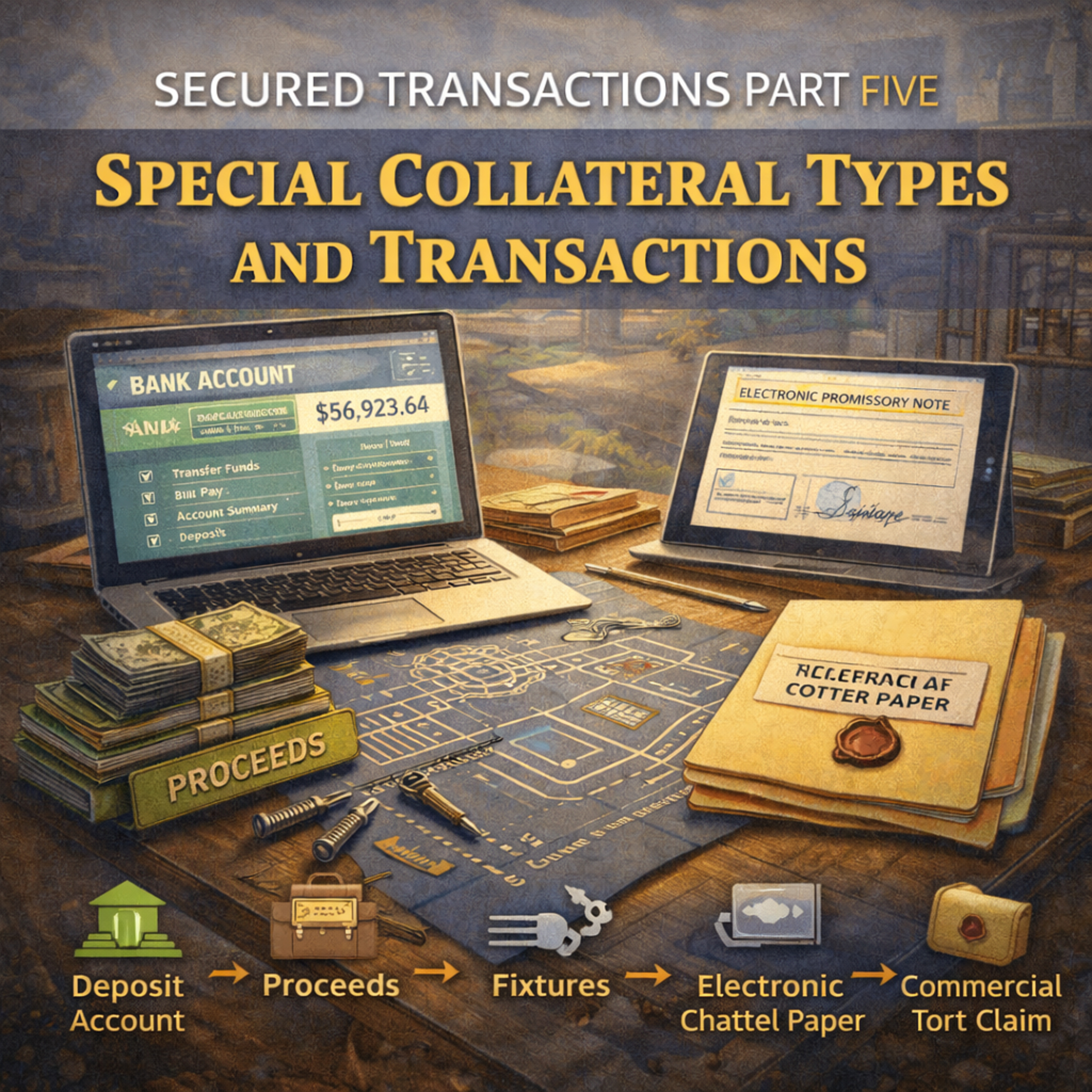
Secured Transactions Part Five — Special Collateral Types and Transactions

Secured Transactions Part Five — Special Collateral Types and Transactions

Author: The Law School of America February 13, 2026 Duration: 39:33

This conversation delves into the complexities of secured transactions, particularly focusing on special collateral types as outlined in Chapter 5 of the UCC. The discussion emphasizes the importance of understanding the unique rules governing deposit accounts, proceeds, fixtures, and commercial tort claims, as well as the implications of electronic chattel paper. The speakers provide insights into the legal frameworks that dictate how these assets are treated in terms of attachment, perfection, and priority, highlighting the critical need for practitioners to recognize when standard rules do not apply.

Unlock the secrets behind the most challenging exceptions in secured transactions with our in-depth analysis of Chapter 5 of the UCC. If you thought filing a UCC-1 was enough, think again—some collateral types demand control, precise descriptions, or even perfect timing to truly secure your interests. This episode reveals how control supersedes filing for deposit accounts, how fixture filings unlock priority over real estate mortgages, and why the graphic complexities of proceeds, electronic chattel paper, and FCC licenses matter more than you think.

You’ll discover the critical “special collateral” framework that separates the simple from the sophisticated—why certain assets are the “danger zone” and how to navigate it. We break down real-world traps like the Lowest Intermediate Balance Rule for commingled funds, the importance of exact legal descriptions in fixture filings, and the race between control agreements and bank priority. Get quirky on the technicalities of electronic chattel paper—think blockchain before blockchain—where control through specialized IT vaults can trump traditional filing.

We dive into high-stakes case studies: how courts view FCC license proceeds, the pitfalls of describing collateral too vaguely in filings, and the complex dance of priority among a construction mortgage, PMSI fixtures, and suppliers. You’ll learn the importance of describing collateral with legal precision, the strategic use of control to avoid unperfected interests, and how to advise clients on safeguarding their assets against layered claims.

This episode is perfect for future litigators, seasoned practitioners, and exam takers aiming to decode the law’s most intricate exceptions. Master the policy reasons behind these rules—why the law favors control for bank accounts and careful descriptions for fixtures—and learn to synthesize real property law with Article 9 in high-stakes scenarios like real estate, digital assets, and complex security arrangements.

Don’t just memorize—understand the “why” behind the rules. Because in secured transactions, knowing the exceptions is the difference between winning and losing control, priority, and perfection. Get ready to navigate the “danger zone” with confidence—your mastery starts here.


Takeaways

Part five separates passing grades from top scores.

Special collateral types require a different analytical approach.

Deposit accounts require control, not just filing.

The lowest intermediate balance rule is crucial for proceeds.

Fixtures must be filed correctly to ensure priority.

Commercial tort claims need specific descriptions in agreements.

Electronic chattel paper requires a unique control system.

Understanding the interplay between UCC and real property law is essential.

The mental map for secured transactions is key for exam success.

Recognizing exceptions is critical for navigating secured transactions.


secured transactions, UCC, collateral types, deposit accounts, proceeds, fixtures, commercial tort claims, electronic chattel paper, legal framework, bankruptcy

Ever wondered how the law really works but felt intimidated by dense textbooks and jargon? Law School, from The Law School of America, is here to change that. This podcast approaches legal education like a series of engaging conversations, breaking down the foundational principles of the American legal system into clear, manageable segments. Each episode focuses on a specific concept or area, building your comprehension step-by-step without overwhelming you. You'll hear straightforward explanations that connect theory to real-world application, making complex topics accessible whether you're a student, a professional in a related field, or simply a curious citizen. The goal is to demystify the law, transforming it from an abstract subject into a practical understanding you can use. By consistently tuning in, you gradually construct a solid framework of legal knowledge. This isn't about quick tricks; it's about dedicated, cumulative learning. The structure of the podcast is designed for steady progress, allowing listeners to absorb information at their own pace and truly integrate it. Think of it as an audio companion for your intellectual journey into jurisprudence, offering clarity and insight one episode at a time.
Author: Language: en-us Episodes: 100

Law School
Podcast Episodes
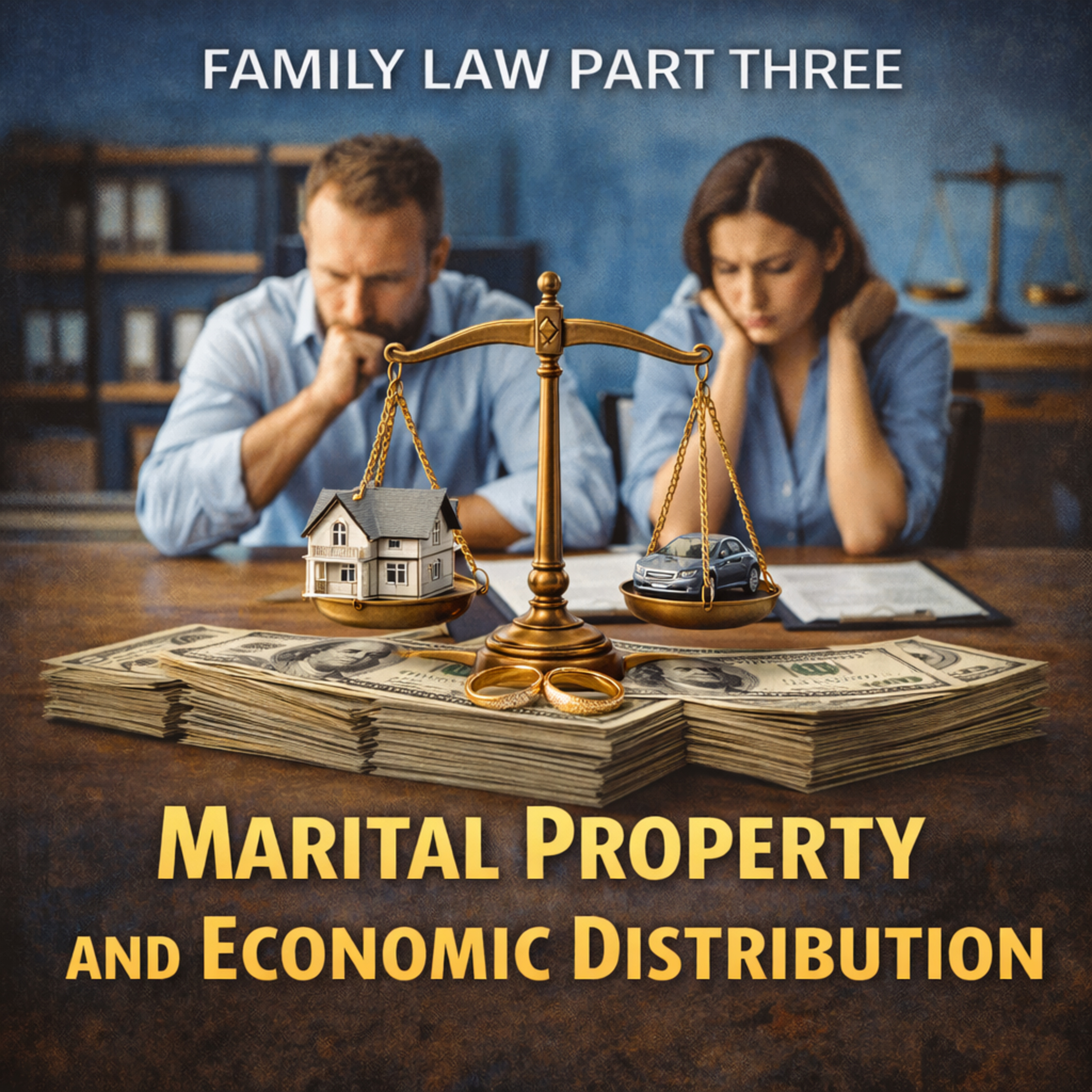
Family Law Part Three - Marital Property and Economic Distribution [not-audio_url] [/not-audio_url]

Duration: 45:31
This conversation delves into the complexities of marital property and economic distribution in divorce, emphasizing the importance of understanding the economic partnership theory. It outlines a three-step process for p…
Family Law Part Two - Divorce, Annulment, and Separation [not-audio_url] [/not-audio_url]

Duration: 40:08
This conversation delves into the complexities of family law, specifically focusing on the dissolution of marriage. It covers essential topics such as jurisdiction, grounds for divorce, annulment, legal separation, and t…
Property Law Part Seven: Transfers of Property [not-audio_url] [/not-audio_url]

Duration: 47:17
This conversation delves into the intricate life cycle of real estate transactions, exploring the various phases from contract signing to closing and recording. It emphasizes the importance of understanding the chronolog…
Property Law Part Five: Land Use Controls [not-audio_url] [/not-audio_url]

Duration: 50:06
This conversation delves into the complexities of land use controls, focusing on the interplay between individual property rights and government regulations. It explores the concept of police power, zoning laws, eminent…
Property Law Part Four: Landlord–Tenant Law [not-audio_url] [/not-audio_url]

Duration: 54:12
Property Law Chapter Four: Landlord–Tenant LawThis conversation delves into the complexities of landlord-tenant law, exploring the evolution of property law, the various types of leasehold estates, and the rights and res…
Property Law Part Three: Concurrent Ownership [not-audio_url] [/not-audio_url]

Duration: 41:40
Most people assume owning property together is simple—until the law reveals its chaotic, high-stakes complexity. If you think co-ownership is just "my house or yours," think again. One wrong step or misunderstood rule ca…
Property Law Part Two: Estates and Future Interest [not-audio_url] [/not-audio_url]

Duration: 50:39
This conversation delves into the complexities of property law, focusing on estates and future interests. It explores the foundational concepts of ownership, the intricacies of defeasible fees, life estates, and the rule…