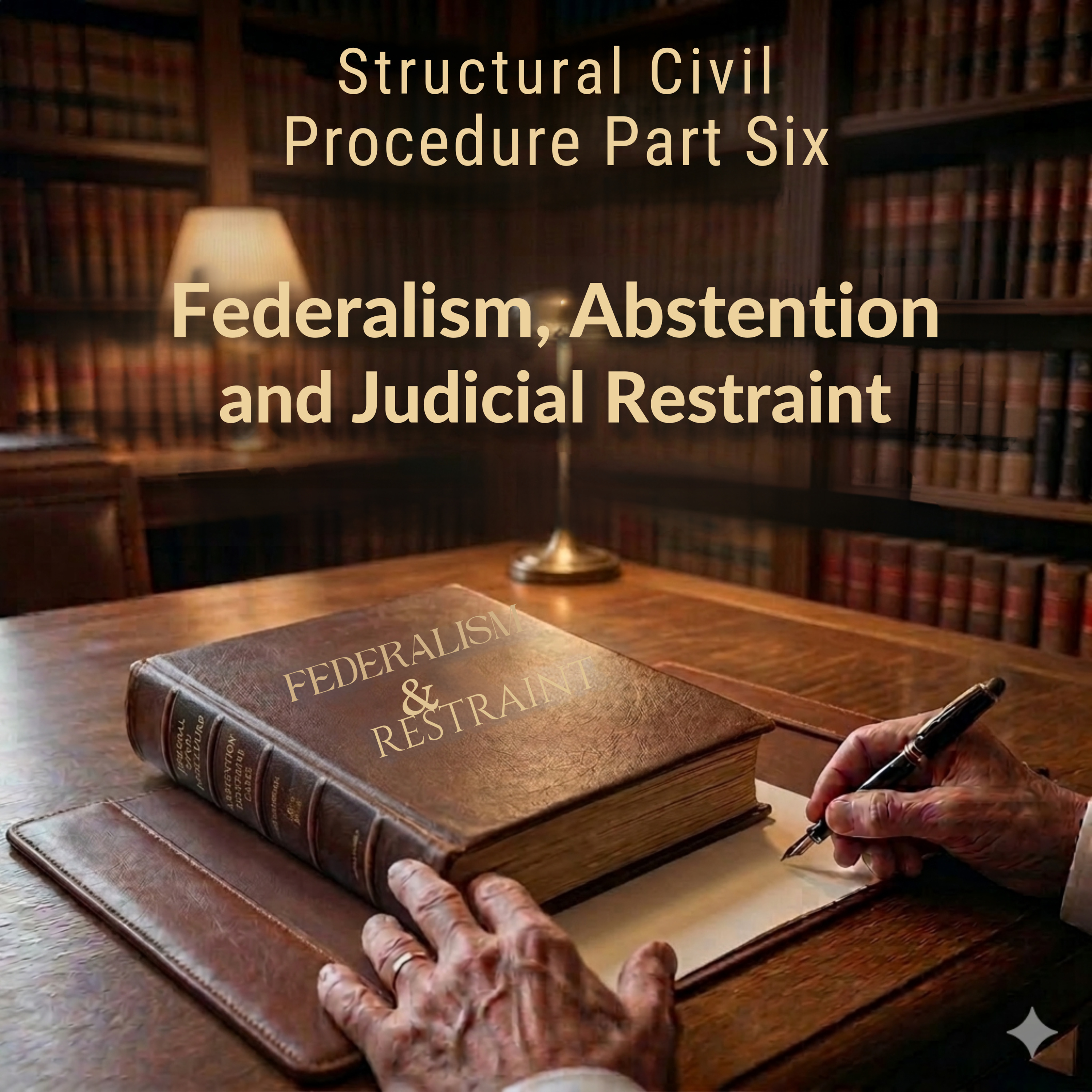
Most civil cases turn on a deeply complex question: when will federal courts say no—even if they have the power to decide? In this masterclass, we unravel the layered world of federal restraint doctrines that protect the balance of power between State and Federal courts. Discover how legal giants like Younger v. Harris, Pullman, Burford, Colorado River, and the Anti-Injunction Act shape when and why federal courts step back, even amid broad jurisdiction.
You’ll explore:
How federal courts honor state sovereignty through Younger abstention, which bars interference in ongoing criminal, civil, or administrative proceedings—unless exceptional circumstances like bad faith, harassment, or flagrantly unconstitutional laws arise.
The subtle art of Pullman abstention, preventing premature constitutional rulings by deferring to state courts on ambiguous laws and utilizing the innovative certification mechanism—an elegant dialogue between sovereigns that keeps the federal judiciary from overstepping.
Judicial economy in Colorado River, showing when courts can prudently decline cases involving parallel disputes—by balancing six crucial factors— to avoid wasteful, conflicting judgments.
Statutory blocks like the Anti-Injunction Act, which outright prohibit injunctions against state proceedings, except in narrowly defined exceptions such as Congress explicitly authorizing or protecting federal rights via statutes like Section 1983.
The emerging landscape of cooperative federalism with certification—a modern tool allowing federal judges to consult state supreme courts on unsettled state law, ensuring accurate application without unnecessary litigation or guesswork.
And finally, the Rooker-Feldman doctrine, which strictly prevents lower federal courts from overturning or reviewing final state court judgments—saving you from the abyss of unauthorized appellate jurisdiction when your injury stems directly from a state decision.
This episode is essential—perfect for civil procedure students, lawyers preparing for exams, or anyone interested in the subtle but powerful mechanisms ensuring federalism’s delicate balance. Master how these doctrines interlock—timing, the nature of the case, exact relief sought, and finality—and understand the ultimate question: who decides where, under what law, and with what binding authority?
By the end, you'll have a crystal-clear framework to quickly analyze complex fact patterns—distinguishing when to intervene, when to defer, and how to navigate the intricate dance of federal restraint that preserves democracy, order, and justice. Whether in exams or real-world litigation, this knowledge keeps the federal judiciary’s power in check, safeguarding both state sovereignty and individual rights.
Prepare to see the big picture of judicial restraint—not as abdication, but as structured moderation—ensuring your strategy is both principled and practical. Hit play and master the art of federal courts’ disciplined restraint.