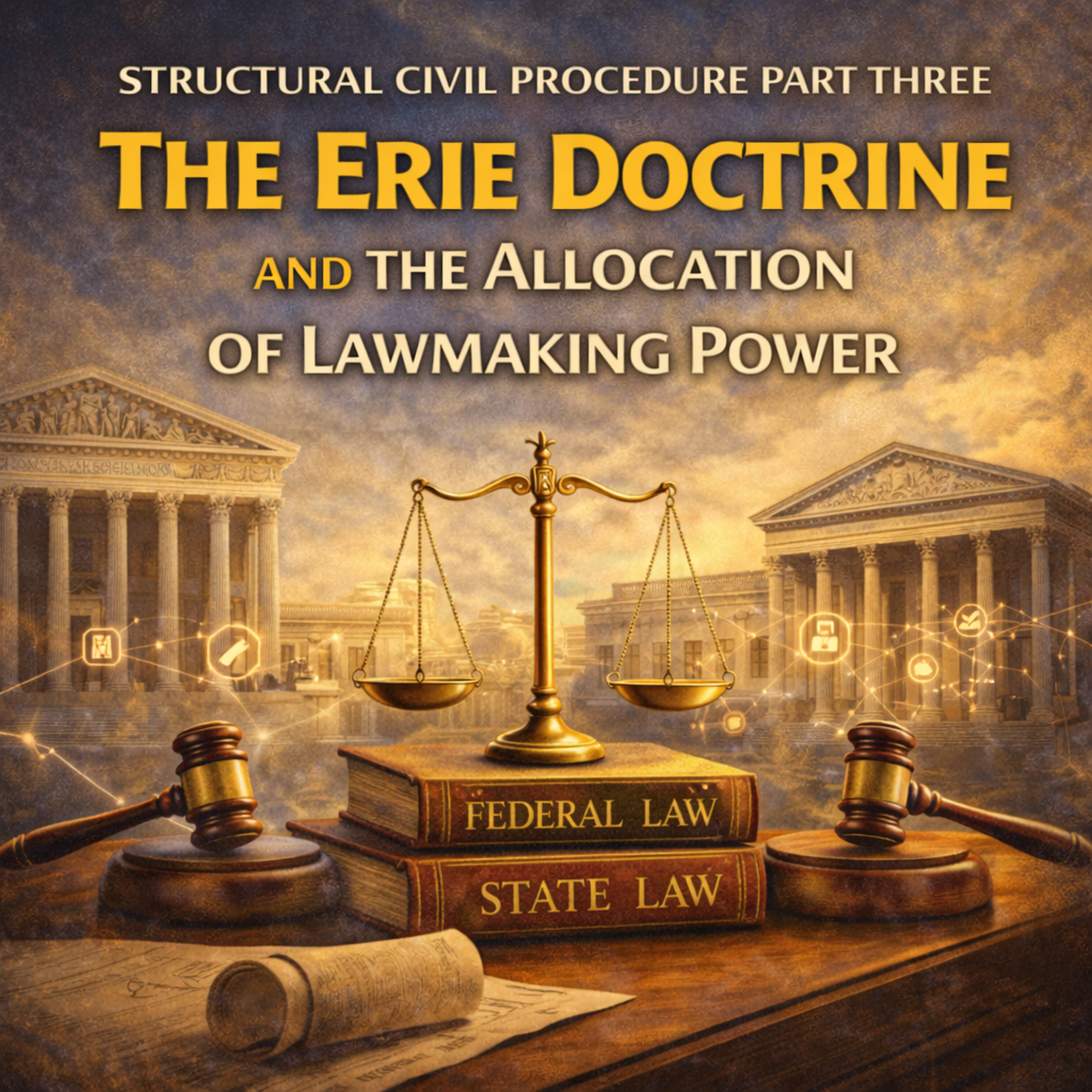
This deep dive explores the complex and foundational Erie Doctrine in federal civil procedure, covering its historical evolution, key cases, and modern analytical framework. Perfect for law students and legal practitioners aiming to master the balance of federal and state law.
Most law students dread the eerie doctrine — often the most intimidating topic in civil procedure. But what if mastering it could unlock your highest exam scores? Imagine transforming this complex, fearsome concept into a crystal-clear decision tree that demystifies federalism, federal court limits, and the true boundaries of judicial power. This episode reveals the structured framework behind the Erie Doctrine, turning insurmountable confusion into strategic mastery.
We begin by unpacking the core constitutional challenge Erie addressed: how federal courts navigate the delicate federal-state law balance after jurisdiction is established. Once jurisdiction hurdles are cleared, the final question emerges — whose law governs? This isn’t just about procedural rules; it’s about safeguarding federalism and preventing federal courts from overstepping their constitutional bounds. Learn why Erie rejected the Swift era’s federal common law and reasserted states’ sovereignty over substantive law, cementing the principle that federal courts must respect state law unless a federal rule or statute explicitly applies.
Delve into the layered hierarchy of laws: the Constitution sits at the peak, followed by federal statutes and rules, then state substantive law, and finally, federal procedural rules at the base. We break down the pivotal tests: the Rules Enabling Act (REA), which validates federal rules if they regulate procedure without affecting substantive rights; and the twin aims of Erie — avoiding forum shopping and ensuring equitable law administration. Discover the historical flaws of outcome determinative and the refined, flexible approach introduced by Hanna and subsequent cases, which impose a careful, structural balance.
You'll uncover the two critical tracks in Erie analysis: Track One, when a federal rule or statute directly conflicts with state law, where the REA controls; and Track Two, which involves assessing whether applying federal practice encourages forum shopping or inequities, using the modified outcome determinative test and the balancing framework from Byrd and Hanna. Our decision tree toolkit offers a step-by-step process, empowering you to evaluate any fact pattern confidently and avoid common pitfalls like mixing procedures and substance or misidentifying the appropriate track.
The episode also tackles nuanced issues: federal common law’s limited scope, how to handle novel state law issues through predictions or certification, and the layered hierarchy guiding judicial deferment. Plus, we explore a paradox — federal judges sometimes influence state law via Erie’s dialogue, raising questions about federal-state interactions that could seem almost paradoxical.
Perfect for exam takers, practitioners, and law lovers alike, this episode transforms daunting doctrine into an accessible, strategic tool. Master the Erie Doctrine’s architecture, understand its constitutional heartbeat, and confidently navigate federal versus state law questions — all in one comprehensive, actionable guide.
Whether you're preparing for the bar, tackling civil procedure, or just love understanding the architecture of our legal system, this episode provides the clarity and confidence to dominate Erie. Don't just memorize rules — understand the structure, so you can apply it seamlessly under exam pressure or in practice.
Key Topics
Erie Doctrine and its constitutional basis
Historical evolution from Swift v Tyson to Erie Railroad v Tompkins
Erie Doctrine, Federal Civil Procedure, Federalism, Swift v Tyson, Hanna v Plumer, Rules Enabling Act, Outcome Determinative Test, Twin Aims, Federal Common Law, Legal Analysis