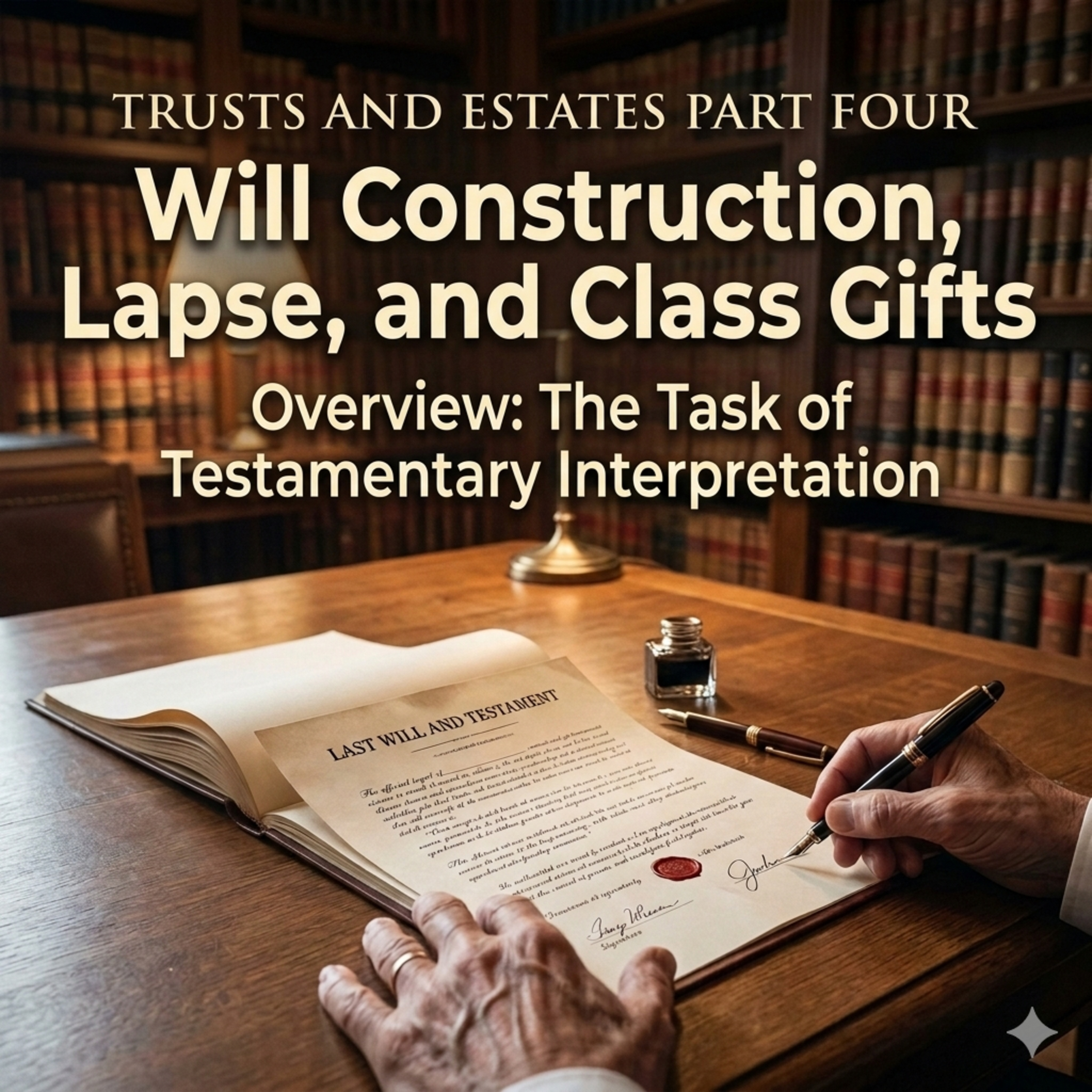
This episode explores the complex world of will construction, focusing on interpreting legal documents, resolving ambiguities, and applying doctrines like lapse, anti-lapse, redemption, and abatement. Perfect for law students and practitioners, it provides a rigorous framework to analyze estate planning disputes.
Most estates spiral into chaos not because of poorly drafted wills, but because of interpretative pitfalls lurking in seemingly straightforward language. If you're a law student cramming for the bar or a practitioner navigating estate disputes, mastering will construction is your secret weapon. This episode unveils the rigorous frameworks, nuanced doctrines, and strategic checklists that decode the complex maze of interpreting, applying, and enforcing wills.
Imagine a final testament that’s perfectly signed and witnessed—yet, despite initial validity, the estate becomes embroiled in controversy because of ambiguities, unexpected deaths, or missing assets. You’ll discover how courts decipher the testator’s true intent by meticulously analyzing the language of the will, the context, and the surrounding facts. We break down the core principles: the paramount importance of the testator’s intent, the plain meaning rule, and how modern courts admit extrinsic evidence through the lens of patent and latent ambiguities. You'll learn the distinctions between these ambiguities and the strategic use of extrinsic evidence—testimony, documents, or even subjective family details—to resolve confusion.
Handling unforeseen events like beneficiaries predeceasing or property vanishing from the estate is where doctrines like lapse, anti-lapse, redemption, and abatement come into play. You’ll understand the crucial classification of gifts—specific, general, demonstrative, and residuary—and how each category influences the outcome in cases of missing property or insufficient assets. The episode highlights how modern law, especially in UPC jurisdictions, shifts from rigid rules toward flexible doctrines like intent-based reformations and exceptions for conservatorship sales or insurance claims, emphasizing that context and purpose matter.
Navigation becomes even more critical with class gifts—the dynamic groups that can change membership over time. Learn the rules for class closure, how lapse and anti-lapse intersect within groups, and the subtle distinctions that determine whether a gift results in a beneficiary windfall or falls to the estate. We provide a step-by-step methodology, a precise checklist to analyze every gift systematically: classify, survive, apply anti-lapse, verify assets, resolve ambiguities, address insolvency, and finally, distribute.
The stakes are high—misinterpretations can unravel millions in assets, igniting fragile family relationships. This episode arms you with the analytical rigor and tactical precision to untangle even the most tangled estate puzzles. Perfect for exam prep or real-world application, this deep dive transforms abstract doctrines into a practical decision tree. When the legal code becomes a labyrinth, follow this blueprint, and you’ll decode it every time.
Whether it's a meticulously drafted will or a family feud in the making, understanding these doctrines ensures you can construct, interpret, and defend testamentary plans with confidence. Legally, wills are more than mere documents—they’re complex codes encoded in words, actions, and contexts. Unlock their secrets with this essential guide to will construction mastery.
Takeaways
Always classify each gift before analysis.
Survivorship must be at least 120 hours to avoid lapsing.
Anti-lapse statutes protect close relatives with surviving issue.
Specific gifts are subject to redemption if the asset is missing.
Abatement prioritizes intestacy, residuary, then general and specific gifts.
Will construction, estate planning, legal interpretation, anti-lapse, lapse, redemption, abatement, trust law, probate, legal analysis