Trusts and Estates Part Seven: Future Interests and the Rule Against Perpetuities: Temporal Limits on the Dead Hand

Trusts and Estates Part Seven: Future Interests and the Rule Against Perpetuities: Temporal Limits on the Dead Hand

Author: The Law School of America March 8, 2026 Duration: 55:01

The Law of "Mine": 5 Surprising Realities About Property


Property law is a complex riddle, less intuitive than commonly believed. It is not about objects but about the invisible legal relationships defining who can use and transfer assets.


1. Property Isn’t a Thing—It’s a Relationship

Ownership is a three-way social relationship: owner to thing, others to thing, and owner to others. Property is the legally-backed power to exclude others, not merely the object itself.


2. Why Chasing the Fox Isn’t Enough (The Rule of Capture)

The rule from Pierson v. Post mandates Actual Possession (physical seizure) for ownership of a wild animal, not mere pursuit. This clear rule prioritizes certainty and peace over rewarding labor alone.


3. Finders Keepers? (The Doctrine of Relativity of Title)

The principle is "First-in-Time, First-in-Right." In Armory v. Delamirie, the court established the Relativity of Title: a possessor has a better right to an object than a stranger, though inferior to the True Owner. This stability is necessary for commerce.


4. The Floor Matters: The Weird Logic of "Lost" vs. "Mislaid"

The locus in quo (place of finding) determines title. Lost Property (unintentionally dropped) generally belongs to the finder. Mislaid Property (intentionally placed, then forgotten) goes to the premises owner. This distinction aims to facilitate the item's return to the True Owner.


5. The "Snooze and Lose" Rule (Adverse Possession)

This provocative doctrine allows a trespasser to gain title by using the land for a statutory period. It punishes the "sleeping" owner and rewards the productive user, ultimately serving to "quiet titles" and cure conveyancing errors.


Conclusion

Property law is a dynamic field constantly adapting. As assets become abstract (digital/genetic data), the ancient logic of capture and possession faces new challenges in the 21st century.


Ever wondered how the law really works but felt intimidated by dense textbooks and jargon? Law School, from The Law School of America, is here to change that. This podcast approaches legal education like a series of engaging conversations, breaking down the foundational principles of the American legal system into clear, manageable segments. Each episode focuses on a specific concept or area, building your comprehension step-by-step without overwhelming you. You'll hear straightforward explanations that connect theory to real-world application, making complex topics accessible whether you're a student, a professional in a related field, or simply a curious citizen. The goal is to demystify the law, transforming it from an abstract subject into a practical understanding you can use. By consistently tuning in, you gradually construct a solid framework of legal knowledge. This isn't about quick tricks; it's about dedicated, cumulative learning. The structure of the podcast is designed for steady progress, allowing listeners to absorb information at their own pace and truly integrate it. Think of it as an audio companion for your intellectual journey into jurisprudence, offering clarity and insight one episode at a time.
Author: Language: en-us Episodes: 100

Law School
Podcast Episodes
Agency and Partnership Part Three: Fiduciary Duties of Agents [not-audio_url] [/not-audio_url]

Duration: 38:10
Unlocking the Core of Agency Law: Fiduciary DutiesIn this episode of "The Deep Dive," the hosts transition from the mechanical aspects of agency law to the philosophical underpinnings of fiduciary duties. He emphasizes t…
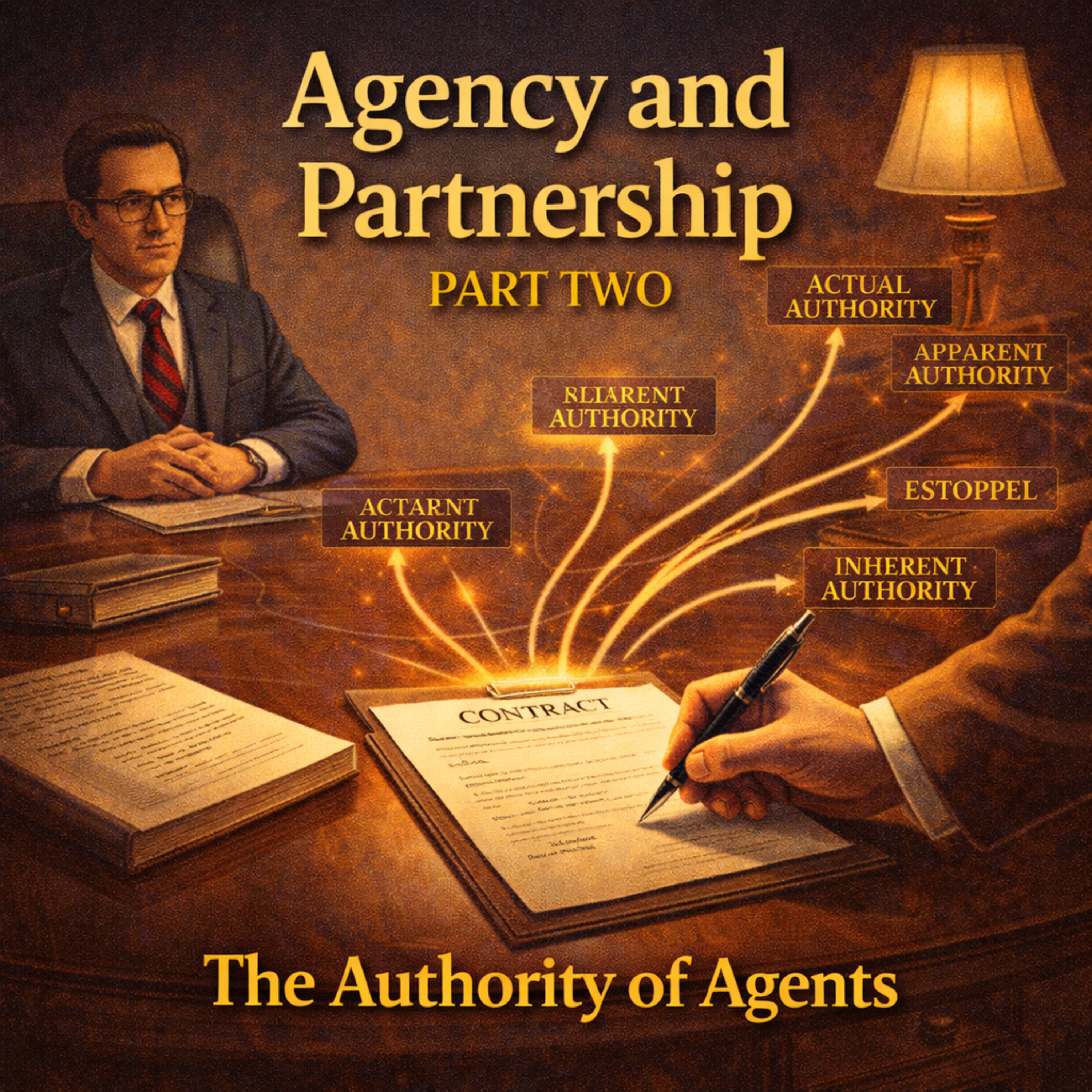
Agency and Partnership Part Two: The Authority of Agents [not-audio_url] [/not-audio_url]

Duration: 43:38
Understanding Agency Law: Navigating the Doctrine of AuthorityIn this episode, we delve into the complexities of agency law, focusing on the doctrine of authority as outlined in Part Two of the Agency and Partnership Gui…