"Deep learning as program synthesis" by Zach Furman

"Deep learning as program synthesis" by Zach Furman

Author: LessWrong January 25, 2026 Duration: 1:11:42
Audio note: this article contains 73 uses of latex notation, so the narration may be difficult to follow. There's a link to the original text in the episode description.

Epistemic status: This post is a synthesis of ideas that are, in my experience, widespread among researchers at frontier labs and in mechanistic interpretability, but rarely written down comprehensively in one place - different communities tend to know different pieces of evidence. The core hypothesis - that deep learning is performing something like tractable program synthesis - is not original to me (even to me, the ideas are ~3 years old), and I suspect it has been arrived at independently many times. (See the appendix on related work).

This is also far from finished research - more a snapshot of a hypothesis that seems increasingly hard to avoid, and a case for why formalization is worth pursuing. I discuss the key barriers and how tools like singular learning theory might address them towards the end of the post.

Thanks to Dan Murfet, Jesse Hoogland, Max Hennick, and Rumi Salazar for feedback on this post.

Sam Altman: Why does unsupervised learning work?

Dan Selsam: Compression. So, the ideal intelligence [...]

---

Outline:

(02:31) Background

(09:06) Looking inside

(09:09) Grokking

(16:04) Vision circuits

(22:37) The hypothesis

(26:04) Why this isnt enough

(27:22) Indirect evidence

(32:44) The paradox of approximation

(38:34) The paradox of generalization

(45:44) The paradox of convergence

(51:46) The path forward

(53:20) The representation problem

(58:38) The search problem

(01:07:20) Appendix

(01:07:23) Related work

The original text contained 14 footnotes which were omitted from this narration.

---

First published:
January 20th, 2026

Source:
https://www.lesswrong.com/posts/Dw8mskAvBX37MxvXo/deep-learning-as-program-synthesis-1

---


Narrated by TYPE III AUDIO.

---

Images from the article:

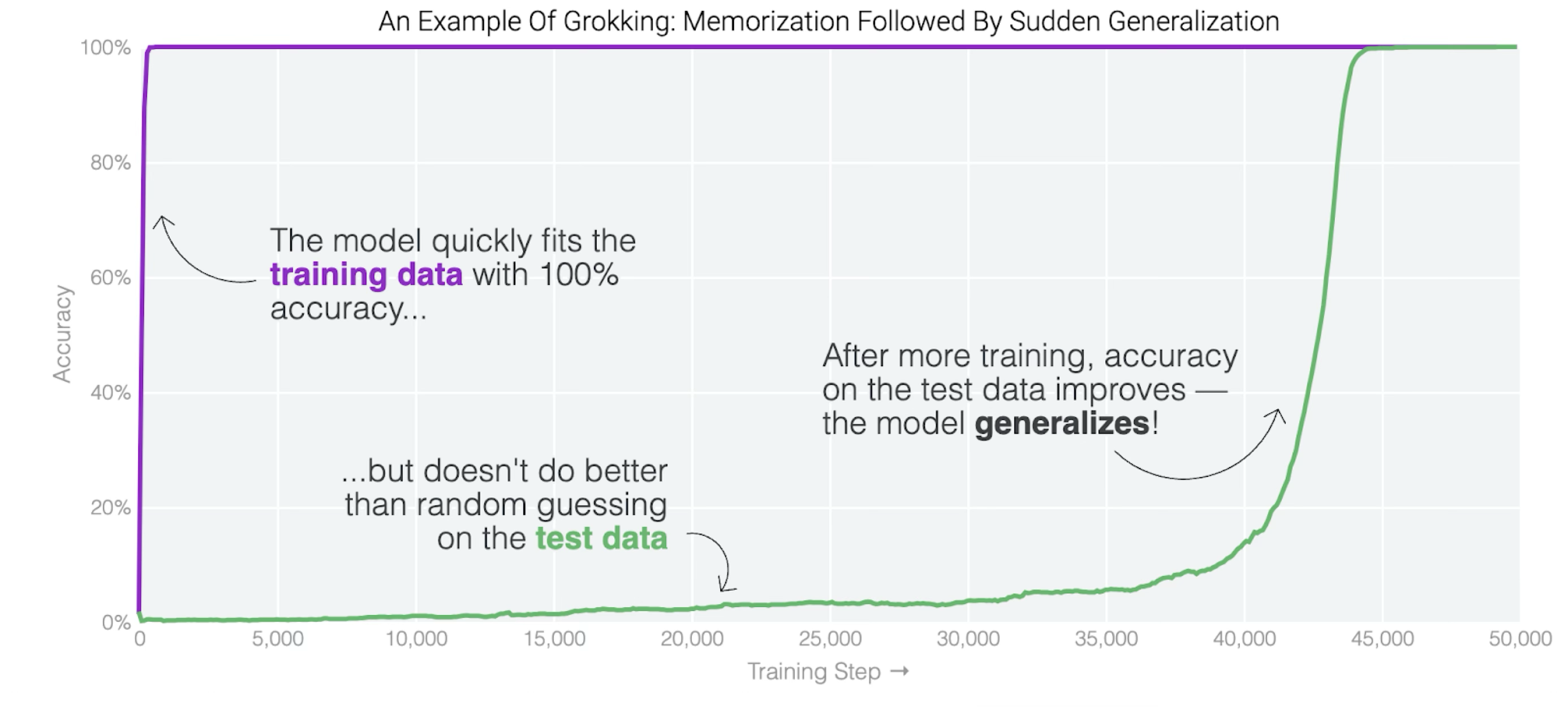
Graph showing
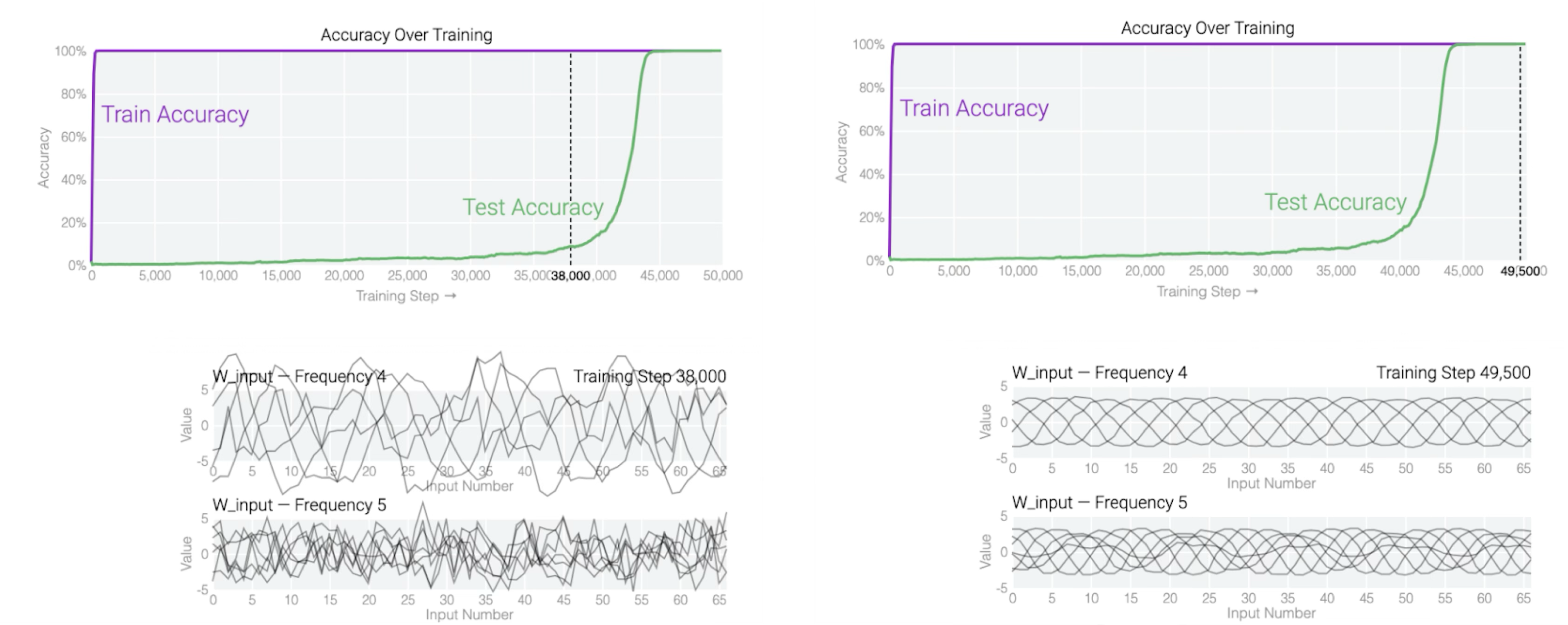
The modular addition transformer from Power et al. (2022) learns to generalize rapidly (top), at the same time as Fourier modes in the weights appear (bottom right). Illustration by Pearce et al. (2023).

Dive into a stream of ideas where technology, culture, philosophy, and society intersect, all through the lens of the LessWrong (Curated & Popular) podcast. This isn't a traditional talk show with hosts, but rather a curated audio library of the most impactful writing from the LessWrong community. Each episode is a narration of a full post, selected for its high value and interesting arguments, focusing on pieces that have been formally curated or have garnered significant community approval. You'll hear clear, thoughtful readings of essays that tackle complex topics like artificial intelligence, rational thinking, moral philosophy, and the forces shaping our future. The audio format lets you absorb these dense, often paradigm-shifting concepts during a commute or a walk, turning written analysis into an immersive listening experience. This particular feed is deliberately selective, offering a manageable stream of the community's standout work. For those who want an even deeper dive into the discussion, there are broader feeds available. The LessWrong (Curated & Popular) podcast serves as an intellectual filter, delivering the signal through the noise and inviting you to engage with some of the most rigorously examined ideas on the internet.
Author: Language: English Episodes: 100

LessWrong (Curated & Popular)
Podcast Episodes
"Why You Don’t Believe in Xhosa Prophecies" by Jan_Kulveit [not-audio_url] [/not-audio_url]

Duration: 9:03
Based on a talk at the Post-AGI Workshop. Also on Boundedly Rational Does anyone reading this believe in Xhosa cattle-killing prophecies? My claim is that it's overdetermined that you don’t. I want to explain why — and w…
"My journey to the microwave alternate timeline" by Malmesbury [not-audio_url] [/not-audio_url]

Duration: 20:26
Cross-posted from Telescopic Turnip Recommended soundtrack for this post As we all know, the march of technological progress is best summarized by this meme from Linkedin: Inventors constantly come up with exciting new i…
"Stone Age Billionaire Can’t Words Good" by Eneasz [not-audio_url] [/not-audio_url]

Duration: 23:19
I was at the Pro-Billionaire march, unironically. Here's why, what happened there, and how I think it went. Me on the far left. From WSJ. I. Why? There's a genre of horror movie where a normal protagonist is going throug…
"On Goal-Models" by Richard_Ngo [not-audio_url] [/not-audio_url]

Duration: 6:36
I'd like to reframe our understanding of the goals of intelligent agents to be in terms of goal-models rather than utility functions. By a goal-model I mean the same type of thing as a world-model, only representing how…
"Post-AGI Economics As If Nothing Ever Happens" by Jan_Kulveit [not-audio_url] [/not-audio_url]

Duration: 16:38
When economists think and write about the post-AGI world, they often rely on the implicit assumption that parameters may change, but fundamentally, structurally, not much happens. And if it does, it's maybe one or two em…
