"Does Pentagon Pizza Theory Work?" by rba

"Does Pentagon Pizza Theory Work?" by rba

Author: LessWrong January 27, 2026 Duration: 11:05
As soon as modern data analysis became a thing, the US government has had to deal with people trying to use open source data to uncover its secrets.

During the early Cold War days and America's hydrogen bomb testing, there was an enormous amount of speculation about how the bombs actually worked. All nuclear technology involves refinement and purification of large amounts of raw substances into chemically pure substances. Armen Alchian was an economist working at RAND and reasoned that any US company working in such raw materials and supplying the government would have made a killing leading up to the tests.

After checking financial data that RAND maintained on such companies, Alchian deduced that the secret sauce in the early fusion bombs was lithium and the Lithium Corporation of America was supplying the USG. The company's stock had skyrocketed leading up to the Castle Bravo test either by way of enormous unexpected revenue gains from government contracts, or more amusingly, maybe by government insiders buying up the stock trying to make a mushroom-cloud-sized fortune with the knowledge that lithium was the key ingredient.

When word of this work got out, this story naturally ends with the FBI coming [...]

---

Outline:

(01:27) Pizza is the new lithium

(03:09) The Data

(04:11) The Backtest

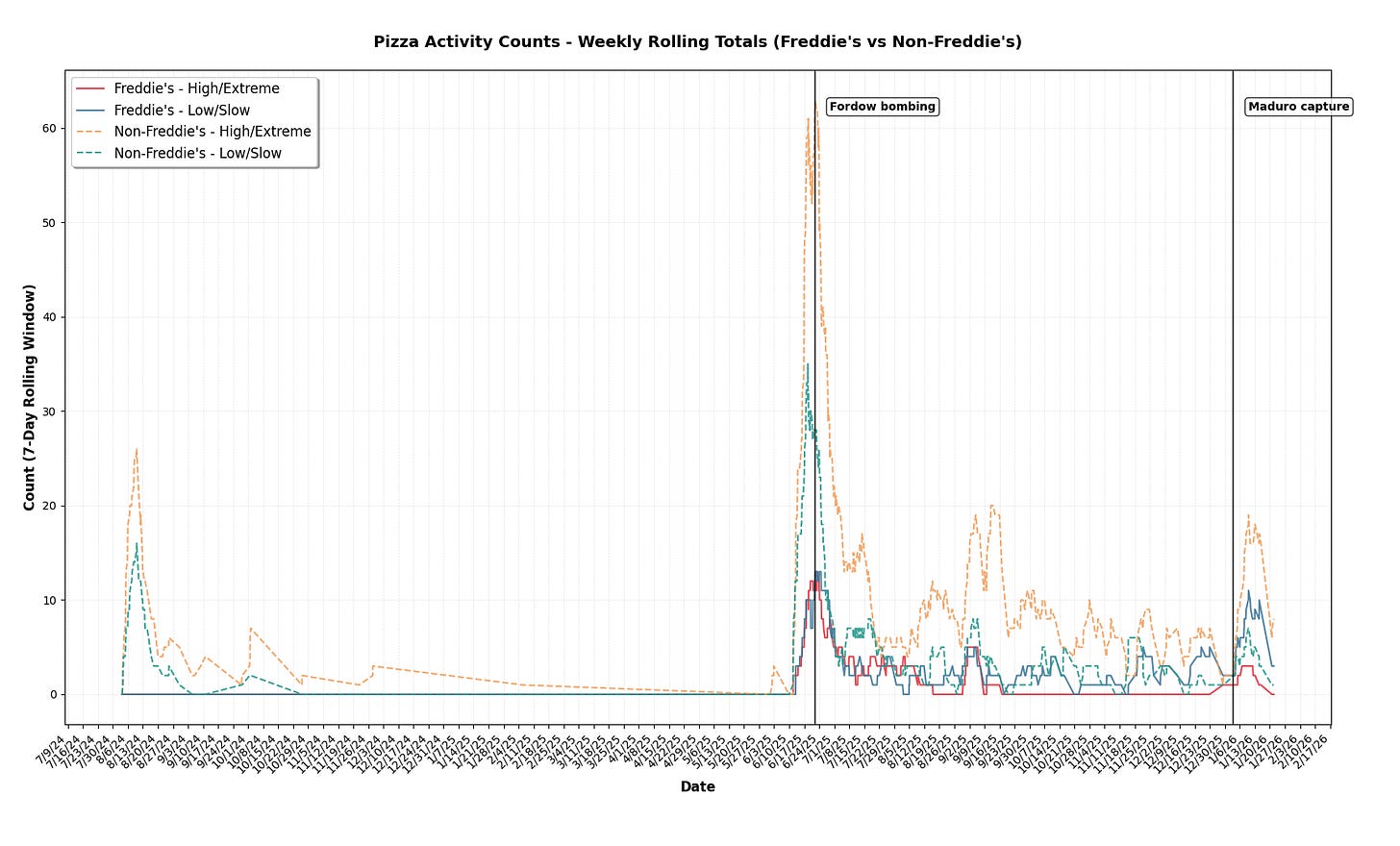
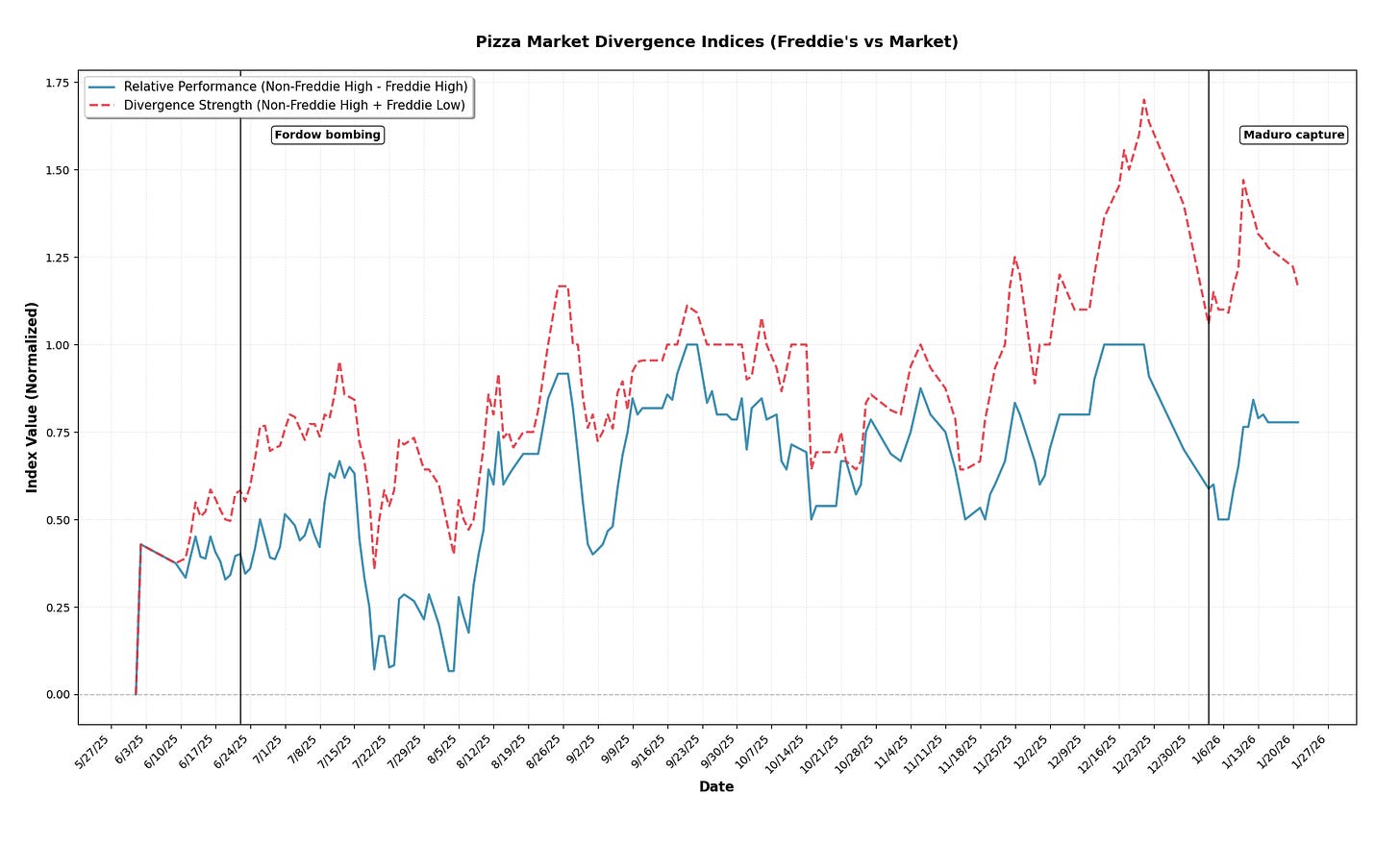
(04:36) Fordow bombing

(04:55) Maduro capture

(05:15) The Houthi stuff

(10:25) Coda

---

First published:
January 22nd, 2026

Source:
https://www.lesswrong.com/posts/Li3Aw7sDLXTCcQHZM/does-pentagon-pizza-theory-work

---


Narrated by TYPE III AUDIO.

---

Images from the article:

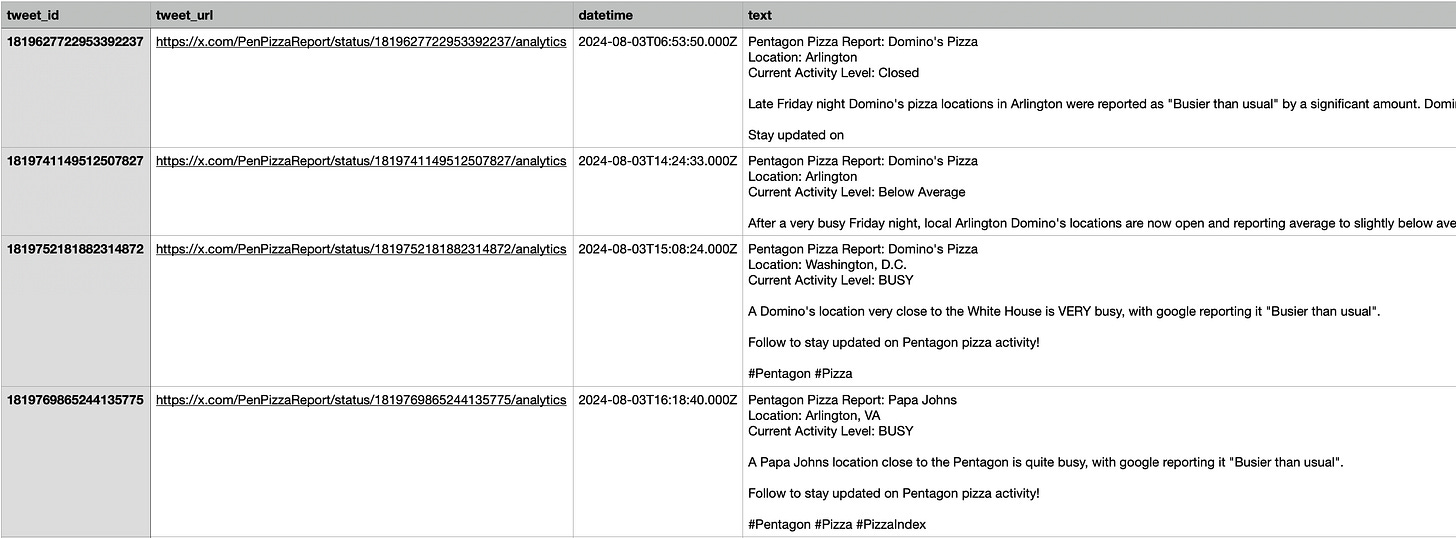
Fig 1. First few PPR tweets.
Fig 2. Weekly rolling PPR tweet volume since August 2024, broken down by tweet type.

Dive into a stream of ideas where technology, culture, philosophy, and society intersect, all through the lens of the LessWrong (Curated & Popular) podcast. This isn't a traditional talk show with hosts, but rather a curated audio library of the most impactful writing from the LessWrong community. Each episode is a narration of a full post, selected for its high value and interesting arguments, focusing on pieces that have been formally curated or have garnered significant community approval. You'll hear clear, thoughtful readings of essays that tackle complex topics like artificial intelligence, rational thinking, moral philosophy, and the forces shaping our future. The audio format lets you absorb these dense, often paradigm-shifting concepts during a commute or a walk, turning written analysis into an immersive listening experience. This particular feed is deliberately selective, offering a manageable stream of the community's standout work. For those who want an even deeper dive into the discussion, there are broader feeds available. The LessWrong (Curated & Popular) podcast serves as an intellectual filter, delivering the signal through the noise and inviting you to engage with some of the most rigorously examined ideas on the internet.
Author: Language: English Episodes: 100

LessWrong (Curated & Popular)
Podcast Episodes
"How to Hire a Team" by Gretta Duleba [not-audio_url] [/not-audio_url]

Duration: 8:40
A low-effort guide I dashed off in less than an hour, because I got riled up. Try not to hire a team. Try pretty hard at this. Try to find a more efficient way to solve your problem that requires less labor – a smaller-f…
"The Possessed Machines (summary)" by L Rudolf L [not-audio_url] [/not-audio_url]

Duration: 16:43
The Possessed Machines is one of the most important AI microsites. It was published anonymously by an ex- lab employee, and does not seem to have spread very far, likely at least partly due to this anonymity (e.g. there…
"Ada Palmer: Inventing the Renaissance" by Martin Sustrik [not-audio_url] [/not-audio_url]

Duration: 26:17
Papal election of 1492 For over a decade, Ada Palmer, a history professor at University of Chicago (and a science-fiction writer!), struggled to teach Machiavelli. “I kept changing my approach, trying new things: which t…
"Dario Amodei – The Adolescence of Technology" by habryka [not-audio_url] [/not-audio_url]

Duration: 1:54:18
Dario Amodei, CEO of Anthropic, has written a new essay on his thoughts on AI risk of various shapes. It seems worth reading, even if just for understanding what Anthropic is likely to do in the future. Confronting and O…
"The inaugural Redwood Research podcast" by Buck, ryan_greenblatt [not-audio_url] [/not-audio_url]

Duration: 3:27
After five months of me (Buck) being slow at finishing up the editing on this, we’re finally putting out our inaugural Redwood Research podcast. I think it came out pretty well—we discussed a bunch of interesting and und…
"Deep learning as program synthesis" by Zach Furman [not-audio_url] [/not-audio_url]

Duration: 1:11:42
Audio note: this article contains 73 uses of latex notation, so the narration may be difficult to follow. There's a link to the original text in the episode description. Epistemic status: This post is a synthesis of idea…
