MoM Ep3: Eudoxus of Connitus

MoM Ep3: Eudoxus of Connitus

Author: Brian HIrschfield and Rob Hamilton February 2, 2026 Duration: 9:37

httts://www.magicinternetmath.com

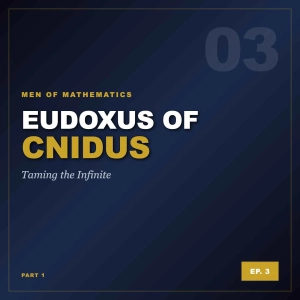
This podcast episode of Men of Mathematics explores the life and mathematical contributions of Eudoxus of Connitus, highlighting his solutions to the crisis of incommensurables and his development of the method of exhaustion.

Key Topics:

  • The crisis of incommensurables in Greek mathematics
  • Eudoxus's theory of proportions
  • The method of exhaustion
  • Eudoxus's cosmological model
  • Eudoxus's influence on future mathematicians, including Archimedes, Newton, and Leibniz

Summary:

Eudoxus of Connitus was a mathematician born around 408 BC who made significant contributions to geometry, astronomy, geography, medicine, and philosophy. He lived in poverty, walking miles to attend Plato's Academy. He eventually became a distinguished colleague of Plato. His work is known through references by Euclid, Aristotle, Archimedes, and later commentators, as none of his writings survive.

Eudoxus addressed the crisis of incommensurables, which arose from the discovery that the diagonal of a unit square (the square root of 2) cannot be expressed as a ratio of whole numbers. This discovery challenged the Pythagorean worldview, which was based on the belief that all ratios could be expressed as ratios of whole numbers. To resolve this, Eudoxus developed a theory of proportions that defined equality of ratios in terms of comparisons, rather than relying on whole numbers. Two ratios, A to B and C to D, are equal if, for all positive integers M and N, when M times A is greater than N times B, then M times C is greater than N times D, and similarly for equality and less than. This definition works for both commensurable and incommensurable quantities. This approach anticipated modern mathematics by over 2,000 years.

Eudoxus also developed the method of exhaustion, a technique for calculating areas and volumes of curved figures by approximating them with polygons. As the number of sides of the polygons increases, they exhaust more and more of the curved area. This method relies on the Archimedean axiom, which Eudoxus is credited with, stating that for any two magnitudes A and B, there exists a positive integer n such that n times A is greater than B. Using this method, Eudoxus proved several geometric theorems, including the relationship between the area of a circle and the square of its diameter, the volume of a cone and a cylinder, the volume of a pyramid and a prism, and the relationship between spheres and the cubes of their diameters.

Beyond pure mathematics, Eudoxus proposed the first mathematical model of the cosmos, which consisted of 27 concentric rotating spheres centered on Earth. This model aimed to explain the observed motions of the sun, moon, and planets, including complex motions like planetary retrograde.

Eudoxus's work established a standard of rigor in Greek mathematics. His method of exhaustion influenced subsequent mathematicians, including Archimedes, who used it to calculate areas and volumes. The ideas behind the method of exhaustion were later formalized and extended by Newton and Leibniz in the development of calculus. The debate about the legitimacy of infinitesimals, which violate Eudoxus's Archimedean axiom, continues to this day. Eudoxus's theory of proportions is preserved in Book V of Euclid's Elements, considered one of the greatest achievements of Greek mathematics.


What if the foundational ideas securing Bitcoin weren't just abstract concepts but something you could grasp and verify for yourself? Magic Internet Math, hosted by Brian Hirschfield and Rob Hamilton, is built on the conviction that true ownership in the digital age requires personal understanding. This podcast delves into the specific mathematical principles that make Bitcoin function, moving beyond surface-level explanations to explore the actual reasoning behind the protocol. The goal is to replace reliance on experts with genuine, self-verified knowledge. Hirschfield and Hamilton believe that without comprehending this core math, one's belief in the system remains fragile, always subject to external influence and uncertainty. Their discussions aim to transform complex topics into accessible, conversational explorations, breaking down the barriers that often make technical subjects feel intimidating. By focusing on the logical pathways from first principles, the show provides listeners with the tools to build their own intellectual conviction. It’s for anyone who has ever wondered how Bitcoin actually works under the hood and feels that trusting a white paper or a charismatic figure isn't quite enough. The conversations in this podcast are designed to empower, offering a deeper literacy in the cryptographic and economic ideas that define this new asset class. You'll hear detailed walkthroughs of key algorithms, discussions on probability and game theory as they apply to consensus, and an ongoing analysis of how mathematical certainty creates a new form of digital sovereignty. This isn't about investment advice or price speculation; it's a foundational education. Tune in to shift from being a passive holder to an informed participant, equipped with the knowledge to critically evaluate the system you’re trusting with your value. Magic Internet Math frames mathematics not as a gatekeeper, but as the essential tool for liberation and confidence in a rapidly evolving technological landscape.

Author: Language: English Episodes: 29

Magic Internet Math
Podcast Episodes
MoM Ep10: The Bernoullis [not-audio_url] [/not-audio_url]

Duration: 9:09
This podcast episode of "Men of Mathematics" delves into the history of the Bernoulli family of Basel, a dynasty of mathematicians spanning three generations who made significant contributions to various fields despite t…
MoM Ep9: Gottfried Liebniz [not-audio_url] [/not-audio_url]

Duration: 9:11
This episode of Men of Mathematics discusses the life and work of Gottfried Wilhelm Leibniz, a philosopher, mathematician, diplomat, and inventor who was a contemporary and rival of Isaac Newton. Key Topics: Leibniz's ea…
MoM Ep8: Isaac Newton [not-audio_url] [/not-audio_url]

Duration: 9:20
This podcast episode of Men of Mathematics introduces Isaac Newton, a highly influential scientist and mathematician known for his contributions to calculus and his complex personality. Key Topics: Isaac Newton Summary:…
MoM Ep7: Blaise Pascal [not-audio_url] [/not-audio_url]

Duration: 9:14
This podcast episode explores the life and accomplishments of Blaise Pascal, a mathematician, physicist, inventor, philosopher, and theologian. Key Topics: Pascal's early life and education Pascal's contributions to math…
MoM Ep6: Pierre De Fermat [not-audio_url] [/not-audio_url]

Duration: 9:12
This podcast episode of Men of Mathematics introduces Pierre de Fermat, a contemporary and rival of Rene Descartes, who is considered one of the greatest amateur mathematicians. Key Topics: Fermat's background Fermat's c…
Satoshi Ep5: The Genesis Block [not-audio_url] [/not-audio_url]

Duration: 0:24
This podcast episode discusses the Genesis Block in Bitcoin, created by Satoshi Nakamoto on January 3, 2009, and its significance as the foundation of the Bitcoin network. Key Topics: Genesis Block Satoshi Nakamoto Finan…
Satoshi Ep4:  Proof of Work [not-audio_url] [/not-audio_url]

Duration: 0:24
This podcast episode of Satoshi's Complete Writings discusses the concept of Proof of Work in Bitcoin, its significance in preventing Sybil attacks and double-spending, and its role in establishing decentralized consensu…
Satoshi Ep3:  Double Spending Solved [not-audio_url] [/not-audio_url]

Duration: 0:22
This podcast episode of Satoshi's Complete Writings, titled "Double Spending Solved," discusses how Bitcoin solved the double spending problem, which had plagued previous digital cash attempts. Key Topics: Double Spendin…
Satoshi Ep2: Trust and Trustlessness [not-audio_url] [/not-audio_url]

Duration: 0:22
This podcast episode discusses Satoshi Nakamoto's vision of replacing institutional trust with cryptographic proof in a peer-to-peer electronic cash system. Key Topics: Trust in Financial Systems Cryptographic Proof vs.…
Satoshi Ep 1: The Vision [not-audio_url] [/not-audio_url]

Duration: 4:02
This podcast episode, titled "The Vision," explores the foundational principles behind Bitcoin as articulated by Satoshi Nakamoto, focusing on the problem of double-spending and the innovative solution of replacing trust…