Satoshi Ep 1: The Vision

Satoshi Ep 1: The Vision

Author: Brian HIrschfield and Rob Hamilton February 3, 2026 Duration: 4:02

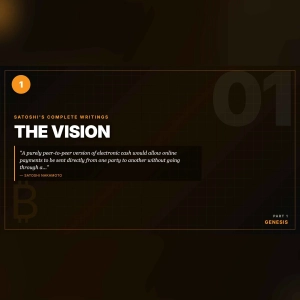
This podcast episode, titled "The Vision," explores the foundational principles behind Bitcoin as articulated by Satoshi Nakamoto, focusing on the problem of double-spending and the innovative solution of replacing trust with cryptographic proof.

Key Topics:

  • Double-Spending Problem
  • The Trust Problem in Digital Currencies
  • Satoshi's Solution: Cryptographic Proof
  • The Importance of Eliminating Trust

Summary:

The episode begins by highlighting Satoshi Nakamoto's launch of Bitcoin on January 3, 2009, as a revolutionary system challenging traditional assumptions about money and the necessity of financial intermediaries. Over two years, Satoshi detailed and defended this vision through 543 forum posts, providing remarkable technical insights and philosophical clarity.

Before Bitcoin, the creation of digital cash was seemingly impossible due to the double-spending problem. In digital systems, data can be perfectly duplicated, raising the question of how to prevent someone from spending the same digital money twice. Previous attempts, such as DigiCash, e-gold, and Liberty Reserve, relied on trusted third parties. These systems used a central server to track ownership and prevent double-spending by maintaining an authoritative ledger. However, this introduced dependencies and single points of failure, creating what is known as the trust problem. These earlier digital currencies required trust in an organization that could be compromised through incompetence, government pressure, or greed. Many such systems failed, often resulting in the loss of users' money. Satoshi noted that the fundamental issue with conventional currency is the trust required for it to function, pointing out that central banks, which must be trusted not to debase currency, have often breached this trust.

Satoshi's breakthrough was replacing trust with cryptographic proof. Instead of relying on a company to maintain an honest ledger, the entire network would maintain a shared ledger that no single party could corrupt. This meant that instead of a single server determining truth, thousands of independent nodes would collectively agree on the state of the ledger. The network would be secured through computational work, making it virtually impossible to rewrite history without redoing all the work.

Bitcoin represented a fundamental shift in how we perceive trust in digital systems. Satoshi's goal was not merely technical but to create a system that could operate without relying on fallible human institutions. The key takeaways from this episode are that Bitcoin solved the double-spend problem without needing trust in any central party, the innovation was replacing trusted third parties with cryptographic proof, Satoshi's vision fundamentally aimed to eliminate dependence on fallible institutions, and Satoshi left a detailed record of how and why Bitcoin works through 543 forum posts. The episode concludes by previewing the next episode, "Trust and Trustlessness," which will explore why eliminating trust was so important to Satoshi and how Bitcoin achieves security through verification rather than faith.


What if the foundational ideas securing Bitcoin weren't just abstract concepts but something you could grasp and verify for yourself? Magic Internet Math, hosted by Brian Hirschfield and Rob Hamilton, is built on the conviction that true ownership in the digital age requires personal understanding. This podcast delves into the specific mathematical principles that make Bitcoin function, moving beyond surface-level explanations to explore the actual reasoning behind the protocol. The goal is to replace reliance on experts with genuine, self-verified knowledge. Hirschfield and Hamilton believe that without comprehending this core math, one's belief in the system remains fragile, always subject to external influence and uncertainty. Their discussions aim to transform complex topics into accessible, conversational explorations, breaking down the barriers that often make technical subjects feel intimidating. By focusing on the logical pathways from first principles, the show provides listeners with the tools to build their own intellectual conviction. It’s for anyone who has ever wondered how Bitcoin actually works under the hood and feels that trusting a white paper or a charismatic figure isn't quite enough. The conversations in this podcast are designed to empower, offering a deeper literacy in the cryptographic and economic ideas that define this new asset class. You'll hear detailed walkthroughs of key algorithms, discussions on probability and game theory as they apply to consensus, and an ongoing analysis of how mathematical certainty creates a new form of digital sovereignty. This isn't about investment advice or price speculation; it's a foundational education. Tune in to shift from being a passive holder to an informed participant, equipped with the knowledge to critically evaluate the system you’re trusting with your value. Magic Internet Math frames mathematics not as a gatekeeper, but as the essential tool for liberation and confidence in a rapidly evolving technological landscape.

Author: Language: English Episodes: 29

Magic Internet Math
Podcast Episodes
MoM Ep5: Descartes [not-audio_url] [/not-audio_url]

Duration: 9:36
This podcast episode of Men of Mathematics discusses the life and mathematical contributions of René Descartes, focusing on his unification of algebra and geometry. Key Topics: René Descartes' early life and education De…
MoM Ep4: Archimedes [not-audio_url] [/not-audio_url]

Duration: 10:35
This podcast episode of Men of Mathematics discusses the life and achievements of Archimedes of Syracuse, considered the greatest scientist of the ancient world. Key Topics: Archimedes' early life and education Archimede…
MoM Ep3: Eudoxus of Connitus [not-audio_url] [/not-audio_url]

Duration: 9:37
httts://www.magicinternetmath.com This podcast episode of Men of Mathematics explores the life and mathematical contributions of Eudoxus of Connitus, highlighting his solutions to the crisis of incommensurables and his d…
MoM Ep2: Zeno of Elea [not-audio_url] [/not-audio_url]

Duration: 9:22
https://magicinternetmath.com This podcast episode of "Men of Mathematics" delves into the paradoxes of Zeno of Elea, exploring how his challenges to motion and infinity spurred mathematical development over two millenni…
MoM Ep1: Men of Mathematics - An Introduction [not-audio_url] [/not-audio_url]

Duration: 10:41
Episode 1: 2,500 Years of Mathematical Genius Men of Mathematics | Part 1: Ancient Mathematics What do a Greek philosopher killed by Roman soldiers, a French teenager who died in a duel, and a German mathematician driven…
BFI Ep2: HODL'ing Bitcoin is Irrational [not-audio_url] [/not-audio_url]

Duration: 0:25
HODL'ing Bitcoin is Irrational 📚 BUY THE BOOK Amazon: https://www.amazon.com/Bitcoin-Institutions-Brian-Hirschfield/dp/B0FCZHXFGS/ Buy with Bitcoin: https://zeuspay.com/btc-for-institutions 🎓 TAKE THE FREE COURSE http://…
BFI Ep1: Bitcoin is for Individuals [not-audio_url] [/not-audio_url]

Duration: 0:25
Episode 1 of 15 | Part 1: Bitcoin is for Individuals Introduction 📚 BUY THE BOOK Amazon: https://www.amazon.com/Bitcoin-Institutions-Brian-Hirschfield/dp/B0FCZHXFGS/ Buy with Bitcoin: https://zeuspay.com/btc-for-institut…
The Genesis Episode: Reteaching Math as a Liberal Art [not-audio_url] [/not-audio_url]

Duration: 1:18:58
Magic Internet Math Hub: https://mathacademy-cyan.vercel.app/index.html Brian Hirschfield X: @fundamentals21m npub12eml5kmtrjmdt0h8shgg32gye5yqsf2jha6a70jrqt82q9d960sspky99g Website: https://zeuspay.com/btc-for-instituti…