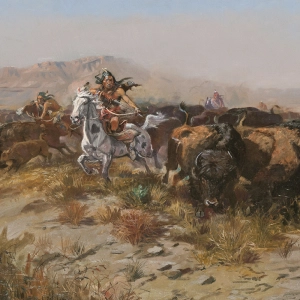
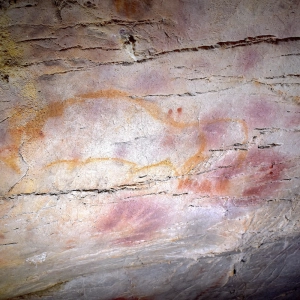
There's a story about of our past that you know well. It goes like this: At some point earlier in human evolution, we started to hunt. Men in particular—perhaps channeling some deep-seated aggressive impulses—began to seek out big game. This new food source, this bonanza of calories, was what allowed our brains to expand. It changed our bodies and our societies and sent our species off on a whole new track. In short, Man the Hunter made us human. This story—told in different versions, with different points of emphasis—has circulated for decades. It's been debunked and revived, rejected and reimagined. What is the history behind the Man the Hunter idea? How does it square with our current understandings of evolution? Is it, in fact, pure fiction?
My guest today is Dr. Vivek Venkataraman. Vivek is an evolutionary anthropologist at the University of Calgary, and an editor-in-chief of the journal Hunter Gatherer Research. He and his collaborators recently published an article on the different layers and meanings of the Man the Hunter idea.
Here, Vivek and I lay out those meanings. We talk about how the phrase refers, first, to that popular myth about our evolution, but also to a landmark scientific conference in the 1960s, and to a major finding of research on contemporary hunter-gatherer groups—namely, that men generally do do most of the hunting. We do a little crash-course on the field of hunter-gatherer research, including the kinds of questions it asks and frameworks it uses. We dig into some of the key ingredients of the Man the Hunter myth: the idea that we have aggressive tendencies, the idea that only men hunt, and the idea that hunting played a transformative role in our evolution. We walk through three recent, high-profile studies challenging Man the Hunter ideas in various ways. And we talk about the ever-present danger of projecting our current norms and ideals back in time. Along the way, Vivek and I touch on 2001: A Space Odyssey; reasons why contemporary hunter-gatherers may differ from the hunter-gatherers of long ago; giant sloths; extractive foraging; the case of the Agta, a society in which women do engage in big-game hunting; the forest people and the fierce people; risk and cooperation in sexual divisions of labor; persistence hunting and endurance activities; caregiving and cognition; and honey.
Alright friends, I think you'll enjoy this one. On to my conversation with Dr. Vivek Venkataraman.
Notes
3:30 – The article by Dr. Venkataraman and colleagues, 'The Meaning and Dividends of Man the Hunter.' Commentaries on the article can be read here. A recent popular essay by Dr. Venkataraman on the same ideas.
5:00 – Raymond Dart's "killer ape" was originally laid out in a 1953 article 'The Predatory Transition from Ape to Man' (unavailable online) and then developed in Robert Ardrey's book, African Genesis.
8:30 – The "dawn of man" scene from 2001: A Space Odyssey.
16:00 – The 1966 conference titled 'Man the Hunter' resulted in a 1968 volume of the same name.
27:00 – A philosophical discussion of the use of the "ethnographic analogy" in reconstructions of the past. The paper describing the "tyranny of the ethnographic record."
33:00 – The classic ethnography, The Forest People; the classic ethnography, Yanomamö: The Fierce People.
36:00 – The article by Chris Boehm on the concept of "reverse dominance hierarchy." See also his book Hierarchy in the Forest.
37:00 – Our earlier episode with Brian Hare.
38:00 – Steven Pinker's widely read and contested book, The Better Angels of our Nature.
44:00 – A study of the Agta, a society in which women hunt for big game.
48:00 – The paper by Judith Brown about childcare and subsistence. A paper by Haneul Jang and colleagues about how young girls help mothers during foraging.
55:00 – For a book-length treatment of hunting in evolution and history, see Matt Cartmill's A View to a Death in the Morning.
1:01:00 – For the 2023 paper by Anderson and colleagues on the prevalence of women's hunting across cultures, see here. For Dr. Venkataraman and colleagues' commentary on the paper, see here. For the related study by Dr. Venkataraman and colleagues about women's hunting, see here.
1:05:00 – For the 2020 paper by Haas and colleagues about female hunters of the Americas, see here.
1:13:00 – For the academic 'Woman the Hunter' papers by Lacy and Ocobock, see here (for the physiology paper) and here (for the archaeology paper). For their article in Scientific American, see here. For an interview on the podcast On Humans with Cara Ocobock, see here.
1:14:00 – For the recent study on persistence hunting in the ethnographic record, see here.
1:20:00 – The authors of the three critiques discussed here have all written commentaries on Dr. Venkataraman and colleagues' paper. These commentaries and others can be read here.
1:24:30 – For the commentary emphasizing the links between popularization and science, by Nadine Weidman, see here.
1:28:00 – For our earlier episode with Alison Gopnik, in which we discuss the overlooked cognitive capacities involved in caregiving, see here.
1:29:00 – For papers on the importance of honey in human evolution, see here and here. For one of Dr. Venkataraman's own honey-related studies, see here.
Recommendations
Creatures of Cain, by Erika Lorraine Milam
The Killer Instinct, by Nadine Weidman
Tile art credit: Image via Biodiversity Heritage Library
Many Minds is a project of the Diverse Intelligences Summer Institute, which is made possible by a generous grant from the John Templeton Foundation to Indiana University. The show is hosted and produced by Kensy Cooperrider, with help from Assistant Producer Urte Laukaityte and with creative support from DISI Directors Erica Cartmill and Jacob Foster. Our artwork is by Ben Oldroyd.
Subscribe to Many Minds on Apple, Stitcher, Spotify, Pocket Casts, Google Play, or wherever you listen to podcasts. You can also now subscribe to the Many Minds newsletter here!
We welcome your comments, questions, and suggestions. Feel free to email us at: manymindspodcast@gmail.com.
For updates about the show, visit our website or follow us on Bluesky (@manymindspod.bsky.social).