The sparkling deep

The sparkling deep

Author: Kensy Cooperrider – Diverse Intelligences Summer Institute June 20, 2026 Duration: 1:20:28

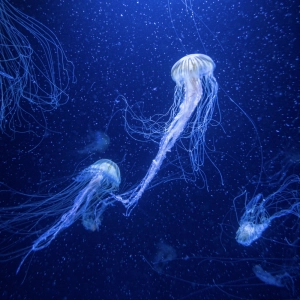
It's tempting to see bioluminescence as an oddity, one of those rare eccentricities of life on earth. And, on land, maybe that's true. But our planet is mostly water, and out in the open ocean bioluminescence is utterly commonplace. Creatures of all shapes and sorts sparkle and glow, glitter and pulse. But what are these displays for? Why did they evolve? How did light become the currency of the deep?  

My guest today is Dr. Sönke Johnsen. Sönke is a Distinguished Professor of Biology at Duke University, where he and his research group study the visual ecology of the ocean. He's the author of a number of books: most recently Into the Great Wide Ocean, about life in the pelagic realm, and The Radiant Sea, a photographic tour of bioluminescence and color, written in collaboration with Dr. Steven Haddock. 

Here, Sönke and I talk about the open ocean: the most common habitat on our planet, yet one that many people will never experience. We consider the curious distribution of bioluminescence— rare on land, exceptionally prevalent in the ocean, and all but absent in freshwater. We talk about how bioluminescence seems to have evolved—many, many times over in fact. We survey the functions of making light in the deep—from counter-illumination to courtship to revenge. Finally, we consider what Sönke takes to be the biggest remaining puzzle about bioluminescence at sea. 

Alright friends, if you're enjoying Many Minds, we ask (humbly) if you would think about rating us, reviewing us, leaving us a comment, boosting us on social media, or perhaps haranguing your friends—relentlessly—until they give us a listen. 

Without further ado, onto my conversation with Dr. Sönke Johnsen. Enjoy! 


Notes

3:30 – The scientific report by Dr. Johnsen and colleagues describing the bioluminescent octopus, Stauroteuthis syrtensis.  

12:00 – A popular article on the bristlemouth. The article reports a scientist's estimate of "as many as a dozen [bristlemouths] per square meter of ocean."

15:00 – A recent discussion of the "burglar alarm hypothesis." 

18:00 – The website for the Johnsen Lab at Duke University. 

24:00 – A chart and discussion of the depth zones of the ocean.

29:30 – A study by Séverine Martini and Steven Haddock quantifying the prevalence of bioluminescence at different depths. A popular write-up of the same study. 

33:00 – A popular article on vertical migration in the ocean, also called "diel vertical migration." A recent scientific study of the phenomenon. 

39:00 – A recent article on the evolution of bioluminescence. 

45:00 – For detailed scientific discussion of the physical basis of bioluminescence, fluorescence, and other phenomena we discuss, see Dr. Johnson's book, The Optics of Life.  

52:00 – For previous episodes on the use of sound in the animal kingdom, see here and here. For our previous episode on electroreception and electric ecology (including in marine organisms), see here.  

57:00 – For more on the functions of bioluminescence, see here. For a report of a recently discovered function of bioluminescence, see here. 

1:03:00 – An article by Dr. Johnsen about the different colors of bioluminescence present in the deep sea.

1:05:00 – A video of ostracod mating displays.  

1:08:00 – For our recent episode on cave art, see here.

1:16:00 – For our earlier episode on firefly synchronization, see here.  


Recommendations

Website and review article by Steven Haddock

The lab of Todd Oakley

Below the edge of darkness, Edie Widder


Tile art credit: Image by Georgi Kalaydzhiev via Unsplash


Many Minds is a project of the Diverse Intelligences Summer Institute, which is made possible by a generous grant from the John Templeton Foundation to Indiana University. The show is hosted and produced by Kensy Cooperrider, with help from Assistant Producer Urte Laukaityte and with creative support from DISI Directors Erica Cartmill and Jacob Foster. Our artwork is by Ben Oldroyd.

Subscribe to Many Minds on Apple, Stitcher, Spotify, Pocket Casts, Google Play, or wherever you listen to podcasts. You can also now subscribe to the Many Minds newsletter here!

We welcome your comments, questions, and suggestions. Feel free to email us at: manymindspodcast@gmail.com.

For updates about the show, visit our website or follow us on Bluesky (@manymindspod.bsky.social).


There's a quiet revolution happening in how we understand intelligence, and it's not just about humans. Many Minds, hosted by Kensy Cooperrider of the Diverse Intelligences Summer Institute, digs into this expansive idea. Each episode is a journey into the inner worlds of creatures and creations we share the planet with. You'll hear from researchers who decode the complex social minds of crows, who map the sensory universe of an octopus, or who grapple with the emerging cognition of artificial systems. This isn't a dry lecture series; it's a collection of thoughtful conversations that feel like pulling up a chair with experts who are genuinely redefining what it means to think, feel, and learn. The Many Minds podcast operates from a simple but profound premise: to grasp our own human experience, we need to listen to the many other kinds of minds around us. Tune in every other week for explorations that are as much about philosophy and wonder as they are about science and education, all grounded in rigorous research and a deep curiosity about the beings-animal, human, and artificial-that fill our world.
Author: Language: English Episodes: 50

Many Minds
Podcast Episodes
Science, AI, and illusions of understanding [not-audio_url] [/not-audio_url]

Duration: 59:47
AI will fundamentally transform science. It will supercharge the research process, making it faster and more efficient and broader in scope. It will make scientists themselves vastly more productive, more objective, mayb…
The primeval soil of play [not-audio_url] [/not-audio_url]

Duration: 56:37
Puppies wrestling and mock-biting each other. Toddlers playing hide and seek. Kittens pouncing—repeatedly—on a toy mouse. You've no doubt looked on at scenes like this with amusement. And you've no doubt seen some of tho…
The big five and beyond [not-audio_url] [/not-audio_url]

Duration: 1:46:39
If you've heard anything about the study of human personality, you've probably heard about the "big five." This is a framework that attempts to characterize human personality in terms of five broad factors or dimensions—…
Philosophers on psychedelics [not-audio_url] [/not-audio_url]

Duration: 1:40:49
Some call it the "psychedelic renaissance." In the last decade or so, interest in psychedelic drugs has surged—and not just among Silicon Valley types and psychiatrists and neuroscientists. It's also surged among a stere…
The cuttlefish and its coat of many colors [not-audio_url] [/not-audio_url]

Duration: 1:33:38
We humans have a hard time becoming invisible. For better or worse, we're basically stuck with the skin and body we have; we're pretty fixed in our color, our shape, our overall appearance. And so we're fascinated by cre…
Life, free energy, and the pursuit of goals [not-audio_url] [/not-audio_url]

Duration: 1:06:49
You've probably come across the "free energy principle." It's become one of the most influential ideas in the broader cognitive sciences. Since the neuroscientist Karl Friston first introduced it in 2005, the theory has…
Universal emotions in fact and fiction [not-audio_url] [/not-audio_url]

Duration: 1:20:22
Are human emotions universal? Or do they vary from one place to the next and from one time period to the next? It's a big question, an old question. And every discipline that's grappled with it brings its own take, its o…
From the archive: Fermentation, fire, and our big brains [not-audio_url] [/not-audio_url]

Duration: 1:05:36
Hi friends, We're taking care of some spring cleaning this week. We'll be back in two weeks with a new episode. In the meantime, enjoy this favorite from our archives! - The Many Minds team ––––––––– [originally aired Fe…
Howl, grunt, sing [not-audio_url] [/not-audio_url]

Duration: 1:13:38
The tree of life is a noisy place. From one branch come hoots and howls, from another come clicks and buzzes and whines. And coming from all over you hear the swell of song. But what is all this ruckus about? Why do so m…
The development of evolution [not-audio_url] [/not-audio_url]

Duration: 1:36:43
Evolution is not what it used to be. A lot has changed since Darwin's day. In the first half of the 20th century, evolutionary theory was integrated with an emerging understanding of genetics. Late in the 20th century, b…