MDT Ep. 73: Concerning a Mouse and a Frog

MDT Ep. 73: Concerning a Mouse and a Frog

Author: Medieval Death Trip May 28, 2019 Duration: 1:02:48
This episode, we turn to another genre of wisdom literature: the fable. We look at four versions of the fable of the Mouse and the Frog from across one-and-a-half millennia, with quasi-classical versions from the Vita Aesopi and the Romulus Aesop and medieval elaborations on the story by Marie de France and Robert Henryson. Today's Texts: Life of Aesop. Translated by Anthony Alcock, Roger-Pearse.com, 4 Aug. 2018, https://www.roger-pearse.com/weblog/2018/08/14/life-of-aesop-translated-by-anthony-alcock/. "The Mouse and the Frog." The Comedies of Terence and The Fables of Phædrus, translated by Henry Thomas Riley, George Bell & Sons, 1891, p. 456. Google Books. Marie de France. "The Mouse and the Frog." The Fables of Marie de France, translated by Mary Lou Martin, Summa Publications, 1984, pp. 36-42. Henryson, Robert. "The Taill of the Paddok and the Mous." The Poems and Fables of Robert Henryson, edited by David Laing, William Paterson, 1865. Google Books. References: Adrados, Francisco Rodríguez. History of the Graeco-Latin Fable. Translated by Leslie A. Ray, vol. 1, Brill, 1999. Daly, Lloyd W., translator and editor. Introduction. Aesop Without Morals, Thomas Yoseloff, 1961, pp. 11-26. Fox, Denton, editor. The Poems of Robert Henryson. Clarendon Press, 1981. Kiser, Lisa J. "Resident Aliens: The Literary Ecology of Medieval Mice." Truth and Tales: Cultural Mobility and Medieval Media, edited by Fiona Somerset and Nicholas Watson, Ohio State UP, 2015, pp. 151-167. Academia.edu, www.academia.edu/11171687/Resident_Aliens_The_Literary_Ecology_of_Medieval_Mice. Jacobs, Joseph. The Fables of Aesop. Vol. 1, History of the Æsopic Fable, 1889, Burt Franklin, 1970. Mann, Jill. From Aesop to Reynard: Beast Literature in Medieval Britain. Oxford UP, 2009. Martin, Mary Lou. Introduction. The Fables of Marie de France, translated by Mary Lou Martin, Summa Publications, 1984, pp. 1-30. O'Connor, Flannery. "Writing Short Stories." Mystery and Manners, FSG, 1970, pp. 87-106. Skillen, Anthony. "Aesop's Lessons in Literary Realism." Philosophy, vol. 67, no. 260, Apr. 1992, pp. 169-181. JSTOR, www.jstor.org/stable/3751449. [Greek text of the fable in the Vita Aesopi, Ch. 21:] Vita Aesopi. Edited by Antonius Westermann, Williams and Norgate, 1845, p. 54. Google Books. [Romulus Latin Text in:] "Mus et Rana." Phaedri Fabularum Aesopiarum libri quinque, quales omni parte illustratos publicavit Joann. Gottlob. Sam. Schwabe. Accedunt Romuli Fabularum Aesopiarum libri quatuor, quibus novas Phaedri Fabellas cum notulis variorum et suis subjunxit, edited by J. B. Gail, vol. 2, 2nd ed., N.E. Lemaire, 1826, p. 386. Google Books. Music by Chris Lane.

Step into the strange and vivid world of the Middle Ages with Medieval Death Trip. Each episode is built around a single primary source-a chronicle, a poem, a letter, or a legal record-that reveals something peculiar, grim, or wonderfully unexpected from the period. The chosen texts are the real draw, offering unmediated glimpses into a mindset that can feel both alien and strangely familiar. You’ll hear about bizarre miracles, brutal justice, mystical visions, and the quiet, odd details of daily life that history books often overlook. After presenting the document in full, the host provides context and personal reflections, piecing together what the story might tell us about the people who wrote it and the world they inhabited. This isn’t a dry academic lecture; it’s more like a guided tour through the archives, pointing out the bloodstains and the marginal doodles with equal fascination. The podcast lives in the intersection of several genres, pulling from history, literature, and cultural study to examine how medieval people made sense of their reality. Listening feels like uncovering a series of forgotten artifacts, each one a conversation starter about belief, violence, humor, and humanity. For anyone curious about history’s shadowy corners and the raw, unfiltered voices of the past, this series provides a consistently engaging and thought-provoking journey. The approach is both serious and accessible, treating these centuries-old accounts with respect while never shying away from their inherent strangeness. Tune in for a deep dive into the archives, one unsettling and fascinating story at a time.
Author: Language: English Episodes: 100

Medieval Death Trip
Podcast Episodes
St. Patrick's Letter to Coroticus [not-audio_url] [/not-audio_url]

Duration: 26:23
For this St. Patrick's Day, we finally present the last canonical text written by St. Patrick, his letter to Coroticus, completing the series we began in Episode 68 with the first half of Patrick's Confessio. Today's Tex…
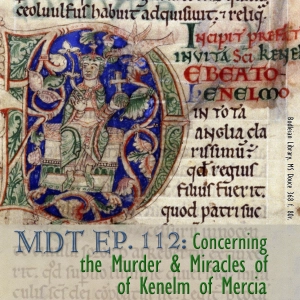
Concerning the Murder and Miracles of Kenelm of Mercia [not-audio_url] [/not-audio_url]

Duration: 46:22
This episode, we go into more depth with the legend of St. Kenelm (Cynehelm) and his jealous sister Quendrida (Cwenthryth). We also learn what it means to "crab the parson." Today's Text - "The Legend of St. Kenelm." Tra…
Concerning Conjoined Twins, Some Incorruptibles, and Royal Murders [not-audio_url] [/not-audio_url]

Duration: 56:09
We continue on from last episode's look at the Green Children of Woolpit with a further consideration of what it meant to wonder at a marvel in the middle ages, with additional illustration of some wondrous things from W…
Concerning the Green Children of Woolpit and Other Prodigies [not-audio_url] [/not-audio_url]

Duration: 1:03:59
This Halloween marks our 10th anniversary, and we observe it by hearing the earliest written accounts of one of the most well-known pieces of medieval weird history: the Green Children of Woolpit -- and also hear the oth…
Concerning the Miseries of the Flesh according to Pope Innocent III [not-audio_url] [/not-audio_url]

Duration: 53:36
In this episode, we explore the tradition of contemptus mundi with a text all about how horrible it is to be a human being, On the Misery of the Human Condition, written by Pope Innocent III (when he was but Cardinal Lot…
MDT Ep. 106: Concerning the Hard Work of a Housewife [not-audio_url] [/not-audio_url]

Duration: 42:49
For Mother's Day, we look at a 15th-century tale of a plowman who thinks that -- in terms of daily labor -- his wife has it too easy, and how he learns otherwise. Today's Text "Ballad of a Tyrannical Husband." Reliquiae…
MDT Ep. 105: Concerning the Voice of the Golem [not-audio_url] [/not-audio_url]

Duration: 1:47:59
We kick of 2024 with a look at humanity's attempts to recreate itself, first with a dip into the legends of the Golem of Prague, and then an extended discussion of the role of AI in the future of medieval studies and par…
MDT Ep. 104: Concerning the Abacus and Succubus of Gerbert d'Aurillac [not-audio_url] [/not-audio_url]

Duration: 58:37
We conclude our miniseries comparing the legends to the real life of Gerbert d'Aurillac: mathematician, pope, and alleged magician. Today's variant of the Dark Legend comes from Walter Map, and we follow that with a look…