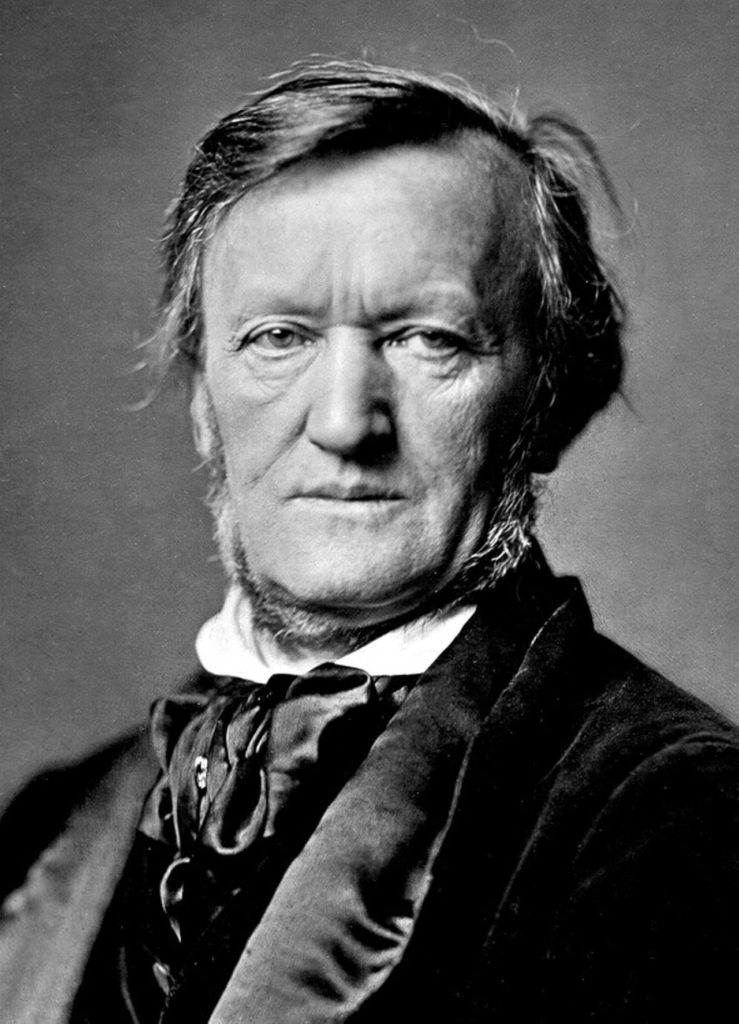
We mark the death, on February 13, 1883 – 140 years ago today – of the German composer Richard Wagner, in Venice, at the age of 69. He had been born in the Saxon city of Leipzig on May 22, 1813.
Wagner’s Health
Writing in Hektoen International – A Journal of Medical Humanities, George Dunea, MD, states that:
“[Richard] Wagner was an extraordinarily highly strung individual.”
Do you think, Dr. Dunea?
In fact, he was a pathologically overwrought individual, a certifiable narcissist who required maximum stimulation at all times whether he was awake or asleep. (Yes, even asleep. As a young child he kept his many siblings awake at night by shouting and talking while he slept.)
Wagner was not born a particularly healthy person, and as an adult, his personal habits and constant excitability exacted a considerable toll on his already compromised constitution.
Writing in the Journal of the American Medical Association back in 1903 (Gould, George M.; The Ill-health of Richard Wagner, JAMA 1903; 51: 293 and 368; as articles go, this is an oldie but a goodie!), Dr. George Gould described Wagner as having the collective symptoms of:
“[Thomas] DeQuincy [best known for his Confessions of an English Opium-Eater]; [Thomas] Carlisle; [Charles] Darwin, [Thomas Henry] Huxley; [Robert] Browning, [Herbert] Spencer, and [James] Parkinson all together and all at once.”
The illnesses shared by these illustrious individuals included migraine headaches, severe gastric issues, anxiety, depression, and insomnia. They were all workaholics who, according to Dr. Gould, drove themselves until they were:
“threatened either by disease or by despair.”
From childhood on, Wagner suffered recurrent skin disease that has been variously diagnosed as eczema or erysipelas. He suffered from what were likely migraine headaches his entire life, complaining about “the nerves of his brain.” As an adult he suffered from depression and severe anxiety, and thought obsessively about death. (As early as 1852, as a young man of 39, he wrote: “I am daily thinking of my death.”)
He was an insomniac and subject to rheumatic pains and constant gastric discomforts. Physically, he was a mess. But migraines and dyspepsia were not likely to kill Wagner, as opposed to his problems with his heart.
Those problems began in December of 1873, when Wagner was 60, at a time when he was desperately trying to put together the funding for his Bayreuth Festival, his grand monument to himself and his art (more on the festival in just a moment). The anguish and stress he put himself through and the anxiety and depression he experienced began to affect his heart. (According to Wagner’s wife Cosima, writing in her diary:
“by starting the festival, he signed his own death-warrant; he seldom had a good night and his attacks of cramp about the heart became more and more frequent.”)
The Bayreuth Festival
The Bayreuth Festival – held in the picturesque, medieval Bavarian city of Bayreuth in southern Germany – is an annual music festival/Wagner lovefest dedicated to performing the works of Richard Wagner his very self.…
Every week, Music History Monday arrives with the kind of curiosity that turns dates on a calendar into doorways. Hosted by composer and historian Robert Greenberg, this podcast digs into the stories that happened *around* the music, finding the human moments-sometimes profound, sometimes scandalous, always fascinating-tied to a specific Monday. Greenberg approaches his subjects not as distant icons but as the complicated, brilliant, and often messy people they were, which makes each episode feel like a conversation rather than a lecture. You’ll hear about pivotal premieres, bitter rivalries, unexpected inspirations, and the sheer luck or misfortune that shaped the pieces we know today. The tone is erudite but never dry, packed with context and delivered with a wit that respects the art without putting it on a sterile pedestal. It’s for anyone who loves a good story and suspects that the history behind a symphony or a sonata is just as compelling as the notes themselves. Tune in each Monday with Robert Greenberg to connect the dots between a day in history and the soundtrack it inspired.
Author: Robert Greenberg
Language: en-us
Episodes: 100
Giovanni Gabrieli (circa 1555-1612) We mark the death on August 12, 1612 – 412 years ago today – of the composer Giovanni Gabrieli. Born in Venice circa 1555, he grew up and spent his professional life in that glorious c…