
Music History Monday: Gioachino Rossini and the Comedic Mind

Music History Monday: Gioachino Rossini and the Comedic Mind

Author: Robert Greenberg November 13, 2023 Duration: 19:54
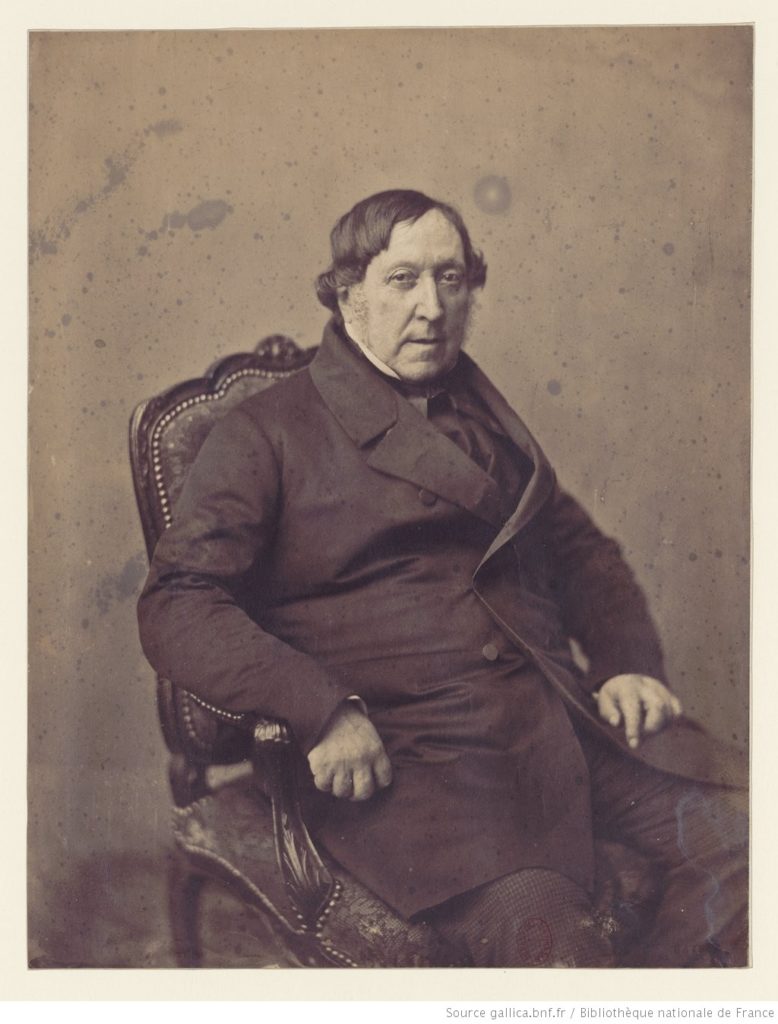
Gioachino Antonio Rossini (1792-1868)” circa 1856
Gioachino Antonio Rossini (1792-1868) circa 1856

We mark the death on November 13, 1868 – 155 years ago today – of the opera composer Gioachino Antonio Rossini, in Paris, at the age of 76. He was one of the most famous and beloved artists of his time, and he remains no less so today. It is my humble opinion that anyone who does not like Rossini’s operas – and, believe it or not, I have met any number of such people in the “rarified” confines of academia – well, such a person is a crank and a humbug, someone averse to melodic brilliance, theatric sparkle, and wit.

10,000 Hours?

In his book Outliers: The Story of Success (Little, Brown and Company, 2008), the English-born Canadian journalist (and staff writer at The New Yorker) Malcolm Gladwell posited his “10,000-hour rule.” Gladwell’s 10,000-hour rule asserts that:

“the key to achieving true expertise in any skill is simply a matter of practicing, albeit in the correct way, for at least 10,000 hours.”

Of course this is complete nonsense. We must conclude that Mr. Gladwell has practiced making absurd statements for well over 10,000 hours, so completely daft is his “rule.” Listen: when I was twenty, I was 5’7” in height and weighed 145 pounds (I can only wish that the latter were still the case!). I was strong, fast, and had good hand-eye coordination. I also had a vertical jump of about six inches, so no amount of time and practice was going to make me a high-jump champion, a ballet dancer, or allow me to fulfill my singular fantasy: to be able to dunk a basketball.

No way, no how.

Alicia de Laroccha
Alicia de Laroccha (1923-2009)

The magnificent Spanish pianist Alicia de Laroccha (1923-2009) is said to have learned and memorized in twelve days – when she was but a child – the twelve pieces that make up Isaac Albéniz’s incredibly virtuosic Iberia.  All 12 pieces in 12 days; one piece a day. Again, I would, gratuitously, use myself as an example: I have “practiced” the piano for many more than 10,000 hours over the course of my life, and there no way on this good earth that I could learn and memorize any one piece from Iberia in under two weeks, if at all.

Again, no way, no how.

It is an unfortunate but irrefutable fact that genetic predisposition – meaning talent – counts for something as well. Yes, talent must be nurtured and “practiced,” but without it, Malcolm Gladwell’s 10,000 hours means bupkis (which is Yiddish for “goat droppings”).

Rossini in 1862, photographed in Passy (Paris), where he lived (and died) in a no longer extant villa at 2 Avenue Ingrès

Wit

I would suggest that among the gene-given abilities most impossible to “learn” – practice time notwithstanding (along with being able to dunk a basketball) – is wit, which is defined by the Oxford Dictionary as:

“a natural aptitude [i.e. talent] for using words and ideas in a quick and inventive way to create humor.”

When it comes to wit, you either got it or you don’t. Practicing bon mots for 10,000 hours will not make a tedious bore a witty person. (I personally find few social situations more awkward than being trapped in conversation with someone who thinks he or she is really clever but is, in fact, not clever at all. To paraphrase the old saw, “’tis better to remain silent and be thought a witless blockhead than to open one’s mouth and prove it.”)

Gioachino Rossini was, bless him, pretty much always the wittiest person in the room. Yes, other composers were famous for their quips as well; the acid-tongued Johannes Brahms and the easily irritated Arnold Schoenberg immediately come to mind. (Brahms was reputed to have left a party by standing at the door and bellowing, “if there’s anyone here I haven’t insulted, I apologize!”; the equally caustic Arnold Schoenberg wrote to a friend, telling him “I hope you weren’t stupid enough to be offended by what I said!”

Great lines both. But not as great as Rossini’s best lines.)…

Continue reading, and listen without interruption, on Patreon!

Become a Patron!
 

Listen and Subscribe to the Music History Monday Podcast

The Robert Greenberg Best Sellers

The post Music History Monday: Gioachino Rossini and the Comedic Mind first appeared on Robert Greenberg.


Every week, Music History Monday arrives with the kind of curiosity that turns dates on a calendar into doorways. Hosted by composer and historian Robert Greenberg, this podcast digs into the stories that happened *around* the music, finding the human moments-sometimes profound, sometimes scandalous, always fascinating-tied to a specific Monday. Greenberg approaches his subjects not as distant icons but as the complicated, brilliant, and often messy people they were, which makes each episode feel like a conversation rather than a lecture. You’ll hear about pivotal premieres, bitter rivalries, unexpected inspirations, and the sheer luck or misfortune that shaped the pieces we know today. The tone is erudite but never dry, packed with context and delivered with a wit that respects the art without putting it on a sterile pedestal. It’s for anyone who loves a good story and suspects that the history behind a symphony or a sonata is just as compelling as the notes themselves. Tune in each Monday with Robert Greenberg to connect the dots between a day in history and the soundtrack it inspired.

Author: Language: en-us Episodes: 100

Music History Monday
Podcast Episodes
