We mark the death on January 16, 1864 – 159 years ago today – of Anton Felix Schindler, in Frankfurt, at the age of 68. Born on June 13, 1795, in the town of Medlov in today’s Czech Republic, Schindler was, for a time, Beethoven’s “factotum”: his secretary and general assistant. He was also a scoundrel and a profiteer, who after Beethoven’s death lied about his relationship with Beethoven, stole irreplaceable objects and documents from Beethoven’s estate, and falsified and destroyed many of those documents (some of which he later sold off) in order to make himself look better in the eyes of history. Boo-hoo for Schindler: the “making-himself-look-better-in-the-eyes-of-history” thing didn’t work, and today he is regarded as the patron saint of lying and thieving employees.
Among the Beethovenian documents Anton Schindler took upon himself to “remove for safekeeping” were Beethoven’s so-called “Conversation Books.”
Beethoven’s Conversation Books
Ludwig van Beethoven (1770-1827) in 1803
It took an agonizingly long time for Beethoven to go completely deaf. His hearing loss began in 1796, in his 26th year: a buzzing in his ears and a slow but progressive loss of high frequency hearing. By the fall of 1802, Beethoven had cut himself off from much of his world out of fear his infirmity would be discovered. Having been assaulted by doctors and the useless (and often painful) remedies they prescribed, Beethoven had come to realize that his condition was incurable and irreversible, and he considered suicide. But he survived his crisis by convincing himself that like the great man of his age – Napoleon Bonaparte (1767-1821) – he (Beethoven) would struggle against his “enemies” (fate, despair, and physical disability) and emerge victorious through his music!
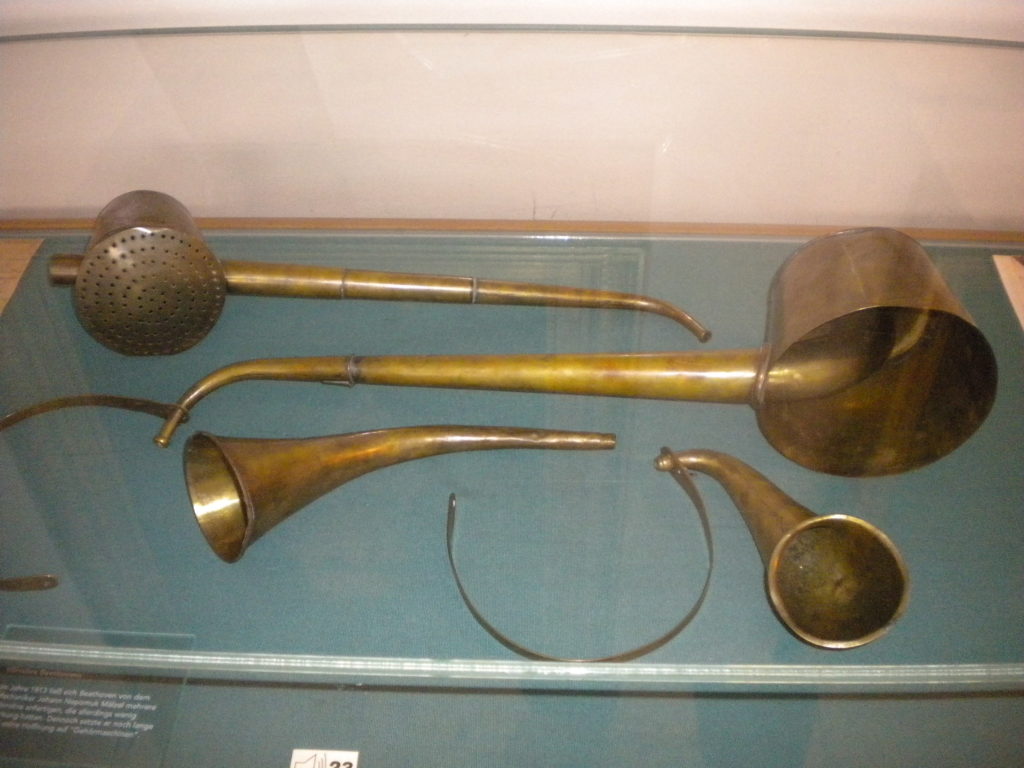
Beethoven’s ear-trumpets, as displayed at the Beethoven Haus Museum in Bonn
Beethoven was still playing the piano in public and attempting to conduct as late as 1812. Between 1816 and 1818 he employed various ear-trumpets built for him by his erstwhile friend (and the presumed inventor of the metronome) Johann Nepomuk Mälzel (1772-1838).
Sadly, by 1818 Beethoven’s deafness had advanced to the point where the ear-trumpets had become useless.
From 1818 to 1827 (the year of his death), Beethoven carried around blank books in which friends and acquaintances could write down their side of a conversation, conversations during which Beethoven would speak out loud. Beethoven also used the books for “private” purposes: to jot down notes and ideas, drafts for letters and other documents, shopping lists, and even some brief compositional sketches. …
Every week, Music History Monday arrives with the kind of curiosity that turns dates on a calendar into doorways. Hosted by composer and historian Robert Greenberg, this podcast digs into the stories that happened *around* the music, finding the human moments-sometimes profound, sometimes scandalous, always fascinating-tied to a specific Monday. Greenberg approaches his subjects not as distant icons but as the complicated, brilliant, and often messy people they were, which makes each episode feel like a conversation rather than a lecture. You’ll hear about pivotal premieres, bitter rivalries, unexpected inspirations, and the sheer luck or misfortune that shaped the pieces we know today. The tone is erudite but never dry, packed with context and delivered with a wit that respects the art without putting it on a sterile pedestal. It’s for anyone who loves a good story and suspects that the history behind a symphony or a sonata is just as compelling as the notes themselves. Tune in each Monday with Robert Greenberg to connect the dots between a day in history and the soundtrack it inspired.
Author: Robert Greenberg
Language: en-us
Episodes: 100
Anton Bruckner (1824-1896) in 1896, wearing the Order of Franz Joseph, in a portrait by Josef Büche We mark the birth on September 4, 1824 – 199 years ago today – of the composer and organist Josef Anton Bruckner, in the…