Fanny Mendelssohn-Hensel (1805-1847), drawn by her Husband Wilhelm Hensel (1794-1861) in 1829, the year they were married
We mark the birth on November 14, 1805 – 217 years ago today – of the German composer, pianist, wife, mother, and hausfrau Fanny Mendelssohn-Hensel, in the Hanseatic city of Hamburg. She died on May 14, 1847, all-too-young at the age of 41, at her home in the Prussian capital of Berlin.
Fanny Cäcille Mendelssohn was the first child (of an eventual four) of Lea and Abraham Mendelssohn. Lea Mendelssohn took one look at her infant daughter’s hands and famously exclaimed:
“Look! She has Bach fugue hands.”
And that she did.
The next Mendelssohn child was born three years and three months later, Fanny’s baby brother – the “genius” – Felix Mendelssohn (1809-1847).
“Genius”
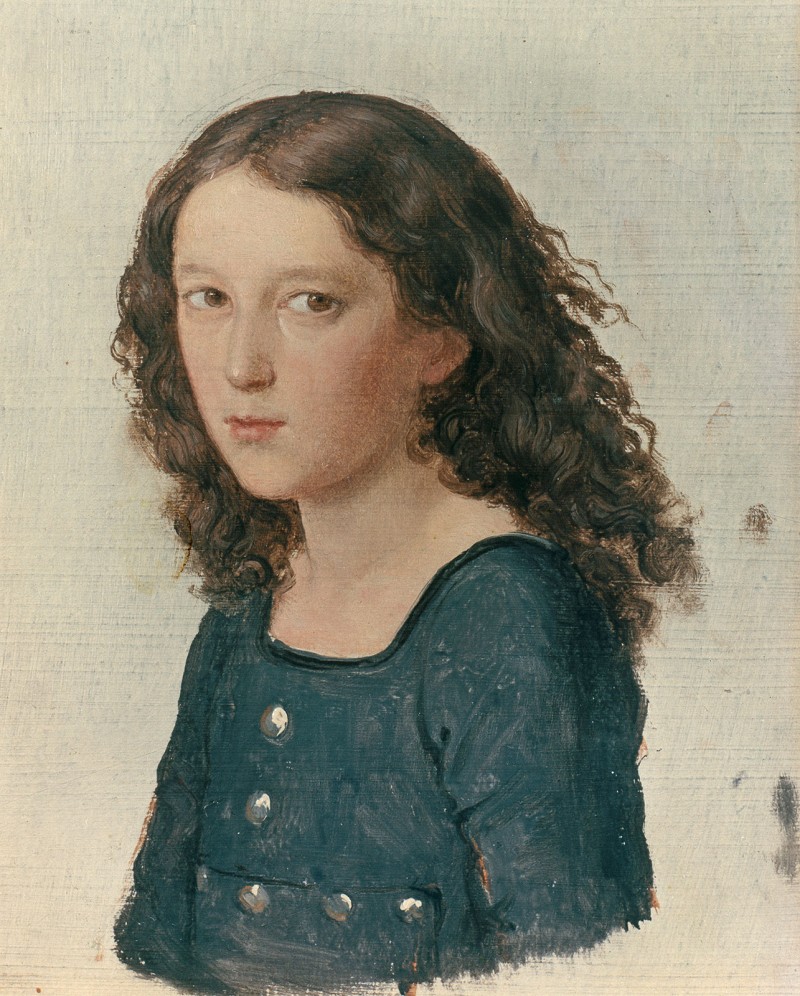
Felix Mendelssohn (1809-1847) in 1821 at the age of 12, by Carl Joseph Begas
The word “genius” is so overused as to be almost useless. Nevertheless, it is necessary that we define it and then discuss an aspect its usage.
Definition. Admittedly, while there is no precise, scientific way to measure and define genius, the following definition, by Walter Isaacson, will do. (Isaacson “knows” genius; his biographies of Albert Einstein, Benjamin Franklin, Steve Jobs, and Leonardo da Vinci are must reads.)
“Genius is a characteristic of original and exceptional insight in the performance of some art or endeavor that surpasses expectations, sets new standards for future works, establishes better methods of operation, or remains outside the capabilities of competitors. Genius is associated with intellectual ability and creative productivity, and may refer to a polymath who excels across diverse subjects.”
A most intriguing question: when was the last time any of us heard of a woman being referred to as a “genius”?
Before setting out to write this blog, I’d never asked myself that question. But after a proper bit of brain wracking, my personal answer is never.
Dr. Katherine Johnson (1918-2020) in 1966
Yes, Marie Curie (1867-1934) remains the only woman to have won the Nobel Prize twice. (Perhaps Walter Isaacson would consider writing a biography of Madame Curie?) The actress Hedy Lamar (1914-2000) was a self-taught inventor who, among many other things, helped create frequency-hopping, a technology that today lies at the heart of wi-fi and Bluetooth. As a mathematician for NASA, it was Dr. Katherine Johnson (1918-2020) who calculated the flight paths for the Apollo moon missions.
I could go on, but I don’t need to, because whatever we choose to call them, there always have been and always will be geniuses that are women. The issues for us, right now, are, one, whether or not their societies allow women to develop their genius and two, whether their societies are willing to designate them as being geniuses.
Alas, male-dominated societal machinations have traditionally conspired against smart women. Sadly, it’s an undeniable fact: such women have historically been perceived as presenting a threat to patriarchal order, and were kept at home, there to protect the patrilinear family. As such, writes Françoise Tillard:
“the notion of ‘genius’ belongs to a world of masculine concepts that do not include female creativity.”
The distinction between “talent” and “genius” was formulated by German writers and philosophers in the eighteenth century. By the nineteenth century, the prestigious French Le Robert Dictionary defined “genius” (génie) as (the following italics are mine):
“a superior aptitude of the mind that lifts a man above the common measure and renders him capable of creations, inventions and undertakings which seem extraordinary or superhuman to his peers.”
“Man”, “him”, and “his.” This is not just old-style pronoun usage. It is a mindset that takes as an ironclad given that men create and women procreate, and never shall that twain meet!…
Every week, Music History Monday arrives with the kind of curiosity that turns dates on a calendar into doorways. Hosted by composer and historian Robert Greenberg, this podcast digs into the stories that happened *around* the music, finding the human moments-sometimes profound, sometimes scandalous, always fascinating-tied to a specific Monday. Greenberg approaches his subjects not as distant icons but as the complicated, brilliant, and often messy people they were, which makes each episode feel like a conversation rather than a lecture. You’ll hear about pivotal premieres, bitter rivalries, unexpected inspirations, and the sheer luck or misfortune that shaped the pieces we know today. The tone is erudite but never dry, packed with context and delivered with a wit that respects the art without putting it on a sterile pedestal. It’s for anyone who loves a good story and suspects that the history behind a symphony or a sonata is just as compelling as the notes themselves. Tune in each Monday with Robert Greenberg to connect the dots between a day in history and the soundtrack it inspired.
Author: Robert Greenberg
Language: en-us
Episodes: 100
Frontispiece to the Harmonice musices odhecaton A, published on May 15, 1501 On May 15, 1501 – 522 years ago today – the first polyphonic (that is, multi-part) music printed using moveable type was released to the public…