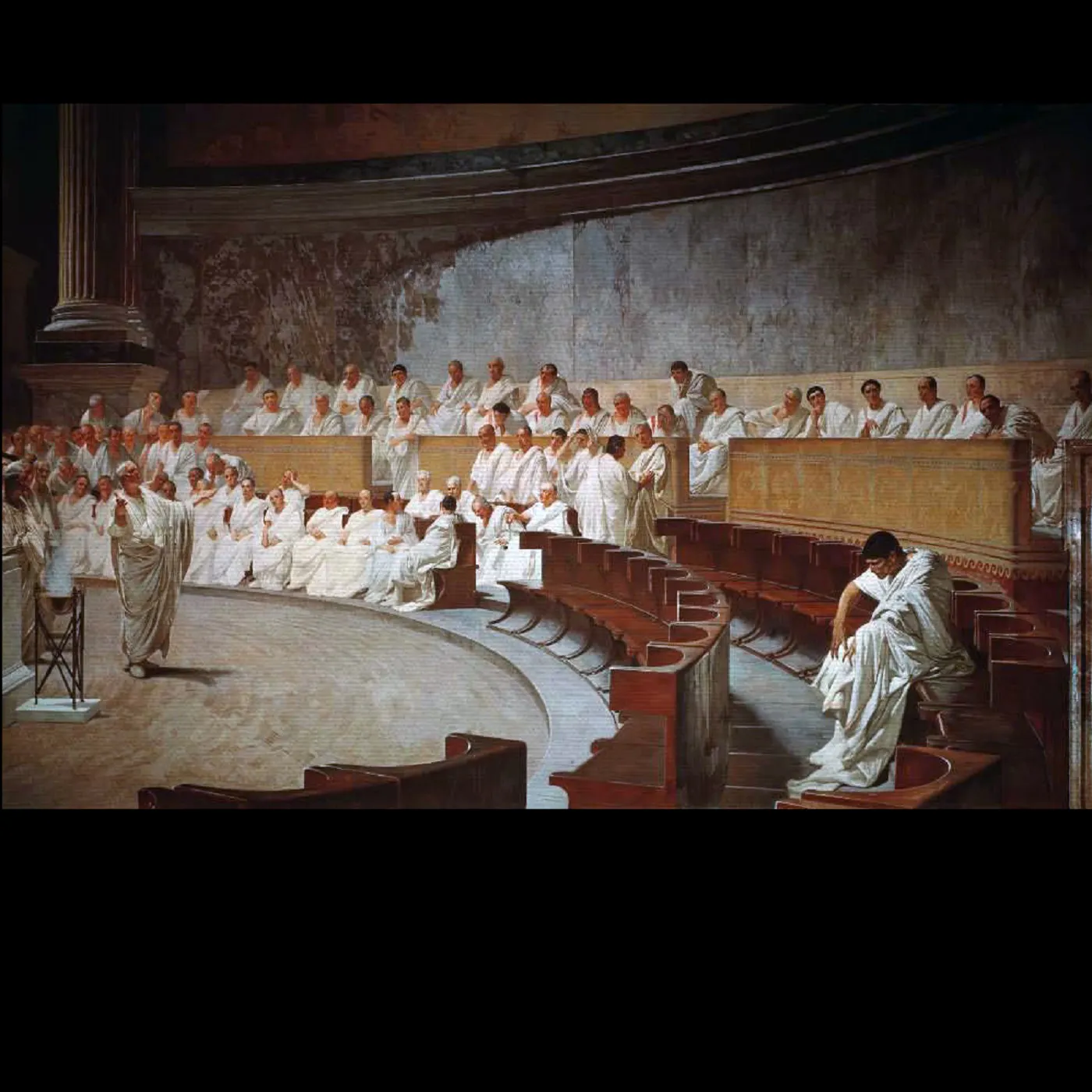
WHAT WOULD CICERO SAY? Interview with Professor Rob Goodman of Ryerson University on Speech Issues, Modern and Ancient
Author: Bruce Carlson
August 30, 2024
Duration: 39:24
Through most of American history, calling someone a Cicero was the highest democratic honor. John Adams wrote of the Roman orator, that “as all the ages of the world have not produced a greater statesman and philosopher united in the same character, his authority should have great weight.” Thomas Jefferson said Cicero was “the father of eloquence and philosophy” John Quincy Adams dramatically said that if he did not have book of Cicero at hand it was having to live without "of one of my limbs.” And a young Abraham Lincoln reading from a borrowed library benefited greatly from his works, as well as others.
We talk to Ryerson University professor of politics and author of Words on Fire Rob Goodman about these topics. Through close readings of Cicero – and his predecessors, rivals, and successors – political theorist and former speechwriter Rob Goodman tracks the development of this ideal, in which speech is both spontaneous and stylized, and in which the pursuit of eloquence mitigates political inequalities.
For Cicero, speech was essential. More than just talking or Cicero referred to speech as “what has united us in the bonds of justice, law, and civil order, this that has separated us from savagery and barbarism”. Speech was to Cicero a sign of humanity’s inherently communal and cooperative nature and one of our greatest tools in creating a prosperous life for ourselves.
"Be no Atticus," John Quincy Adams told his good friend Charles Sumner when he thought he got to reclusive and too bookish and didn't get out there in the debate. He almost could of said, "be more like Atticus's friend Cicero!" Cicero took part in debate, spoke to defend the republic and celebrated those who did.
Rob Goodman's book Words on Fire is available here - https://www.cambridge.org/core/books/words-on-fire/FEB517ABF09F8A067773B2F563F45150
We are part of Airwave Media Network. Check out the other shows there - airwave media.com
Advertise on our podcast - sales@advertisecast.com
Learn more about your ad choices. Visit megaphone.fm/adchoices