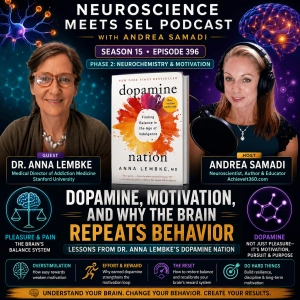
Dopamine, Motivation and Why the Brain Repeats Behavior with Dr. Anna Lembke
Author: Andrea Samadi
May 24, 2026
Duration: 23:26
Host Andrea Samadi welcomes Dr. Anna Lembke to explain how pleasure and pain share the same neural circuitry and how dopamine governs motivation. The episode explores why overconsumption of easy rewards dulls motivation, creates withdrawal-like deficits, and shifts the brain toward pain.
Through clear takeaways—delay borrowed rewards, try temporary abstinence, create friction for temptations, and practice purposeful effort—the episode shows how recalibrating the brain’s reward system restores enjoyment in ordinary activities and builds sustainable motivation.
Welcome back to Season 15 of the Neuroscience Meets Social and Emotional Learning Podcast.
I'm Andrea Samadi, and on this podcast, we bridge the science behind social and emotional learning, emotional intelligence, and practical neuroscience so we can create measurable improvements in well-being, achievement, productivity, and results.
Season 15 Orientation
This season, we're exploring what I call:
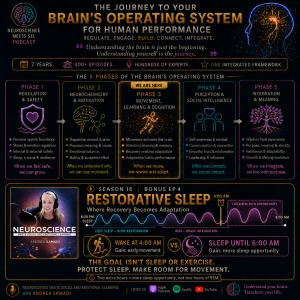
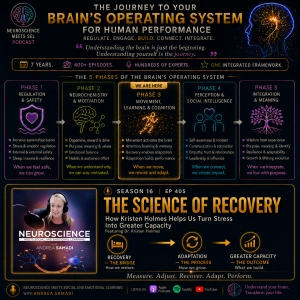
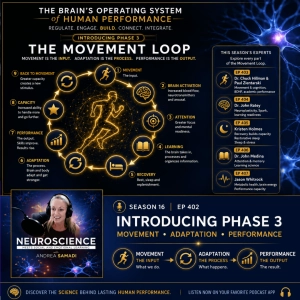
The Brain's Operating System for Human Performance.
Instead of looking at neuroscience, health, learning, motivation, and emotional intelligence as separate topics, (like we did for the past 14 seasons) we're exploring how these systems come online in sequence.
Each phase builds on the one before it:
✔ Phase 1 — Regulation & SafetyIs the nervous system safe enough to learn?
✔ Phase 2 — Neurochemistry & MotivationWhat drives behavior, focus, and sustained effort?
✔ Phase 3 — Movement, Learning & Cognition
✔ Phase 4 — Perception, Emotion & Social Intelligence
✔ Phase 5 — Integration, Insight & Meaning
By the end of this year my hope is that we can step back and ask:
Where am I out of alignment?
Is it regulation?
Is it my thinking?
Is it my focus? Or Belief?
Is it how I’m learning or connecting with others?
Or do I need some work with integration, insight and meaning?
Because once we can see our gap…
We can begin to close it.
“The goal is not more effort—it’s better alignment.”
“And when these systems are aligned…
Effort feels easier
Learning becomes faster
And results become more consistent
Because peak performance is not about doing more.
It’s about aligning the systems that drive our results.
Recap Where We've Been
In EP 392[i], we introduced the Motivation Loop and explored how the brain decides what is worth doing.
In EP 393[ii], we looked at how our beliefs trigger neurochemistry that drives action, feedback, and repetition.
In EP 394[iii] we looked at how our thought patterns impact our neurochemistry and results with Dr. Caroline Leaf.
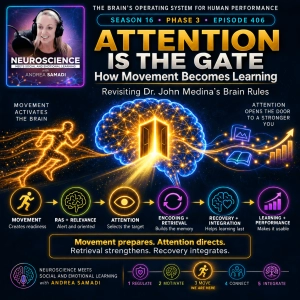
Then in EP 395[iv], reviewing Dr. John Medina's work on Theory of Mind, we explored something equally important:
The brain pays attention to what it believes matters.
Dr. Medina showed us that attention and reward are deeply connected.
When the brain predicts something will be valuable, relevant, or meaningful, attention increases.
And when attention and reward align:
✔ Learning improves
✔ Memory strengthens
✔ Motivation increases
✔ Behaviors become repeatable
But that leaves us with an important question:
What creates that sense of reward in the first place?
What makes the brain continue pursuing something?
What makes us stay motivated and what makes us lose interest?
And why can effort sometimes feel rewarding—and other times feel exhausting?
Today's Episode
To answer those questions, we're turning to Dr. Anna Lembke, author of the book: Dopamine Nation who we first met September 2021 on EP 162.[v]
Her work helps to explain the neurochemical engine underneath the Motivation Loop that we’ve been covering.
While John Medina helped us understand how attention and reward influence learning, Dr. Lembke helps us understand:
✔ Why the brain seeks reward
✔ How dopamine drives motivation
✔ Why pleasure and pain operate on the same neural system
✔ And what happens when the balance gets disrupted
Because the real goal isn't simply just feeling good.
The goal is understanding how the brain learns to associate eff