PART 2: Review of Wallace D. Wattles The Science of Getting Rich on ”Thinking and Acting in a Certain Way” Chapter 4
Author: Andrea Samadi
December 11, 2023
Duration: 34:34
“A man’s mind may be likened to a garden, which may be intelligently cultivated or allowed to run wild: but whether cultivated or neglected, it must, and will, bring forth. If no useful seeds are put into it, then an abundance of useless weed-seeds will fall therein, and will continue to produce their kind. Just as a gardener cultivates his plot, keeping it free from weeds, and growing flowers and fruits which he requires, so may a man tend the garden of his mind, weeding out all the wrong, useless, and impure thoughts, and cultivating toward perfection the flowers and fruits of right, useful and pure thoughts. By pursuing this process, a man sooner or later discovers that he is the master-gardener of his soul, the director of his life.” (James Allen, As a Man Thinketh, 1902).[i]
On today's episode #315 and PART 2 of our REVIEW of Wallace D. Wattles The Science of Getting Rich, we will cover:
✔ REVIEW PART 1: Prosperity Thinking vs Poverty Thinking.
✔ Why are our thoughts so important for our results?
✔ Why are Chapters 4/14/7 important chapters for unlocking the "secrets" for wealth and abundance?
✔ Why must we THINK and ACT in a Certain Way to achieve certain results in our life?
✔ A look at 2 types of thinking with famous examples.
✔ 3 STEPS for changing our Money Mindset.
Which brings us to chapter 4 of Wallace D. Wattles’ The Science of Getting Rich, published in 1910.
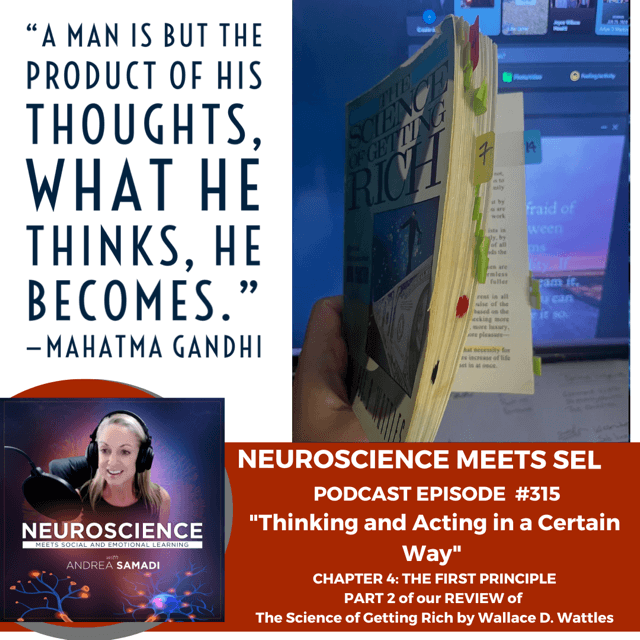
“A man is but the product of his thoughts. What he thinks, he becomes.” Mahatma Ghandi (an Indian lawyer who inspired movements for civil rights and freedom across the world).
Bringing us to PART 2 of our Deep Dive into Wallace D. Wattles’ The Science of Getting Rich.
Welcome back to The Neuroscience Meets Social and Emotional Learning Podcast, where we connect the science-based evidence behind social and emotional learning (that’s finally being taught in our schools today) and emotional intelligence training (used in our modern workplaces) for improved well-being, achievement, productivity and results—using what I saw as the missing link (since we weren’t taught this when we were growing up in school), the application of practical neuroscience. I’m Andrea Samadi, an author, and an educator with a passion for learning and launched this podcast 5 years ago with the goal of bringing ALL the leading experts together (in one place) to uncover the most current research that would back up how the brain.
On today’s episode #315 we launch into a Deep Dive of Wallace D. Wattles The Science of Getting Rich starting with Chapters 4/14/7. If you look at the image in the show notes, you will see a TABBED and very well-read Science of Getting Rich book. This was the book I sent to Paranormal Researcher, Ryan O’Neill from Scotland, UK over 10 years ago, instructing him to read this book, starting with Chapters 4/14/7[ii] for 90 days. He sent me this image of his book, all these years later, well-read and marked up, and his results (that we cover on our interview with Ryan on EP #203[iii]) are a byproduct of him doing things in this certain way, beginning with Chapter 4, The First Principle in the Science of Getting Rich that we will cover today. Next, we’ll move onto chapter 14 on The Impression of Increase that is by far my favorite chapter in this book. I love watching this principle in action in others, and then learning to practice this myself has been something that I think has given me some depth with my character over the years. We’ll move back to Chapter 7 on Gratitude, that ties all these chapters together, before reviewing the other chapters of this book, and coming up with some action steps for implementing these timeless principles in our own lives.
If you want a guide, I’ll link a YouTube audio version of these SPECIAL chapters 4/14/7) in the show notes for you and if you look in the comment section, someone knew the power of these chapters in this order revealing their awareness when they wrote “thanks for the combination to the safe.” It’s