Sleep Is Your Superpower: Optimizing Brain Health & Performance with The Silva Method PART 2 with Dr. Shane Creado
Author: Andrea Samadi
December 7, 2025
Duration: 29:43
Join Andrea Samadi as she reviews Dr. Shane Creado’s insights on why sleep is a core pillar of brain health, how chronic sleep deprivation harms reaction time, inflammation, pain perception, and why children pay the highest price.
Learn practical sleep strategies—consistent schedules, light management, wind-down routines—and how the Silva Method’s mind-training can deepen restorative sleep for athletes, high performers, and families.
Welcome back to SEASON 14 of The Neuroscience Meets Social and Emotional Learning Podcast, where we connect the science-based evidence behind social and emotional learning and emotional intelligence training for improved well-being, achievement, productivity and results—using what I saw as the missing link (since we weren’t taught this when we were growing up in school), the application of practical neuroscience.
I’m Andrea Samadi, and seven years ago, launched this podcast with a question I had never truly asked myself before: (and that is) If productivity and results matter to us—and they do now more than ever—how exactly are we using our brain to make them happen?
Most of us were never taught how to apply neuroscience to improve productivity, results, or well-being. About a decade ago, I became fascinated by the mind-brain-results connection—and how science can be applied to our everyday lives.
That’s why I’ve made it my mission to bring you the world’s top experts—so together, we can explore the intersection of science and social-emotional learning. We’ll break down complex ideas and turn them into practical strategies we can use every day for predictable, science-backed results.
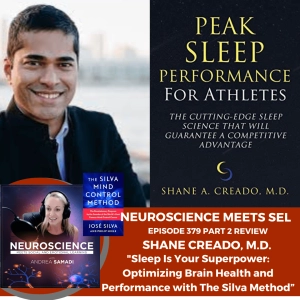
This week, we move onto PART 2 of our review of EP 72[i] with Shane Creado, MD and his book Peak Sleep Performance for Athletes recorded back in July of 2020.
In PART 1[ii], we covered:
How strategic napping, morning brain habits, and even the Silva Method all work together to reset your brain, boost performance, and transform your health from the inside out.
Today, PART 2 we will continue with our review, diving a bit deeper into sleep deprivation and its impact of performance (whether you are an athlete, or just someone looking to improve productivity).
PART 3, next week, we will go a bit deeper into the impacts of concussions and brain injuries on our sleep and performance.
Just a reminder: Dr. Creado is a double board-certified sleep medicine doctor and psychiatrist who practices functional sleep medicine, integrative psychiatry, and sports psychiatry. He brings all of these specialties together to uncover the underlying factors that sabotage our sleep and then treats them comprehensively, helping people to achieve their health and performance goals with sleep at the forefront
As we work through our reviews, we will spend a considerable amount of time on this important health staple that’s scientifically proven to boost our physical and mental health.
For today’s EP 379, and PART 2 of our review of our 2020 interview with Dr. Shane Creado, we will cover:
✔ Sleep as a core pillar of health according to Dr. Shane Creado, author of Peak Sleep Performance for Athletes.
✔ Sleep deprivation is a national crisis and kid’s pay the highest price.
✔ 7 Well-Known Tips for Improving Sleep
✔ Applying the Silva Method to Reset and Improve Our Sleep
✔ Important sleep tips for athletes and high performers
Let’s go back to 2020 and revisit what Dr. Creado had to say about sleep.
CLIP 1 — Why Sleep Is Non-Negotiable for Brain Health
Short Explanation:In Clip 1, Dr. Shane Creado explains that sleep is a foundational pillar of brain health, equal in importance to exercise and nutrition. He emphasizes that without optimizing sleep, it is impossible to truly optimize learning, emotional regulation, focus, or performance. Dr. Creado highlights that chronic sleep deprivation is widespread in the U.S., often unnoticed, and especially damaging for children—where lack of deep sleep suppresses growth hormone, increases obesit