What Gets Measured Gets Improved: Sleep, Recovery & Peak Performance with Dr. Kristen Holmes
Author: Andrea Samadi
March 28, 2026
Duration: 27:17
Host Andrea Samadi revisits a 2021 conversation with Dr. Kristen Holmes (VP of Performance Science at WHOOP) to explain how measuring sleep, recovery, and strain transforms performance and resilience. The episode emphasizes that small daily habits in downtime—sleep, HRV, hydration, and strategic movement—create a sustainable competitive advantage.
Practical tips include tracking one recovery metric, building a shutdown routine, auditing downtime choices, prioritizing consistent sleep, and balancing strain with recovery so you can train smarter, reduce stress, and improve focus and wellbeing.
For today's EP 390, we cover:
✔ What “What gets measured gets improved” really means for performance
✔ How sleep, recovery, and strain work together as one system
✔ Why recovery—not effort—is the true driver of results
✔ The hidden cost of high strain without adequate sleep
✔ How to use data to match your effort to your recovery capacity
✔ The difference between training harder vs. training smarter
✔ Why shorter, intentional workouts can outperform longer sessions
✔ How wearable data (like WHOOP) builds awareness and better decision-making
✔ The connection between overtraining, inflammation, and performance plateaus
✔ How to create sustainable performance through balance, not extremes
Welcome back to Season 15 of the Neuroscience Meets Social and Emotional Learning Podcast.
I’m Andrea Samadi, and here we bridge the science behind social and emotional learning, emotional intelligence, and practical neuroscience—so we can create measurable improvements in well-being, achievement, productivity, and results.
When we launched this podcast seven years ago, it was driven by a question I had never been taught to ask—not in school,not in business,and not in life:
If results matter—and they matter now more than ever—how exactly are we using our brain to make these results happen?
Most of us were taught what to do.Very few of us were taught how to think under pressure,how to regulate emotion,how to sustain motivation,or even how to produce consistent results without burning out.
That question led me into a deep exploration of the mind–brain–results connection—and how neuroscience applies to everyday decisions, conversations, and performance.
That’s why this podcast exists.
Each week, we bring you leading experts to break down complex science and translate it into practical strategies that we can all apply immediately.
Season 15 we’ve organized as a review roadmap, where each episode explores one foundational brain system—and each phase builds on the one before it.
Season 15 Roadmap:
Phase 1 — Regulation & Safety
Phase 2 — Neurochemistry & Motivation
Phase 3 — Movement, Learning & Cognition
Phase 4 — Perception, Emotion & Social Intelligence
Phase 5 — Integration, Insight & Meaning
PHASE 1: REGULATION & SAFETY
Staples: Sleep + Stress RegulationCore Question: Is the nervous system safe enough to learn?
Anchor Episodes
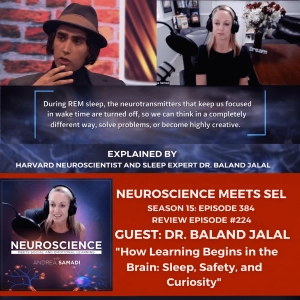
Episode 384[i] — Baland JalalHow learning begins: curiosity, sleep, imagination, creativity
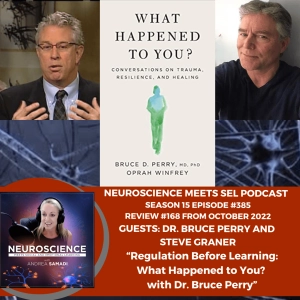
Episode 385[ii] — Bruce Perry“What happened to you?” — trauma, rhythm, relational safety
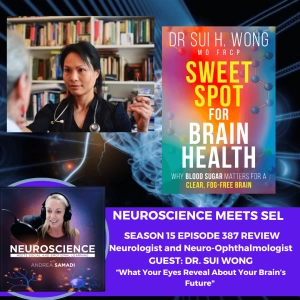
Episode 387[iii] Sui WongAutonomic balance, lifestyle medicine, brain resilience
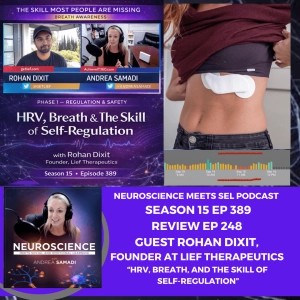
Episode 389[iv] Rohan DixitHRV, real-time self-regulation, nervous system literacy
Episode 390 Dr. Kristen Holmes (Whoop)Recovery Metrics, physiological readiness
Episode 391 Antonio ZadraSleep, dreaming, REM Integration
EPISODE 390 — Dr. Kristen Holmes Recovery Metrics, physiological readiness.
In Phase 1: Regulation & Safety, we are asking one essential question:Is the nervous system safe enough to learn?
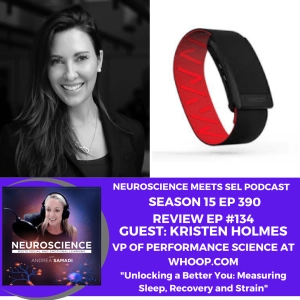
And today we cover this topic as we travel back to May 2021 for EP 134[v] when we first met Dr. Kristen Holmes, the VP of Performance Science at Whoop. Back then, I had just turned 50 and purchased the Whoop wearable tracker to help me to improve my weakest link (at the time): Sleep.
For today’s EP 390 —
We revisit this earlie