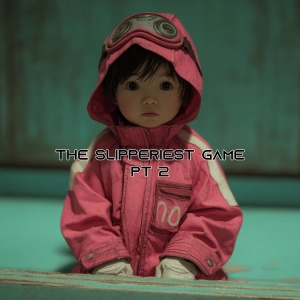
Slipperiest Game 2: The Failure of Narrative Design in Squid Game's Later Seasons

Slipperiest Game 2: The Failure of Narrative Design in Squid Game's Later Seasons

Author: Josh Varty and Kristoffer Hansen August 8, 2025 Duration: 30:14

My big problems:

The Murder Game. Until Tag was introduced, there was never a game where one player had to go out of their way to murder another player in order to win and survive. In every other game, murder was an *option* and the consequence of loss was always death, but it was possible to win without killing a person yourself. The “System” outsourced most of the actual violence. Tag fundamentally changed this and by doing so changed the dynamic and the social contract of the show entirely. There was no longer a plausible separation between winning and murder. The staff did the murder. The consequence for losing was death and your life was equally on the line. Not so in Tag. 

The fucking baby. One of the fundamental rules of the Squid Game event is that everyone is there by choice. It’s one of the themes that was hammered on in the first season, and it mirrored the capitalist rat race beautifully. Everyone was doing this of their own free will, and the second season even introduced voting between rounds to ensure that people were kept in the games by the Will of the People. But the baby didn’t consent and couldn’t consent to being involved in the games. The baby was an unwilling participant, and making the baby a ‘player’ undermined any trust the real players may have had that the games were in any way fair. 

Now, the games are _not_ fair. They never were. They rely on financial coercion, the illusion of fairness, random chance, positional chance, and the exploitation of personal relationships. But it maintains a facade. All of that breaks down with the baby.


And I kinda get where they were going with this. I get that it’s illustrative of the unfairness of the institutions Squid Game is trying to criticize. The rules were never fair, the people running the games never cared about fairness at all, the whole thing is spectacle. But it also fundamentally undermines the premise of the games in a way that would be ruinous for anything other than a shadowy international rich-man’s dog fight. 


In No Plot, Only Lore, hosts Josh Varty and Kristoffer Hansen settle in for a conversation that feels like pulling up a chair at a familiar table. Their focus is the intricate, often messy, and deeply rewarding world of collaborative storytelling games, examining them not as rulebooks to be won but as frameworks for shared imagination. Each episode digs into the craft behind these experiences-how a setting’s history shapes a character’s decision, why a particular game mechanic fosters better stories, or what it means to build a narrative together without a predetermined endpoint. You’ll hear two seasoned practitioners reflect on the subtle art of being a player and a guide, discussing the tools and philosophies that transform a simple game night into a memorable saga. This podcast is for anyone who has ever gotten lost in a character’s backstory or spent more time discussing a campaign’s lore than actually rolling dice. It’s a thoughtful, meandering, and personal look at the stories we tell when we play, offering insights that resonate long after the session ends. Join Josh and Kristoffer for a deep, comfortable dive into the heart of why we gather to imagine together.
Author: Language: English Episodes: 93

No Plot, Only Lore
Podcast Episodes
Building Theory-Craftable Worlds: Lessons from Deltarune and FNAF [not-audio_url] [/not-audio_url]

Duration: 14:46
How do you build a world that players can’t stop talking about between sessions?In this video, we analyze the narrative techniques used by Toby Fox in Deltarune and Scott Cawthon in Five Nights at Freddy’s to create "the…
Steal Everything: One Piece Lore [not-audio_url] [/not-audio_url]

Duration: 16:50
Last week, someone pointed out that I accidentally did a plot. Well we can't have that, not around these parts! So today I'm going to go through One Piece Lore that I barely understand and look at how we can apply that t…
One Piece Season 2 is a Chaotic D&D Game [not-audio_url] [/not-audio_url]

Duration: 18:53
Crazy twists and turns, sudden ass-pulls, quick stops to change the story because a player couldn't make it this week, and forcing your little brother to play the cleric - all in this season of One Piece.
Failure to Thrive [not-audio_url] [/not-audio_url]

Duration: 29:00
Josh isn't around, so I have an opportunity to do something proper philosophical and In the Weeds about games theory, but instead I'm gonna get personal and talk about failure. Failing at things in life, failing at podca…
Meditations on Evil [not-audio_url] [/not-audio_url]

Duration: 33:51
D&D dropped some "evil" class options. What does "evil" actually mean in this case? Can you be a *good* plague cleric? If having evil ancestors makes you evil, what does that mean for tieflings?
Badaptation [not-audio_url] [/not-audio_url]

Duration: 37:56
In this episode of No Plot, Only Lore, Kris and Josh dive deep into the messy, often heartbreaking world of media adaptations. Whether it’s a sprawling fantasy book series becoming a TV show or a legendary video game hit…
Why We Like Nazis [not-audio_url] [/not-audio_url]

Duration: 50:20
Why do Nazis make the ultimate antagonists for your tabletop campaigns? In this episode of No Plot, Only Lore, Josh and Kris break down the mechanics of using fascist-coded villains to create high-stakes, morally clear,…
Too Much Lore: Sumo 2, Fatter and Sassier [not-audio_url] [/not-audio_url]

Duration: 40:35
We’re back with part two of our deep dive into Sumo history! This episode covers the transformation of the sport from the Meiji era to today. We discuss the formalization of the Yokozuna rank, the impact of international…