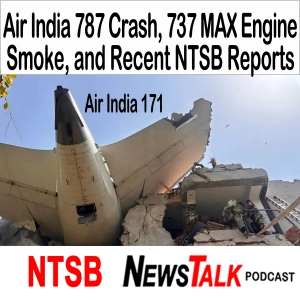
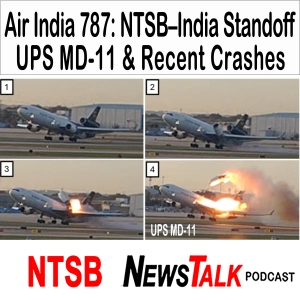
Max Trescott and Rob Mark return for Episode 4 of NTSB News Talk with critical analysis and commentary on recent aviation accidents and safety investigations. The show kicks off with an update on the fatal Air India Flight 171 crash involving a Boeing 787, which resulted in 241 onboard deaths and 19 fatalities on the ground. A single survivor remains, and while early speculation surrounds the Ram Air Turbine deployment and potential engine failure, official conclusions await India's preliminary report, expected in three months.
The discussion then shifts to the LEAP-1B engine bird strike incidents involving Southwest Airlines Boeing 737 MAX jets. Both flights suffered bird ingestion leading to severe cockpit smoke—traced to a design issue where the Load Reduction Device (LRD) triggered an oil leak into the bleed air system. Though the FAA downplayed the threat, the NTSB issued a safety bulletin highlighting the potential risk, drawing parallels to the MCAS issue that plagued earlier MAX crashes.
Next, Max recaps the San Diego Citation S550 crash, which occurred during an LNAV approach at night. The pilot descended well below minimums—possibly misreading a military-only value of 500 feet on the approach chart. With no weather reporting available at Montgomery Field and several human factors at play, fatigue and poor decision-making appear to have contributed to the crash.
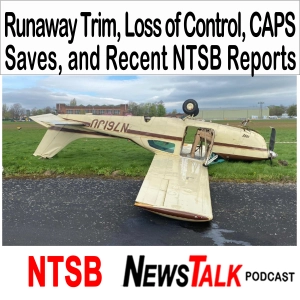
In Broomfield, Colorado, a Beechcraft Travel Air crashed after the pilot reported a door pop shortly after takeoff. The pilot flew an abnormally low pattern and lost control during the downwind leg, possibly due to a stall induced by slowed airspeed. Max and Rob stress that open doors are not emergencies and urge pilots to fly a normal pattern and maintain aircraft control.
Rob covers a fatal floatplane crash near Beaver Island, Michigan, where a homebuilt Avid Magnum impacted water during a low sightseeing pass. Though conditions were reported clear, satellite imagery later revealed smoke and haze that likely obscured the horizon. The glassy water conditions and lack of instrumentation may have contributed to the pilot's inability to perceive altitude, a classic seaplane hazard.
The show also reviews the in-flight breakup of a Cessna 182 in Reliance, Tennessee, caused by continued flight into a thunderstorm and turbulence beyond the aircraft’s maneuvering speed. Shockingly, the aircraft’s BRS parachute was deployed but not connected properly to the structure, rendering it useless.
Finally, the episode covers a Cessna 182RG crash in North Carolina. Witnesses reported an excessively nose-high attitude during a soft field takeoff attempt. The airplane stalled and crashed after barely lifting off. Investigators determined that the pilot likely failed to properly set the elevator trim before takeoff. Toxicology revealed the presence of Zyrtec, a sedating antihistamine, which Max points out is among the FAA’s “no-go” medications for pilots.
Throughout the episode, Max and Rob provide context, safety takeaways, and lessons learned that apply to general aviation pilots. Topics include fatigue, medication safety, proper emergency procedures, and the importance of weather briefings and adherence to approach minimums.