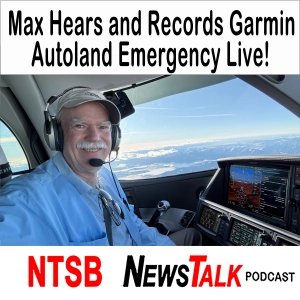
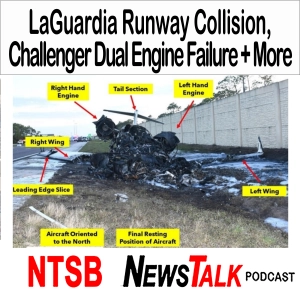
Episode 20 of NTSB News Talk opens with an aviation milestone: the first confirmed in-service, real-world use of Garmin’s Autoland. A King Air B200, tail number N479BR, squawked 7700 and ultimately landed itself at Rocky Mountain Metropolitan Airport (KBJC) in Broomfield, Colorado on Saturday, December 20, 2025.
Garmin later confirmed the activation, and ATC audio captured the synthetic callouts declaring “pilot incapacitation” and the system’s intention to land.
Max adds the kind of detail that makes this story feel real: he was flying in Colorado that day, monitoring Guard, and heard the automated messages as they occurred.
He also heard a voice transmit on Guard mentioning a depressurization and describing difficulty changing frequencies—consistent with the way Autoland takes control of communications once activated.
In their discussion, the flight track shows the airplane climbing out of Aspen into the low-20s, then descending, leveling, and later maneuvering near the destination before landing—exactly the kind of structured “get down, get safe, get on the ground” profile Autoland is designed to execute.
Aviation outlets reported the emergency was tied to a pressurization issue and the engagement of emergency descent logic. Aviation International News+1
After a quick note that Episode 19 was cited in a New York Post story by Emily Crane, the episode pivots into four NTSB reports that all share one theme: the accidents are “simple” only if you ignore the physics.
First is N850JH, a fatal TBM 850 crash near Ludington, Michigan. The NTSB concluded the pilot departed after pulling the airplane from an unheated hangar during active snowfall and taxiing out with visible snow contamination on the wings and horizontal stabilizer.
Deice boots don’t solve that on the ground; contamination kills performance margins by reducing lift and increasing drag right when the airplane is most vulnerable—after rotation. The report narrative (and local coverage quoting it) describes a normal-looking departure that quickly turned into a wing drop, stall, and impact.
Next is N7756N, a Cherokee accident at Frazier Lake Airport in Hollister, California (Sept. 10, 2025)—no injuries, but packed with lessons. The pilot came in high and fast, tried to salvage it with a slip, floated significantly, then initiated a late go-around.
During the go-around attempt, the wheels touched down about two-thirds down the grass runway; with 40° flaps still selected, the airplane became airborne again, but the pilot saw about 45 knots and a mostly-on stall warning and then pulled power to idle to “abort” the go-around, leading to a hard landing, bounce, and impact with a dirt mound.
The report also highlights a major contributing setup: landing runway 05 with wind 250 at 11—i.e., meaningful tailwind.
Third is a fatal VFR-into-IMC CFIT involving N320P, a Lancair 320 near Manitowoc, Wisconsin. The flight track suggests an attempted approach, then a diversion, but conditions were night IMC with a 400-foot ceiling.
The airplane remained on a VFR code (1200) with no recorded ATC contact, and investigators concluded the pilot flew in IMC without an IFR clearance and executed an unapproved instrument approach into trees and terrain.
Then comes the gut punch: this wasn’t a low-time private pilot. Max and Rob note the pilot was a 57-year-old airline ATP/CFI with tens of thousands of hours.
The point is brutal and useful: experience doesn’t rescue you from bad process and bad decisions.
Finally, they cover a Pearland, Texas runway collision involving N127SL, a Cessna 182T and N5450L, a Grumman AA-5 after the AA-5 suffered a total electrical failure.
The AA-5 pilot said the airplane had been “jumpstarted,” then lost comms and couldn’t extend flaps, followed the 182 to the runway, and rolled into it after it exited—without increasing spacing or going around.
Max and Rob use this to teach a genuinely under-taught concept: alternators often need battery field current to self-excite, so a “dead battery + jumpstart” can still leave you with no charging system after takeoff.
The NTSB final report for this event is explicit about the electrical failure and the pilot’s poor judgment that it required an expedited landing.