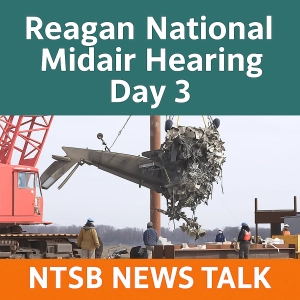
Reagan National Midair NTSB Hearing Day 3: Collision Avoidance & Safety Culture

Reagan National Midair NTSB Hearing Day 3: Collision Avoidance & Safety Culture

Author: Max Trescott | Aviation News Talk Network August 6, 2025 Duration: 1:38:26

On this episode of NTSB News Talk, Max Trescott covers the third and final day of the NTSB’s investigative hearing into the January 2024 midair collision near Washington’s Reagan National Airport between a PSA Airlines CRJ-700 and a U.S. Army UH-60L Black Hawk. Day 3 featured Panel 4: Collision Avoidance Technology and Panel 5: Safety Data and Safety Management Systems.

The hearing opened with spatial disorientation testimony and interviews with Army pilots about Route 4 altitude protections they incorrectly believed would keep them clear of Runway 33 arrivals. NASA’s Dr. Stephen Casner explained that cockpit traffic displays can help pilots spot targets up to eight times faster than by visual scan alone.

Experts detailed ADS-B system complexities — including the two incompatible broadcast frequencies (UAT and 1090ES) — and reviewed the limits of pre-ADS-B collision avoidance technology. The UH-60L Black Hawk lacks integrated traffic displays, relying instead on iPads with Stratus receivers, which Army policy prohibits the flying pilot from using. Portable ADS-B In devices provide only partial traffic pictures unless paired with ADS-B Out, limiting situational awareness.

Discussions turned to TCAS: its nuisance alert problem, differences for helicopter operations, and why the CRJ-700 lacks a certified ADS-B In solution. The NTSB Chairwoman confronted the FAA over its 17-year refusal to mandate ADS-B In, despite repeated post-collision recommendations. The Army is now procuring 1,685 Stratus/iPad sets for priority units, but operational use will still be limited at low level.

FAA data revealed 366 TCAS resolution advisories within 10 nm of DCA from 2023–2025. Testimony noted that crews involved in RAs are typically not notified unless a deviation occurs. Panelists debated safety culture, just culture, and leadership removals at DCA Tower after the accident. A controller supervisor described the pre-accident culture as “robust,” but post-accident changes removed key institutional knowledge.

The hearing also exposed gaps in PSA pilot special-qualification training for DCA — including no information on helicopter routes or operations — and examined simulator results showing that circling to Runway 33 can double or triple pilot workload compared to a straight-in to Runway 1.

Closing testimony on future ACAS XR technology indicated it could have alerted the Black Hawk crew 73 seconds before impact, with potential nationwide deployment by 2027. Max weaves these details into a narrative showing how technological shortfalls, flawed assumptions, procedural gaps, and cultural challenges all converged in this tragic midair — and what reforms could prevent a repeat.

NTSB Docket on Reagan National midair collision

Check out our other Aviation News Talk Network podcasts:

UAV News Talk Podcast 

Rotary Wing Show Podcast

Aviation News Talk


Ever wonder what really happens after the dust settles on an aviation accident? NTSB News Talk-Aviation Accidents, Safety Investigations & Pilot Lessons pulls back the curtain on the meticulous world of safety investigations, transforming complex reports into actionable knowledge. Hosted by award-winning aviation journalist Rob Mark alongside Max Trescott-a flight instructor with formal accident investigator training-each episode delves into recent findings from the National Transportation Safety Board. Their conversations move beyond the headlines to analyze the chain of events, human factors, and mechanical failures that lead to incidents. This isn't about sensationalism; it's a clear-eyed look at the facts, designed to translate tragedy into tangible lessons for those in the cockpit. Whether you're a seasoned pilot, a flight instructor shaping the next generation, or an enthusiast fascinated by the intricacies of flight safety, this podcast serves as a vital resource. You'll hear detailed breakdowns of specific cases, discussions on broader safety trends, and practical takeaways that can directly inform decision-making and checklists. The dialogue between a journalist's perspective and an instructor's hands-on experience creates a unique and authoritative tone, making technical details accessible and immediately relevant. Tune in for a sobering yet essential exploration of how the aviation community learns, adapts, and strives to make every flight safer.
Author: Language: English Episodes: 29

NTSB News Talk – Aviation Accidents, Safety Investigations & Pilot Lessons
Podcast Episodes
Piper Seminole Crash, Cirrus SR22 Hard Landing, Mooney Door-Pop Spin [not-audio_url] [/not-audio_url]

Duration: 42:43
Max talks with Rob Mark about a dense lineup of recent accidents and final reports, led by the Piper PA-44 Seminole N595ND crash in Fort Pierce, Florida, the Cirrus SR22 N124SP hard landing in St. Paul, Minnesota, and th…
Cirrus CAPS Save, Go-Around Stall, Advisory Glidepath Trap [not-audio_url] [/not-audio_url]

Duration: 41:01
Max Trescott and Rob Mark talk about how pilots get into trouble when they misunderstand instrument procedures, mishandle a go-around, or make shockingly poor decisions on the ground and in the air. They open with Max’s…
TNFlyGirl Debonair Crash: Autopilot/Trim PIO + Icing & Night IMC [not-audio_url] [/not-audio_url]

Duration: 36:22
In episode 25 of NTSB News Talk, Max Trescott and Rob Mark break down seven NTSB reports with a common theme: the accident often starts long before the impact.Brought to you by AVEMCO aircraft insurance.Support Rob and M…