Host Lisa Cahill meets with the winner of the 2025 MAKE Award, metalsmith and jeweller Cinnamon Lee. Cinnamon tells us about her hybrid practice combining jewellery and lighting, the intricate process of making her winning work Noctua, and the hidden meanings embedded throughout the piece.
You'll hear from judges Brian Parkes and Simone LeAmon on what made Cinnamon's work a prize-winning piece.
Sydney-based artist Cinnamon Lee is trained as a gold and silversmith, creating wearable objects in the form of jewellery and non-wearable objects in the form of lighting. Her practice is characterised by meticulous hand-crafted detail, hidden elements, and a fascination with creating "more than meets the eye." Lee has been a practising artist for 30 years, having studied and taught at the Canberra School of Art's Gold and Silversmithing workshop.
Guests
Show highlights and takeaways
[00:03] Secrets and hidden beauty
"Everybody likes a secret."
Cinnamon Lee introduces her philosophy on jewellery and the personal relationship between object and wearer. She discusses her practice of hiding gemstones – sometimes partially, sometimes completely – inside rings and other pieces.
[02:54] A young metalworker
Cinnamon describes how she discovered metalworking at age 17 through Enmore Design Centre, where her mother was teaching.
"Once I was in that workshop it was like I'd found my calling, which I feel really fortunate about because it happened quite quickly."
She spent the next decade studying and eventually teaching at the Canberra School of Art's Gold and Silversmithing workshop with Johannes Kuhnan and Ragnar Hansen.
"It completely changed my life, that workshop."
[04:47] Cinnamon's practice
Cinnamon explains that she creates both wearable objects (jewellery) and non-wearable objects (lighting), often using very precious materials.
[00:05:12] Winning the 2025 MAKE Award
Lisa congratulates Cinnamon on winning the MAKE Award, biennial prize for innovation in Australian craft and design.
"It feels especially meaningful given that I am now marking the 30th year of being a practising artist. So to have this recognition by the craft and design community is very special."
Cinnamon reflects on her long relationship with the Australian Design Centre, dating back to her first exhibition as a student in 1995 at the Crafts Council of New South Wales Space in the Rocks, Sydney.
[06:44] Noctua: the winning work
Lisa asks about the meaning of Noctua, and Cinnamon explains it's the genus name for a cutworm, a type of nocturnal moth, with the Latin translation meaning Little Owl.
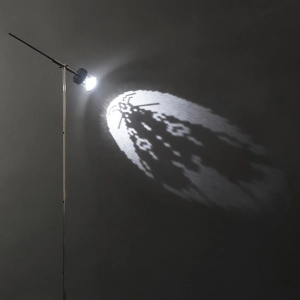
The object is a hybrid creation – a slender standing lamp made of stainless steel, just over one and a half metres tall, with a cylindrical head containing the light source.
But it holds secrets:
"As well as being a lamp, it also contains a wearable brooch. So the wearable brooch sits into the lamp and is able to project a shadow onto the wall or any other surface, depending on where the lamp is situated. So it's a lamp and a sculpture and a piece of jewellery."
[08:12] The brooch: materials and technique
The brooch is made from titanium and silver in two layers, circular and about the size of a palm. Each disc has been hand-drilled with approximately 1,000 holes – 1.2 millimetre holes creating a grid.
"I love my drill press and it's just a crappy old drill press, but wow, it's drilled a lot of holes."
Instead of creating a simple spotlight, Cinnamon filled specific holes with tiny sapphires that stop the light from passing through.
"The shadow that is projected onto the wall is created by a whole lot of sapphires that form the silhouette of a moth."
[09:20] Why the Bogong moth?
"It was a moth that very quietly appeared around my home."
Cinnamon had previously created a series of brooches with flashlights projecting moths in 2023, using Australian sphinx moths or hawk moths. For the MAKE Award, she chose the Bogong moth for its humble, unassuming nature.
"It wasn't even as exciting as those hawk moths. It was such a humble, unassuming creature, but it represented something that was more than meets the eye in terms of its importance, because all insects are so important, but it also became an emblem of hidden beauty, which is really important in my work."
[10:57] Layers of secrets
Cinnamon describes the multiple hidden elements in Noctua:
"On one level there's the gems which are hidden in the brooch, which are not visible immediately. The brooch is hidden in the lamp, which is not necessarily visible immediately either. Those were the main two secrets."
She also explains the secret ways the object was made – all by hand at her bench, despite looking machine-made.
[11:32] Working without machines
Cinnamon's workshop has shrunk considerably over time, with reduced access to equipment.
"Pretty much everything I do is at my bench, but using hand tools. But I say I grew up on machines. I was trained with access to a whole range of machines."
She attributes her 'machine aesthetic' to Johannes Kuhnan's influence, noting she used to have a metal lathe but no longer does.
"The black cylindrical housing where the brooch fits into, of course, any normal person would just turn all of those components on a machine, but if you don't have one, you have to cut them all by hand with a piercing saw and file them all round."
[12:32] Hidden technical details
More secrets in the work include:
- Hidden magnets in the washer holding the brooch to the lamp
- Hand-cut threads
- An LED with a sterling silver heat sink
- The lamp structure itself conducts the electric current.
[13:32] Hiding the handmade
Lisa comments that, “too often we associate meticulousness with a machine-made work and the handmade, where it has its imperfections, we forgive because they're made by the hand, but you've actually taken this work in particular to another level and hidden the handmade."
Cinnamon says she likes to make her own “little physical challenges... to make it look like it could have been made by a machine, but it actually wasn't."
[14:13] Innovation in craft
Cinnamon discusses why she was excited to enter the MAKE Award, which acknowledges innovation.
She references listening to a previous episode of this podcast with Johannes Kuhnan, where he mentioned his professor Friedrich Becker "didn't allow anything through that wasn't innovative."
"I think I have also had that passed on to me from him, that idea that you should always, as a craftsperson and a designer, be looking to innovate."
"For me, innovation isn't simply trying something new. For me, innovation is – it's a way of thinking and it's about changing your thinking to be able to create and come up with something completely different."
"It's about not just being innovative for my own self, but to be innovative in order to provoke other people to think differently as well."
[15:33] Bringing two practices together
Cinnamon says that for this piece, she brought together the two sides of her practice to try to create something that she didn’t think existed before. The brooch is completely wearable by itself but has a secondary life in the purpose-built lamp housing, creating a new hybrid object.
[16:30] Judge's comments: Brian Parkes
Brian Parkes, CEO of JamFactory, discusses following Cinnamon Lee's practice for decades, noting she is one of the most accomplished makers in the country who has worked in lighting design and jewellery for the last 20 years.
He describes the work as both a brooch and a lamp, a sculpture and theatre, pixelated yet analogue, with interesting contrasts throughout. Every detail has been deeply considered, and the work combines technical proficiency with poetic sensibility, with a narrative informing every material and aesthetic decision.
"If you look at it really closely and inspect all the details, you'll see that every single thing, whether it's the fixings, the finishes – it's all been deeply considered. And that's the sign of an absolute perfectionist maker."
[18:23] Displaying jewellery
Lisa notes that Cinnamon's work provides a natural, beautiful way of displaying...