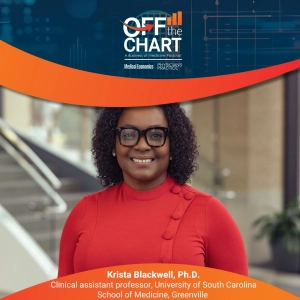
Krista Blackwell, Ph.D., clinical assistant professor of biomedical sciences at the University of South Carolina School of Medicine, Greenville, joins the show to talk about two new reports from the
U.S. Centers for Disease Control and Prevention (CDC) and the
American Heart Association (AHA) examining ultraprocessed foods and their growing role in the American diet.
Blackwell explains why youth consumption stood out in the data, how convenience, family routines, school meals and food marketing influence eating patterns, and what the latest research says about cardiometabolic risks. She also discusses how primary care physicians can approach nutrition counseling more effectively using motivational interviewing and principles of culinary medicine.
AHA report:
"
Ultraprocessed Foods and Their Association With Cardiometabolic Health: Evidence, Gaps, and Opportunities: A Science Advisory From the American Heart Association"
https://www.ahajournals.org/doi/epub/10.1161/CIR.0000000000001365CDC report:
"
Ultra-processed Food Consumption in Youth and Adults: United States, August 2021–August 2023"
https://www.cdc.gov/nchs/products/databriefs/db536.htmMusic Credits:
Midnight Jazz by Alexey Anisimov -
stock.adobe.com
Relaxing Lounge by Classy Call me Man -
stock.adobe.comA Textbook Example by Skip Peck -
stock.adobe.comEditor's note: Episode timestamps and transcript produced using AI tools.
0:00 — Intro Overview of today’s topic: new CDC and American Heart Association reports on ultra-processed foods.
1:30 — First impressions of the new data Dr. Blackwell explains why the findings align with lifestyle-medicine training and culinary-medicine education.
2:43 — CDC survey surprises Why children ages 6–11 had the highest intake of ultra-processed foods.
3:56 — Pandemic effects on diet How COVID-19 changed food preparation, access, and reliance on processed foods differently for different populations.
5:56 — Why kids consume so many ultra-processed foods Marketing, school meals, fast-food access, and environmental factors.
6:40 — Key takeaways from the AHA scientific advisory What the advisory says about saturated fat, sugar, sodium, additives, and unknowns about processing techniques.
8:47 — Are 70% of grocery-store products “bad”? How to evaluate ultra-processed foods using nutrition labels and the “1:1 sodium-to-calories” rule taught in culinary medicine.
10:24 — How physicians can approach nutrition counseling Motivational interviewing, identifying small changes, and real-world examples for primary care.
12:20 — How patients respond to motivational interviewing Why meeting people where they are leads to better engagement.
14:09 — What culinary medicine looks like in practice Hands-on patient cases, meal prep, and teaching medical students practical nutrition skills.
16:29 — What future research needs to explore Additives, processing methods, and understanding their impact on cardio-metabolic disease.
17:41 — The GLP-1 conversation How GLP-1 drugs fit into the gut-brain axis research and what they mean for individualized patient care.
19:29 — Ultra-processed foods and national policy How MAHA and recent federal attention could accelerate progress.
21:03 — Defining “ultra-processed” foods Why the lack of a unified definition complicates dietary guidelines.
22:23 — Where primary care physicians can learn more Culinary-medicine certification and integrating nutrition into practice.
24:12 — What global models can teach the U.S. Australia and EU “health scores” and how clearer labeling could help patients.
25:47 — Closing thoughts Full-circle wrap-up and final remarks from Richard Payerchin and Dr. Blackwell.
26:12 — Outro Show credits and where to find future episodes.