
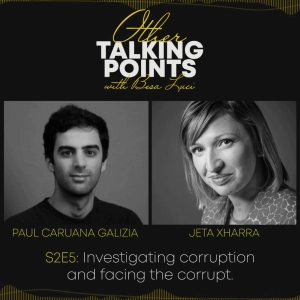
#S2EP5 - Investigating corruption and facing the corrupt

#S2EP5 - Investigating corruption and facing the corrupt

Author: Kosovo 2.0 November 30, 2023 Duration: 58:34
Besa Luci in conversation with Paul Caruana Galizia and Jeta Xharra. In this episode, we talk about threats to journalism and to journalists covering topics that those in power seek to conceal.In his recently published book, “A Death in Malta,” Paul Caruana Galizia says: “Two worlds, corruption and writing about it, collided.” This statement and the entire book refer to the work of his late mother, Daphne Caruana Galizia, the renowned Maltese journalist who was assassinated by a car bomb in 2017 in Malta. Across the globe, many journalists face similar violent collisions of worlds, particularly when challenging or calling out abuses of power. Caruana Galizia’s book highlights how independent journalism is viewed as the problem in many countries rather than the corruption and injustice it exposes. Journalists are often left to fend for themselves with few possibilities for protection. And when they do their job in countries that are seen as rather peripheral to world politics such as Kosovo and Malta, these possibilities become all the more limited. Caruana Galizia is joined in this episode by Kosovar journalist Jeta Xharra. They discuss how corrupt political and economic systems, when combined with lax justice systems, create an unsafe environment for journalists; how for women, gender is a crucial marker of professional experience; and share personal stories of their relationship to journalism. Paul Caruana Galizia became a journalist after his mother was assassinated. Since then, he has won an Orwell Prize special award, a British Journalism Award and other honors for his reporting. With his brothers, he has received a Magnitsky Human Rights Award and an Anderson-Lucas-Normal Award for campaigning to achieve justice for Daphne.Jeta Xharra is the Director of Balkan Investigative Reporting Network (BIRN) in Kosovo, as well as a leading anchor and editor of “Life in Kosovo”. She has written for the Economist, Sunday Telegraph and Jane's Intelligence Review. While in the UK, she worked for the Foreign News Planning Desk at the BBC World Service, Institute for War and Peace Reporting and in 2005 she became one of the founders of Balkan Investigative Reporting Network. In 2012 the South East Europe Media Organisation, SEEMO, named Jeta Xharra as winner of the 2012 Dr Erhard Busek — SEEMO Award for Better Understanding in South East Europe.Other Talking Points is produced by Besa Luci and Aulonë Kadriu.Music and sound mix by PUG musik.This podcast is part of the Human Rightivism project, which is funded by the Embassy of Sweden in Prishtina, implemented by the Community Development Fund through its Human Rightivism Program. The author’s views expressed in this publication do not necessarily reflect the views of the Embassy of Sweden in Prishtina.

In each episode of Other Talking Points, a production of Kosovo 2.0, editor-in-chief Besa Luci sits down with a guest whose voice and work challenge conventional narratives. These are not hurried interviews but considered conversations, often meandering through personal history, creative process, and critical thought. You’ll hear from authors dissecting the narratives of place, scholars questioning entrenched ideas, artists explaining the impetus behind their work, and activists detailing the realities of their struggles. The guests hail primarily from Kosovo and the surrounding region, but the scope frequently widens to include compelling voices from across the globe, creating a unique dialogue between local context and wider currents of thought. This podcast operates in the spaces between news and commentary, offering depth and nuance where headlines often fall short. The aim is to move beyond the usual soundbites and talking points that dominate public discourse, hence the name. By focusing intently on an individual’s journey and intellectual contributions, each discussion naturally opens up to reveal new perspectives on politics, culture, society, and what it means to engage with the world thoughtfully. Listening feels like being present for a genuine exchange, one that prioritizes understanding over simple debate. It’s for anyone curious about the forces shaping contemporary life in Southeast Europe and beyond, delivered through the intimate, unfolding format that only a thoughtful podcast can provide. The result is a collection of episodes that together build a complex and human portrait of the issues that define our time.

Author: Language: English Episodes: 23

Other Talking Points
Podcast Episodes
#S1EP12 - Is there anything new with the Association? [not-audio_url] [/not-audio_url]

Duration: 52:21
Besa Luci in conversation with Adi Ćerimagić and Augustin Palokaj.In this episode, we talk about the Association of Serb-Majority Municipalities in Kosovo.Arising in 2013 as part of an agreement between Kosovo and Serbia…
#S1EP11 - Pop culture — commodity or confrontation? [not-audio_url] [/not-audio_url]

Duration: 58:07
Besa Luci in conversation with Lindita Tahiri and Jovana Gligorijević.Songs, movies, reality shows, video games, news — these products of popular culture shape our society. From the way we interact with others, how we vi…
#S1EP9 -  The Balkan Route, migration and people on the move [not-audio_url] [/not-audio_url]

Duration: 54:31
Besa Luci in conversation with Gorana Mlinarević and Lura Pollozhani.Migration is a topic people in the Balkans are far too familiar with. Whether we’re talking about the current economic migration to the West that is dr…
#S1EP8 -  Same-sex Unions [not-audio_url] [/not-audio_url]

Duration: 57:45
Besa Luci in conversation with Jelena Čolaković and Valmira Rashiti.In this episode we talk about the legal recognition of LGBTQ+ rights, with a focus on same-sex unions.Securing fundamental human rights across the Balka…
#S1EP7 -  Unpaid Labor [not-audio_url] [/not-audio_url]

Duration: 57:15
Besa Luci in conversation with Marigona Drevinja and Nađa Bobičić.In this episode we'll be talking about unpaid labor — about the cleaning, cooking, childcare, eldercare and more that is performed inside the home and in…
#S1EP6 -  Climate Change [not-audio_url] [/not-audio_url]

Duration: 55:25
Besa Luci in conversation with Vladimir Djurdjević and Granit Gashi.In this episode, we’ll be talking about climate change. How vulnerable is our region to the warming of the planet? Are we taking enough measures to addr…
#S1EP5 -  Gentrification [not-audio_url] [/not-audio_url]

Duration: 57:18
Besa Luci in conversation with Dorina Pllumbi and Iva Čukić.In this episode, we look at gentrification in urban spaces in the Balkans.Gentrification is when poor or underserved areas undergo transformations that expand e…
#S1EP4 -  A Different Approach to Kosovo and Serbia [not-audio_url] [/not-audio_url]

Duration: 59:20
Besa Luci in conversation with Visar Ymeri and Aleksandar Pavlović.In this episode, we look at the ways we talk about the relationship between Kosovo and Serbia.Since 2011, the dominant framework for talking about the re…
#S1EP3 - Social Protection [not-audio_url] [/not-audio_url]

Duration: 56:11
Besa Luci in conversation with Maja Gerovska-Mitev and Artan Mustafa.In this episode, we look at social protection. That is, whether and to what extent countries in the region have social schemes and programs that can me…
