*Update: On April 1st, just after this podcast was published, the CDC announced an end to Title 42 beginning the end of May. You can find details on the process here.*
***Castellano más abajo***
Ahoy there!
We hope you’ve safely navigated your way to the weekend.
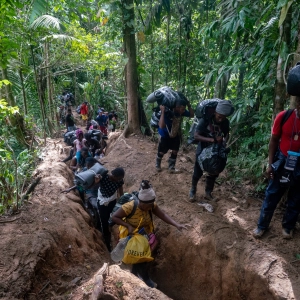
Today, we’re interrupting normal transmission to tell you about some changes. Pirate Wire Services has just turned six months old, and we’ve decided it’s time to make good on our promise to develop the project into a podcast. Our second episode, about growing perceptions of racism as policy in migration standards, asks experts to explain the discrepancy in treatment between Ukrainian asylum seekers and those who have been waiting at the US border from Latin America and Africa, many of whom also come from conflict-ridden regions.
This means we’ll be shifting our focus to bring you a podcast episode each week. It will be emailed out with a newsletter reviewing the news across Latin America, as well as Spanish Words of the Week, What We’re Reading, and other links. However, it will be shorter than the in-depth reports we’ve been sending so far. Paid subscribers will still get the Ship’s Log bonus newsletters every two weeks. The podcast will be in English, but the newsletter will still be bilingual.
We’ll probably still publish occasional written features, because is there even any point in being a pirate these days if you can’t rogue publish stories that merchant vessels like VICE and the Guardian missed?
John Dennehy is temporarily stranded on a desert island searching for buried treasure. So we’re welcoming two new pirates aboard.
Paulo Rosas Chávez is a Peruvian freelance journalist based in Argentina, where he works on politics, immigration, and social movements, as well as fact checking. He is completing a master’s degree in Political and Social Theory at the University of Buenos Aires.
Daniela Díaz Rangel is a Colombian photojournalist based in Bogotá. Her work, which focuses on gender and social issues, has appeared in Latino Rebels, World Politics Review, and NACLA, as well as numerous Colombian publications.
Pirate Wire Services takes a huge amount of time and labor, and while we have a few stars who pay for their subscriptions, it’s still mostly a labor of love. To be sustainable long-term, we need to bring in more paid subscriptions - so if you like what we do, please consider supporting our work from as little as US$5 per month. You can also forward this newsletter and podcast on to others: every subscription helps!
Right. On to the news…
On Wednesday, the Inter-American Court of Human Rights asked the Peruvian government not to release ex-dictator Alberto Fujimori until it has made a pronouncement about a constitutional court ruling that would set him free. In mid-March, the constitutional court ruled that a pardon granted to Fujimori in 2017 by then-president Pedro Pablo Kuczyski should be reinstated following a 2018 supreme court decision to annul it. Fujimori governed Peru between 1990 and 2000. In 2009, he was convicted of corruption offenses and the killing of 25 people in two massacres during his government.
Peru’s Congress rejected a fresh vacancy motion against president Pedro Castillo, who has now survived two such attempts in the first eight months of his presidency. Similar to impeachment, these motions hinge on a previously obscure provision in the constitution allowing for the president to be removed for “permanent moral incapacity.” After a debate lasting until almost midnight on Monday, the right-wing opposition secured just 55 of the 87 votes it needed to oust him. His Health Minister, the controversial doctor Hernán Condori, was less fortunate: a censure motion against him was passed on Thursday and he’ll be out by the weekend. That ministerial door is revolving so fast, they could generate electricity with it.
On 2 April, Argentines will commemorate the 40th anniversary of the Falklands war, when the ruling military junta sent the armed forces in an unsuccessful attempt to reclaim the Falkland Islands (known as las Malvinas in Spanish) from the British. Argentina maintains that the islands are its sovereign territory and that the British presence there is an illegal occupation, which Britain denies. Many of the Argentine soldiers were young conscripts who suffered grotesque mistreatment at the hands of their superiors, chums of the dictatorship who used torture methods against their own troops. Earlier this week, charges of sexual abuse and antisemitism were incorporated into a trial seeking justice for the veterans. This week, President Alberto Fernández told the BBC in a rare interview on the subject: “The only thing I’m clear about is that las Malvinas aren’t English.”
El Salvador has declared a state of emergency after 76 people were murdered in what’s believed to be a spate of gang violence last Friday and Saturday. The bloodshed is bad news for president Nayib Bukele: his government has long claimed that a falling murder rate was the result of good policies, vociferously denying accusations that it was in fact a result of backdoor deals with criminal groups. Observers have interpreted the spree as a gruesome display of who’s really in charge. The state of emergency limits the rights to private communication, freedom of assembly and association, and some steps of due process, sparking a rebuke from Human Rights Watch.
Frontrunner Gustavo Petro, announced his vice-presidential pick in Colombia, the Afro-Colombian activist and social leader Francia Marquez, who obtained the third highest vote in the consultation, surpassing other right and centrist candidates.
Márquez, winner of the 2018 Goldman Prize for environmental issues, would now have the opportunity to become the first black woman to be vice president of the country, representing the most excluded and impoverished populations. The first round elections for the Presidency will be held on May 27, being one of the most decisive campaigns in recent years and taking place in the midst of the harsh resurgence of the conflict in Colombia, as evidenced in a recent report by the International Committee of the Red Cross.
Spanish words of the week:
los pueblos no son los gobiernos - “People aren’t governments”. We often use this phrase to distance ourselves from our governments when they commit atrocities or pass barbarous policies, to show solidarity and make it clear that their actions don’t represent us.
What we’re reading:
This Financial Times long read is a good overview of what’s going on in Castillo’s government
Anthropologist Carwil Bjork-James’s essay on anti-imperialist and anti-military perspectives on the Ukraine conflict contains thought that’s valuable all over the world
NOTICIAS CASTELLANAS!
PERÚ
Alberto Fujimori no saldrá en libertad… por ahora
El pasado miércoles, la Corte Interamericana de Derechos Humanos solicitó al Estado peruano frenar su liberación hasta que puedan emitir un pronunciamiento respecto del fallo judicial que benefició al exdictador. A mediados de marzo, el Tribunal Constitucional peruano emitió una sentencia que restituyó el indulto que fue otorgado en 2017 a Fujimori por el expresidente Pedro Pablo Kuczysnki. En 2018, ese indulto fue cuestionado por la corte supranacional y, posteriormente ese mismo año, anulado por la Corte Suprema peruana. Fujimori gobernó el Perú entre 1990 y 2000; en 2009 fue condenado por delitos de corrupción y por la autoría mediata de dos matanzas perpetradas por un grupo paramilitar, que dejaron 25 muertos.
Pedro Castillo se salvó de la vacancia
El Congreso peruano rechazó un nuevo pedido de vacancia contra el presidente Pedro Castillo, quien en ocho meses de gobierno ha enfrentado ya dos mociones de este tipo. Tras un debate que se extendió a los últimos minutos del pasado lunes, la oposición de derecha solo consiguió 55 de los 87 votos que necesitaban para vacarlo. Sin embargo, este jueves fue aprobada una censura contra el ministro de Salud, Hernán Condori, un médico cuestionado —sobre quien ya escribimos en PWS— que deberá dejar el puesto este fin de semana. Su reemplazo será el ministro número 45 de la gestión de Castillo.
Defensora del medio ambiente afro podría ser la próxima vicepresidenta de Colombia.Gustavo Petro anunció su formula vicepresidencial, la lideresa afro Francia Marquez, quien obtuvo la tercera votación más alta en toda la jornada y rebasó a candidatos de la derecha y centro.Márquez, ganadora en 2018 del premio Goldman en temas medioambientales, tendría ahora la oportunidad de convertirse en la primera mujer negra en ser vicepresidenta del país, representando a las poblaciones más excluidas y empobrecidas. Las elecciones de primera vuelta a la Presidencia se llevaran a cabo el próximo 27 de mayo, siendo una de las campañas más decisivas de los últimos años y que se da en medio del duro recrudecimiento del conflicto en Colombia, así como lo evidenció en su último informe el Comité Internacional de la Cruz Roja.
Get full access to Pirate Wire Services at
www.piratewireservices.com/subscribe