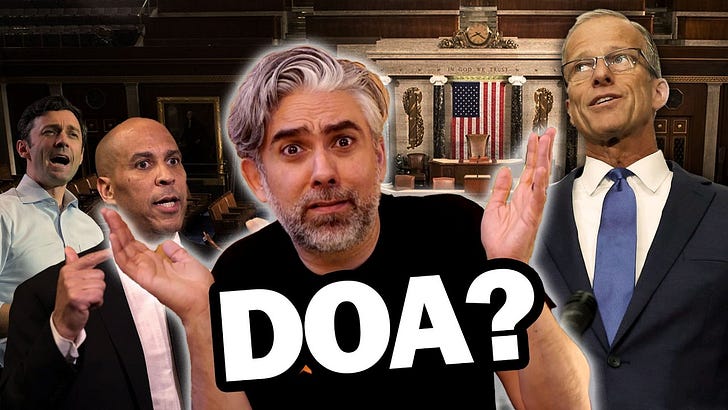
We’re heading into another potential government shutdown, and the maneuvering is already underway. Schumer is strategizing with his caucus on how to handle the September 30 deadline. It’s a familiar script: Democrats want Republicans to commit to avoiding additional rescissions and to agree on the broader budget process before Democrats give their votes. The ask isn’t outrageous — a few basic guarantees in exchange for the seven Democratic votes Republicans would need to hit the 60-vote threshold in the Senate.
The tension, of course, is baked in. Some Democrats want to force a shutdown, not avoid one. They think it’s time to show their base that they’ll stand up to Trump and his agenda. But Schumer doesn’t want to lose the optics war. If Democrats are the ones who initiate a shutdown, he knows they’ll never be able to claim the high road again when Republicans try the same play. That framing matters — especially in an election year.
Meanwhile, Republicans are eager to push another round of budget cuts. They already passed an $8 billion rescissions package and want more. That’s what Schumer is trying to block, while also keeping his own party from turning a funding debate into a loyalty test. It’s a messy balancing act, and the countdown has already started.
Public Media Hits a Wall
Edith Chapin stepping down from NPR is getting attention, but the real story is the billion-dollar rescission Congress just passed — a cut directly targeting the Corporation for Public Broadcasting. That’s the pot of money that gets divided among outlets like NPR and PBS. Chapin insists her departure isn’t related, and maybe that’s true. Thirteen years is a long run. Still, the timing speaks volumes.
For years, public media has downplayed its reliance on federal dollars. They’d argue they only receive about 1% of their funding from the government, so budget cuts shouldn’t matter. But now that Congress has actually slashed that funding, the narrative changes. If they’re not publicly funded in any meaningful way, how do they survive? And if they are, then why haven’t they done a better job of building public goodwill to protect that funding?
I don’t think the model holds up much longer. If you rely on taxpayer money, you have to make your case — constantly. You have to give people something they can see, something they can repeat. You can’t just be vague and institutional and assume the funding will continue. It’s not the ’90s anymore. The party’s ending, and there’s a new bartender who’s ready to close the tab.
UNESCO and the American Pullback
And then there’s UNESCO. Trump is pulling the U.S. out of the UN’s Educational, Scientific and Cultural Organization — again. It’s a reversal of a reversal from his first term. He says it’s too “woke,” too biased, too ineffective. Whatever the justification, it fits a larger pattern: the U.S. retreating from its role as primary funder of global institutions.
There’s always a debate about whether this kind of move opens the door for China to step in and fill the void. That argument has merit. But I’ll say to UNESCO what I said to public media: if you depend on the American public — directly or indirectly — for your funding and relevance, then you have to win public support. You have to tell your story well, and often. You have to make people care.
Some of these global organizations got comfortable. They assumed the checks would keep coming, and the U.S. would always foot the bill. But now they’re running out of room. The music’s fading. And if they can’t answer why they matter in plain language, they’ll find themselves cut off without much fanfare.
Chapters
00:00:00 - Intro
00:01:25 - Justin’s BART Experience
00:08:52 - Interview with Michael Tracey
00:39:40 - Update
00:40:17 - Gov’t Shutdown?
00:43:32 - NPR
00:45:09 - UNESCO
00:47:35 - Interview with Michael Tracey, con’t
01:18:40 - Wrap-up
This is a public episode. If you'd like to discuss this with other subscribers or get access to bonus episodes, visit
www.politicspoliticspolitics.com/subscribe