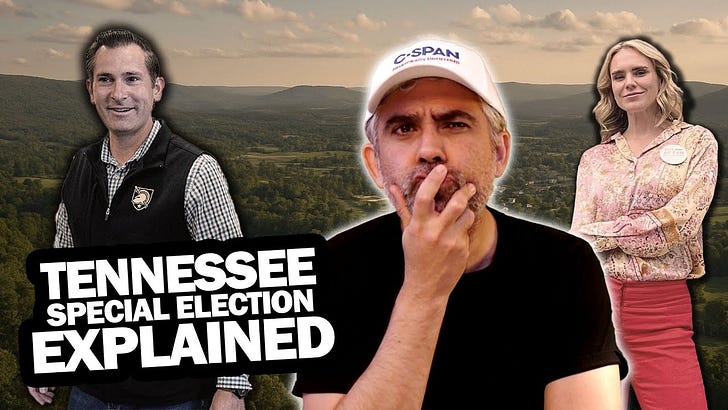
The Tennessee 7th District special election is no ordinary off-calendar contest. It is a rare moment when a deeply red seat, long considered immovable, has become a stress test for the political environment itself. Before the results are spun beyond recognition, here is how I see the race and why its outcome — whatever it is — matters far more than who wins.
Tennessee’s 7th District is not supposed to be competitive. For years it has behaved like a Republican fortress: John McCain won it by 28 points, Mitt Romney by 24, and Donald Trump by anywhere from 21 to 34. Former Representative Mark Green consistently won with more than two-thirds of the vote. But those numbers mask reality. Trump has bled suburban support with each cycle, and while the district remains red, it has trended steadily closer to the center. That shift matters more in a special election, where turnout is low and national money is targeted at one race instead of dozens. In that kind of environment, even a heavily favored side can wobble.
That brings us to the candidates. Republican Matt Van Epps is the type of standard-issue conservative you’d expect to see in a district like this: a veteran, a conventional platform, and a campaign that’s been competent but unremarkable. He has not run toward Trump the way many Republicans in similarly structured districts once would have, an omission that speaks volumes about the nervousness inside the party. Democrats, meanwhile, are running Aftyn Behn, whose message is strong — focused on affordability and frustration with tariffs — but whose opposition research file is… extensive. Past tweets cheering the destruction of a police station and musing about abolishing the Nashville Police Department have given Republicans plenty of material. Not exactly what you want in Tennessee.
Politics Politics Politics is a reader-supported publication. To receive new posts and support my work, consider becoming a free or paid subscriber.
I keep coming back to the same three scenarios. The first is the earthquake: Aftyn Behn flips the seat. If that happens, the panic inside the Republican conference becomes immediate and existential. This majority is already strained by retirements, factional fights, and Trump’s declining approval ratings. Losing Tennessee 7 would signal that no district is safe, and it would meaningfully raise the odds that Republicans lose the House outright — potentially even before the midterms if more members resign.
The second scenario is the reset: Matt Van Epps wins comfortably, by 10 to 15 points. Republicans would exhale. Leadership would declare this a reaffirmation that the party’s base remains intact. They would argue that a focused Democratic effort still couldn’t move the needle enough to threaten a core GOP district. It would be evidence that the sky is not falling — at least not everywhere, and not yet.
The third scenario is the most interesting: a narrow Van Epps win. A single-digit margin would function as a Democratic moral victory and a Republican warning klaxon. It would confirm that the party’s suburban erosion is accelerating, that Trump’s drift downward is shifting the map, and that a generic Republican — even in Tennessee — is not insulated from national sentiment. A Politico report suggested the GOP conference would become “unhinged” if the race lands here. Having watched the last month of Republican caucus behavior, I’m not inclined to disagree.
This isn’t just a regional contest. It’s a snapshot of a party that has been running on fumes — caught between a base powered by Trump and a national electorate increasingly uneasy about his second-term performance. It’s also a test for Democrats, who are experimenting with insurgent messaging in places they normally ignore. Aftyn Behn is trying to run as an outsider in a district where the outsider lane belongs to Republicans. Whether that gamble pays off will tell us something about how Democrats might approach similar red districts next year.
No matter which path emerges, the Tennessee special election is less about two candidates and more about the political weather. And for the first time in a while, Republicans can’t be sure the forecast is on their side.
Chapters
00:00 - Intro
03:11 - Tennessee Special Election Explainer
18:54 - Update
19:25 - Pete Hegseth
22:16 - Travel Ban
27:03 - Paul Finebaum
30:17 - Andrew Heaton on Congressional Dread
52:50 - Wrap-up
This is a public episode. If you'd like to discuss this with other subscribers or get access to bonus episodes, visit
www.politicspoliticspolitics.com/subscribe