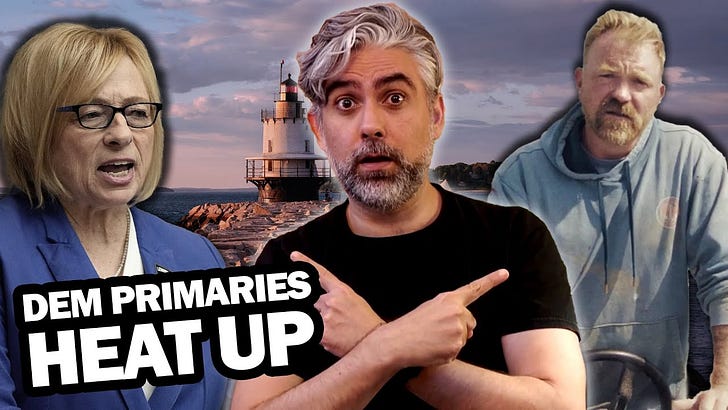
Graham Plattner is running for Senate in Maine. He’s not a career politician. He’s not a household name. He’s a newcomer, and he’s coming in with the kind of video that’s designed to break through the noise. It’s everything you’d expect from someone trying to signal that they’re different — kettlebell lifting, scuba diving, oyster farming, military gear. This is Fetterman-core, and I mean that in the pre-stroke, media-savvy, meme-friendly way. It’s intentionally loud, intentionally masculine, and intentionally designed to get people talking.
But this isn’t just a vibe campaign. Plattner’s already built a real team. He’s working with the same media shop that did ads for Zohran Mamdani in New York and helped elect Fetterman in Pennsylvania. These aren’t DCCC types. They’re insurgent operatives with a history of getting attention — and winning. That tells me Plattner’s not just here to make a point. He’s running to win. And in a state like Maine, where ideological boundaries don’t map neatly onto party lines, he might actually have a shot.
Democratic leadership, though, has other plans. Chuck Schumer and his operation would clearly prefer Janet Mills. She’s the sitting governor, she’s 77 years old, and she’d walk into the race with a national fundraising network already behind her. But that’s exactly the kind of candidate a guy like Plattner is built to run against. If she enters, it turns this race into a referendum on the Democratic establishment. And it gives Susan Collins exactly what she wants: two Democrats locked in a bitter primary while she gears up for a calm general election campaign.
Maine is weird politically. I don’t mean that as an insult — I mean it’s unpredictable in a way that defies national modeling. This is a state that elects independents, splits tickets, and shrugs at coastal assumptions. A candidate like Plattner, who’s running a progressive but culturally savvy campaign, could actually catch fire. He’s already signaling that he’s not going to run from the Second Amendment — which would make him a unicorn among progressives — and he seems to get that guns, culture, and economic populism all intersect here in a way that’s not neat or clean.
It’s early, and most people outside the state probably haven’t even heard of him. But he’s getting coverage. And he’s trying to frame himself as the guy who will show up everywhere — from left-wing podcasts to centrist fundraisers to gun ranges in rural districts. If he pulls it off, it won’t just be a Maine story. It’ll be a signal that Democrats are still capable of producing candidates who can speak across class and cultural lines without watering down the message. We’ll see if he holds up under pressure.
Trump, Zelensky, and the Shape of a Ukraine Deal
Trump’s pushing a peace summit with Russia and Ukraine, and the location that’s gained traction is Budapest. That’s not a random choice. Budapest is where Ukraine gave up its nuclear weapons in exchange for guarantees that turned out to be meaningless. Putin invaded anyway. So now, years later, trying to broker a peace deal in that same city feels almost poetic — or cynical, depending on how you look at it. Macron wants Geneva. Putin wants Moscow. Orbán, who runs Hungary, is offering Budapest as neutral turf. That offer seems to be sticking.
The terms of the talks are shifting. Zelensky isn’t being required to agree to a ceasefire before negotiations begin — which is a major departure from the Biden administration’s stance. Trump’s team seems to believe that real movement can happen only if you start talking now, without preconditions. That’s risky. But it’s also more flexible. The Russians are now suggesting they might accept something like NATO-style security guarantees for Ukraine — just without the name “NATO.” That’s a big shift. If they’re serious, it opens up a lane for something that looks like independence and protection without triggering all-out war.
Zelensky, for his part, is in a bind. His approval rating has dropped. His party just lost ground. The economy is on life support. And the longer the war goes on, the harder it is to keep Ukrainians fully on board with total resistance. That’s not a moral failing — it’s exhaustion. What Ukraine wants now, more than anything, is certainty. If they’re going to give up territory — and no one’s saying that out loud, but everyone’s thinking it — then they want to know they’ll never have to fight this war again. That’s where the Article 5-style guarantees come in.
Trump’s envoy, Steve Witkoff, is reportedly testing those waters. And Marco Rubio said the quiet part out loud — that if Ukraine can get real security commitments in exchange for ending the war, it’s worth exploring. This isn’t the “bleed Russia dry” strategy the Biden administration backed. That was about regime change through attrition. This is something else. It’s about containment, closure, and trying to make sure the region doesn’t explode again five years down the line.
No one’s pretending this is clean. Crimea isn’t coming back. Parts of the Donbas are going to remain contested forever. But if a deal gets Ukraine real protection, even without NATO branding, and gets Russia out of the areas it’s willing to surrender, that’s movement. And right now, movement is the only thing that separates this from another decade of trench warfare and broken promises. Whether it holds is anyone’s guess. But it’s on the table now — and for the first time in a long time, that actually matters.
Chapters
00:00:00 - Intro
00:04:42 - Maine Midterms
00:18:08 - Update
00:19:04 - Trilateral Meetin
00:30:04 - DC Fed Takeover
00:33:24 - Epstein Files
00:36:00 - Interview with Alex Epstein
01:34:40 - Wrap-up
This is a public episode. If you'd like to discuss this with other subscribers or get access to bonus episodes, visit
www.politicspoliticspolitics.com/subscribe