Freeze the Rent! And Other Silly Policies ( w/ Paula Pant)

Freeze the Rent! And Other Silly Policies ( w/ Paula Pant)

Author: Paul Ollinger August 6, 2026 Duration: 1:12:21

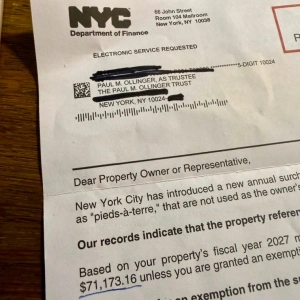
Last week, I received a bill from New York City for $71,1783.16. It was the balance due for my Non-primary residence surcharge, aka the pied-à-terre tax that is a premium on top of the $55k or so we pay in regular, old fashioned property tax. We got pinged because our home is owned by our trusts, which are not New York entities. The good news is that, since we are legit full-time residents, we will get out of this. Still, it’s pretty scary to get this kind of unexpected invoice. Suffice to say, it’s a wild time in New York city real estate. In addition to this new second—or third or fourth—home tax, there are a ton of policy changes in the works, including but not limited to:

* The mayor and the Rent Guidelines Board just implemented a two-to-three year rent freeze for all the city’s rent stabilized units, comprising 41% of the supply of rental housing in the city.

* Pending in the City Council is the Community Opportunity to Purchase Act (COPA) that, when it passes, will impose major restrictions on a multi-family unit owners’ freedom to sell their building.

* Potential “Mansion” Tax reform could lower the threshold from $1 million to $500,000 transactions, increase rates by 40%, and switch the liability from the buyer to the seller.

In short, there’s a massive amount of uncertainty about the future, but all trends point to an increasingly hostile and expensive environment for property owners.

To try to make sense of how it works, I interviewed Paula Pant, founder and host of the Afford Anything podcast, a former newspaper reporter, and Knight-Bagehot Fellow at Columbia University.

Paula is a NYC-based landlord who has developed an expertise on the city’s rent stabilization system, where it came from, and how it works.

Most people assume that rent stabilization exists to help poor people, but that’s not the priority. It operates more like a lottery system where random, lucky “winners” lock in below-market prices regardless of how much money they make. In fact, a recent Wall Street Journal analysis indicated that more than 86,000 rent stabilized households earn over $200,000 a year!

The system and its adjacent policies protect bad tenants, disincentivize capital investment and construction, and have led to 57,000 apartments being left vacant because it’s less expensive to leave them empty than to participate in the city’s rigged game.

The whole thing is wacky and totally non-obvious. I learned a ton talking to Paula and I know you will too. Check it out.

Follow Paula on Instagram here, or X (aka, Twitter) here. Get your free download: 7 Expensive Rental Property Mistakes to Avoid Follow Me (Paul) on Instagram here, or X (aka, Twitter) here.

Get tickets to see me live in Sarasota 8/13-16 here.

Timestamps:

00:00:00 Trailer

00:00:59 Intro

00:03:03 Hyper frugal in her twenties, for all the wrong reasons

00:05:31 A $27,000 down payment on an Atlanta triplex

00:08:21 Never be a landlord in New York City

00:08:33 The price to rent ratio, and how to run it on any apartment

00:14:10 Nobody has a right to 12% returns, and what a 9.9% cap would actually do

00:16:24 Rent control versus rent stabilization: 16,000 units against a million

00:20:16 If it were designed to help poor people, there would be means testing

00:23:36 True working class people are subsidizing the rich

00:24:23 How the units actually get handed out, and the friend earning over $300,000

00:30:32 The Rent Guidelines Board, the 7 to 1 freeze, and the resignation in protest

00:37:07 Check credit or verify income, but not both

00:41:21 The 2019 law and the $100,000 turnover no bank will finance

00:49:25 57,000 vacant units and the Community Opportunity to Purchase Act

00:54:22 Austin as the model, and where Paula puts her own capital

00:57:13 Analyst, not advocate. Data over dogma

00:58:36 Outro


Get full access to Reasonably Happy at words.paulollinger.com/subscribe

Paul Ollinger has worn a few different hats-stand-up comedian, tech executive, and now, the curious host of Reasonably Happy with Paul Ollinger. This isn't a lecture series or a dry self-help guide. Instead, it feels more like pulling up a chair for a series of genuinely engaging talks that wander into the places where our daily lives, careers, and inner worlds collide. The conversations, which feature authors, thinkers, and various creatives, are refreshingly candid. They dig into the practical and philosophical questions about what it actually means to build a life that feels both successful and satisfying. You'll find that each episode of this podcast approaches big themes-money, purpose, and the pursuit of contentment-with a blend of wit and thoughtful depth. The underlying idea isn't about finding a perfect, Instagram-ready version of happiness, but something more grounded and attainable. It's for anyone who's ever wondered if there's a smarter, more meaningful way to navigate the pressures of business and culture without losing sight of what matters. Tuning in, you get the sense that Paul is figuring it out alongside his guests, making the insights feel earned and relatable. The result is a consistently interesting exploration of how we can all aim for a life that feels reasonably, and authentically, well-lived.
Author: Language: English Episodes: 50

Reasonably Happy with Paul Ollinger
Podcast Episodes
Jared Dillian on ‘The Awesome Portfolio’ [not-audio_url] [/not-audio_url]

Duration: 45:04
My guest today is Jared Dillian, a former Wall Street trader, DJ, and the best-selling author of Street Freak, No Worries, and his new book, The Awesome Portfolio.Let me ask you a question: Can you let your investments r…
Dave Winfield, Baseball Legend [not-audio_url] [/not-audio_url]

Duration: 50:40
If MLB first-ballot Hall-of-Famer Dave Winfield’s story tells us anything, it’s that you can’t judge a person by how things appear on the surface.What we saw from the outside: a formidable 6’6”, 220 lb athlete who had ju…
Life in the Soviet Union (w/ Vitaliy Katsenelson) [not-audio_url] [/not-audio_url]

Duration: 58:21
Vitaliy Katsenelson grew up in the Soviet Union - in Murmansk, the largest city north of the Arctic Circle. Today, he is the CEO & Chief Investment Officer of IMA (Investment Management Associates).An award-winning write…
Senator Phil Gramm Dispels Economic Myths [not-audio_url] [/not-audio_url]

Duration: 1:00:09
This week, I sit down with Phil Gramm, economist, three-term United States Senator from Texas, former chairman of the Senate Banking Committee, and co-author of 'The Triumph of Economic Freedom: Debunking the Seven Great…
‘Young Money’ with Jack Raines [not-audio_url] [/not-audio_url]

Duration: 57:39
This week, I’m talking to Jack Raines, the guy behind the mega-popular Substack Young Money and author of a great new book called Young Money: A Field Guide to Wealth and Purpose in Your Twenties.After graduating from co…
Can You Fake Happiness? w/Beth Cabrera [not-audio_url] [/not-audio_url]

Duration: 44:08
“People do not decide their futures: they decide their habits and their habits decide their future.” – F.M. AlexanderIf you want to improve, be kind to yourself. That’s the message from this week’s guest, Dr. Beth Cabrer…
Nobel Prize Winner on "Moral Economics" [not-audio_url] [/not-audio_url]

Duration: 49:36
This week, I sit down with Dr. Alvin Roth, Nobel Prize-winning economist, Stanford professor, and author of Moral Economics: From Prostitution to Organ Sales, What Controversial Transactions Reveal About How Markets Work…
How Empathy Is Destroying Western Civilization (with Gad Saad) [not-audio_url] [/not-audio_url]

Duration: 1:10:26
In this episode of Reasonably Happy, I sit down with Dr. Gad Saad, an evolutionary behavioral scientist, longtime professor, and author of the New York Times bestseller Suicidal Empathy: Dying to be Kind. Gad lays out wh…
The Richest Family You've Never Heard Of [not-audio_url] [/not-audio_url]

Duration: 52:14
Investment management firm Fidelity is a private company that administers over $18 trillion in assets—that’s greater than the GDPs of Germany, Japan, the United Kingdom, and France combined. (Or, it’s18 Elon Musks.) Last…