Who is the Fig Tree Generation?
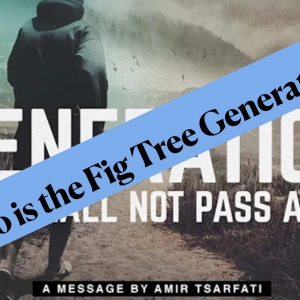
Will a "Fig Tree" Generation as asserted by Amir Tsarfati, see the return of Christ?
Or perhaps the question we should really ask is: Is there a fig tree generation?
In this episode, I review an often repeated assertion by those who believe in a futurist interpretation of the Olivet discourse (Mt 24, Mk13, Lk 21), that there is a “fig tree” generation that will see the return of Christ. In this instance, well-known preacher Amir Tsarfati speaks on this topic, and I pull back the veneer and demonstrate that he is being being true to the text.
Here are the notes & comments from the podcast for those who prefer to read.
After watching the whole video/sermon - this clip represents the central point he made. Please feel free to watch the whole sermon on Youtube for yourself.
So what are the assertions he has made?
He interprets the "fig tree parable" as some special event 2000 years in the future of Jesus disciples, when the nation of Israel will be restored to it's original nationhood
He then says "You" (in the video he points at the audience) are the generation of people who according to Jesus's words "see" this special fig tree based restoration of the nation of Israel and therefore:
When Jesus says "this generation" - he means the generation of people who are alive to witness the restoration of the nation of Israel and they will basically be the ones who experience the second coming of Christ.
The all important question now is: Is this what Jesus actually said?
To assist us in answering this question, let's first read the passage in all three renditions of the Olivet Discourse: Matthew 24, Mark 13 and Luke 21.
"From the fig tree learn its lesson: as soon as its branch becomes tender and puts out its leaves, you know that summer is near. So also, when you see all these things, you know that he is near, at the very gates. Truly, I say to you, this generation will not pass away until all these things take place" - Mt 24:32-34
"From the fig tree learn its lesson: as soon as its branch becomes tender and puts out its leaves, you know that summer is near. So also, when you see these things taking place, you know that he is near, at the very gates. Truly, I say to you, this generation will not pass away until all these things take place" - Mk 13:28-30
"Look at the fig tree, and all the trees. As soon as they come out in leaf, you see for yourselves and know that the summer is already near. So also, when you see these things taking place, you know that the kingdom of God is near. 32 Truly, I say to you, this generation will not pass away until all has taken place" - Lk 21:29-32
What are then some of the important questions we must ask to ascertain what is being said?
- (1) What is the parable about, i.e. what is it's central message?
- (2) What was Jesus trying to say when he referred to the parable by "So also when you see"?
- (3) What did Jesus mean by "all these things"? Was he referring to the parable or the events just detailed before launching into this parable?
- (4) What was Jesus's audience, i.e. who was in view with the pronoun "You"?
- If we can answer these four questions we can I think quite clearly demonstrate who was in view with the term "this generation".
(1) What was the parable about ?
- Tsarfati asserted that the parable is about the restoration of the nation of Israel. In the full sermon he states that the Fig Tree is used as representation of Israel. I would suggest he is engaging in "eisegesis" here since this parable does not say anything about the restoration of a dead tree in the long distant future, even if Israel was meant with the tree, the rest has to be quite literally imposed onto the parable.
Let's break it down and also see what Jesus clearly tells us:
- "From the fig tree learn its lesson" - so we are to learn a specific lesson from the tree
- "As soon as its branch becomes tender and puts out its leaves, you know that summer is near"
- if we read this in plain English it simply means two things:
- "When the tree's branch becomes tender, it put's out its leaves"
- "When it's leaves are out, we can know that summer is near"
- NB: Please note here that the parallel passage in Luke's gospel mentions "and all the trees".
- Given that Luke primarily wrote to a Gentile audience who may or may not know about "fig trees"the addition of "all trees" is a pretty sane give away that Jesus's isn't making any specific assertion about a Fig tree per say and therefore something specific to Israel only, but rather a straightforward and simple assertion that is true of all trees!
- When trees put out their leaves, you know the summer is near!
- This leads us straight into our next question:
(2) What was Jesus referring to when he said "So also when you see"
- The most straightforward and simple explanation is that the "so" does not refer to some special knowledge Jews may have about the restoration of the nation of Israel, but simply:
- In the same way you can conclude that summer is near when you see the leaves on the fig tree
- So you can conclude that the coming of Jesus is near when "these things" have happened.
- which again leads is squarely into the next question namely:
(3) What did Jesus mean by "all these things"?
> Was he referring to the parable or the events just detailed before launching into this parable?
- Again the most obvious and plain reading is that "all these things" refers to the long list of events Jesus has just detailed from verse 3 all the way to verse 31.
- there are several natural reasons why the context demands this is so:
- "these things" is plural, whereas the shedding of leaves is one single thing. If Jesus had meant the shedding of the leaves on fig trees as the sign to look for - would he have used "these things" as plural to refer to it? That makes no sense, firstly it is a single event, and secondly wouldn't he have much more naturally referred to the shedding itself?
- Secondly and more importantly:
- It is much more likely that Jesus was referring to the actual question of the disciples. Remember
that they originally asked "when will these things happen" in verse 3?
- the term "these things" appears not only in the original question but also at several junctures in the list of detailed events Jesus gives.
- "For THOSE THINGS must take place" - verse 6
- "But all THESE [THINGS] are merely the beginning" - verse 8
- Whether "these or those or these things" is used depends on the translation, but the context is very obviously pointing to the fact that when Jesus uses this term in verse 33 - the "these things"refers to the long list of events Jesus predicted.
- that now leads us to the final question of audience:
(4) Who was Jesus speaking with, was "You" Jesus's disciples or some generation in the very far distant future as Tsarfati intimated?
- Imagine for a moment you are at the reading of the testament of your Mother and Father who recently died in a car crash. They have left their will for you, your brother and your sister.
- There are no special things that go to individuals, but rather the house has been left to all three of you. The testament reads:
"When you read this you will know we have passed and have left the house to you. We don't want you to squable over the house, our wish is that you would share the property and each enjoy the gardens and think of us as you cherish it's wealth. When you enter the garage you will find our old car. If you think it is worth restoring, after you have evaluated it, please do restore it."
- Who is the audience of this "testament"?
- The three kids
- Is the testament directed to their grand children? - no
- Will the grand children benefit from the testament - Yes in a secondary nature by the fact that they are grand kids
- Audience relevance: Who again is addressed? Just the three kids
- Who is to restore the car? The kids
- Is the restoration a must? No it's conditional on their evaluation
- Does this testament have relevance in terms of actions for a generation two millenia away?
- I think you know where I am going with this.
If we say that the personal pronoun "You" is not the disciples of Jesus, but some distant generation of people in two millenia away, then words in English have no meaning and you can make the Bible say whatever you want it to say!
- So why do people fall into the trap of misinterpreting this passage so badly?
- I would suggest it is due to the many "difficult" assertions that Jesus makes that sound so very much like "The End of the World" and therefore they feel compelled to find a way out of the very obvious timing passages. The events Jesus is speaking of in Mt 24 include a "coming of Jesus". If you insist on saying this "coming" is about the second coming of Christ, then you will have the problem like Tsarfati of trying to get around the very obvious and plain timing passage we just reviewed.
- If however you come to realise that the "coming" referred to in this passage is not the second coming of Jesus, but a "coming in judgment" - that occurred in AD 70 when the Roman armies invaded Judea and destroyed the temple, then these timing passages all of a sudden come into perfect view!
- I have recently authored a book called "Did Jesus Predict the End of the World?" It is being published in a few weeks, and I intend to publish it - piece by piece on my podcast so you can listen to it for free. I sure hope that some of my listeners will support my ministry by buying the book once it is published.
- Just one final comment. Many today believe that the word "generation" in this verse should be translated "race" i.e. the Jewish Race will not pass until all these things take place. This is yet another of the many questions I answer in my book. The short version is that the Bible gives us no warrant to translate the word "genea" as race in this passage. In my book an entire chapter is devoted to answering the reasons why.
I hope you enjoyed this video
This is a public episode. If you would like to discuss this with other subscribers or get access to bonus episodes, visit
reformedapologist.substack.com