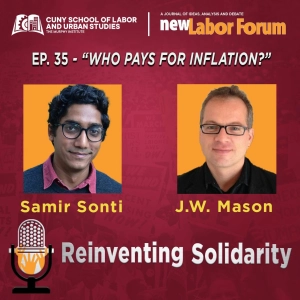
Episode 35 - Who Pays for Inflation?

Episode 35 - Who Pays for Inflation?

Author: CUNY SLU October 2, 2022 Duration: 37:37
The fact that current inflation rates are higher than they have been in decades weighs not only on households and businesses, but has also shifted the political landscape. As we head into the 2022 midterms and then the 2024 Presidential elections, understanding the deeper causes of and available remedies to inflation is of paramount importance. In this episode, Samir Sonti and JW Mason offer their insights on questions posed by inflation: If strong demand has contributed to rising prices, what role have constraints on the supply side played? Why have interest rate hikes become the textbook response inflation? What other remedies should be on the table?

What does it mean to stand together in a world that often feels fragmented? Reinventing Solidarity, from CUNY SLU, digs into that question without easy answers. This isn't a lecture series, but a collection of grounded conversations exploring how connection and mutual support are being reimagined right now. You'll hear from organizers, artists, scholars, and community members who are actively building bridges across differences, examining both the triumphs and the stumbling blocks in contemporary collective action. Each episode focuses on real-world examples, from workplace organizing and neighborhood initiatives to cultural projects that challenge old narratives. The discussions are nuanced, avoiding simple slogans in favor of honest talk about the hard work of building lasting bonds in our communities and institutions. Tune in for a thoughtful exploration of the practical and philosophical sides of coming together. This podcast offers a necessary space to consider how solidarity isn't just a historical concept, but a living, evolving practice we all have a stake in shaping.
Author: Language: English Episodes: 66

Reinventing Solidarity
Podcast Episodes
Episode 44 - "The New Terrain of Veterans Affairs" [not-audio_url] [/not-audio_url]

Duration: 34:30
This episode focuses on a discussion of publicly funded and operated health care in the United States. If this might seem a pipe dream with no national precedence, the authors of the recent book, Our Veterans: Winners, L…
Episode 43 - "The Strike: Labor's Most Powerful Weapon" [not-audio_url] [/not-audio_url]

Duration: 48:51
CUNY School of Labor and Urban Studies faculty member Stephanie Luce speaks with trade unionists Judy Gonzalez and Bob Master about the conditions which make the strike labor’s most powerful weapon. Drawing on recent exp…
Episode 42 - "Independent Unions: The Allure of a Failing Strategy" [not-audio_url] [/not-audio_url]

Duration: 38:52
This episode offers a provocative assessment of independent unionism as a strategy for building worker power in the U.S. In conversation with New Labor Forum Consulting Editor Joshua Freeman, Erik Loomis discusses his sp…
Episode 41 - "Labor Power and Strategy" [not-audio_url] [/not-audio_url]

Duration: 59:26
This episode tackles the big labor organizing questions of the day: What is the relative strategic importance of organizing workers at the commanding heights of the 21st century economy, like the docks for example, versu…
Episode 40 - "The South: Jim Crow and its Afterlives" [not-audio_url] [/not-audio_url]

Duration: 37:18
In this episode, Adolph Reed, Jr. describes Jim Crow as a result of decades of post-emancipation contention between freed slaves, white farmers and laborers, and the ruling class of white planters and merchants. As an ou…
Episode 38 - "Making Hope and History Rhyme" [not-audio_url] [/not-audio_url]

Duration: 49:29
Over the past half-century, labor activists Marilyn Sneiderman and Stephen Lerner have been responsible for spurring major strategic advances in union organizing and movement building. Here, they discuss their recent New…
Episode 37 - Why We Need Debtors' Unions [not-audio_url] [/not-audio_url]

Duration: 26:43
A dramatic increase in national consumer debt began in the mid-1980s and currently stands at 16.5 trillion dollars, making it a key feature of capitalism in the 21st century. Average household debt today in the U.S. – mo…