How do we teach students to sit with evidence longer?

How do we teach students to sit with evidence longer?

Author: Jeff Utecht & Tricia Friedman July 27, 2026 Duration: 23:48

What happens when historical research uncovers a truth you are not sure you want to know?

In this episode of Shifting Schools, Tricia speaks with author Christine Kuehn and her husband and research partner, Mark Schiponi, about Family of Spies: A World War II Story of Nazi Espionage, Betrayal, and the Secret History Behind Pearl Harbor.

Christine's investigation began with a startling discovery: members of her family had been deeply involved with the Nazi Party, and her grandfather had been convicted for his role connected to the attack on Pearl Harbor. What followed was a 30-year search through family testimony, declassified FBI files, National Archives records, historical accounts, photographs, and long-buried memories.

Christine and Mark describe the emotional strain of researching a painful family history and the many times the project was packed away because the discoveries became too difficult to face. They also explain how they compared official records with family stories, handled contradictions, organized years of handwritten notes, and decided what evidence could be trusted.

The conversation also examines the craft of making history readable. Christine and Mark wanted the book to reach people who might never choose a conventional work of World War II history. They discuss weaving the past together with Christine's present-day investigation, writing nonfiction with the momentum of a novel, and removing compelling material when it no longer served the larger story.

For educators, the episode offers a useful exploration of historical inquiry, source evaluation, inherited narratives, memory, and the role storytelling plays in keeping difficult history visible. It raises questions that belong in history, humanities, media-literacy, and ELA classrooms:

How do we respond when evidence challenges the stories we have inherited?

What responsibilities come with uncovering painful history?

How can writers make complex historical research accessible without weakening its accuracy?

What can students learn by comparing personal testimony, archival documents, photographs, government records, and published histories?

Christine also reflects on secrecy, shame, and the realization that people are not responsible for their ancestors' actions. They can, however, decide how honestly they will confront that history and what choices they will make in their own lives.

In this episode:

• The emotional cost of investigating a family's Nazi past
• Using declassified FBI files and National Archives records
• Comparing family memories with documentary evidence
• Turning 30 years of research into a coherent narrative
• Writing history for readers who do not consider themselves historians
• Confronting inherited shame and family secrecy
• Deciding what to remove when it no longer serves the story
• Teaching difficult history through human stories
• Responding to historical denial and misinformation

Timestamps:

00:00 The emotional and practical challenges of the research
03:49 Organizing decades of evidence and handwritten notes
07:20 Why confronting painful truths can matter
11:36 Sharing a private family history with the public
15:15 Historical storytelling and what comes next
18:55 Creating the book's past-and-present structure
21:48 Knowing when a powerful passage must be removed

About the book:

Family of Spies by Christine Kuehn combines memoir, archival investigation, World War II history, Nazi espionage, and the secret history surrounding Pearl Harbor. The book follows Christine's effort to understand her family's involvement and the effects that secrecy had on later generations.

Content note: This conversation discusses Nazism, antisemitism, the Holocaust, Pearl Harbor, family trauma, and inherited shame.

Resources mentioned:

Family of Spies by Christine Kuehn
Christine Kuehn's Politics and Prose conversation
The United States National Archives
Declassified FBI records and Freedom of Information Act research

Subscribe to Shifting Schools for conversations about education, historical and media literacy, emerging technology, storytelling, and the questions shaping how young people understand the world.


Ever feel like the conversation around education moves faster than a school day? Shifting Schools: Conversations for K12 Educators is here to slow things down just enough for a meaningful dialogue. Hosted by practicing educators Jeff Utecht and Tricia Friedman, this podcast creates a necessary space for teachers and administrators to dig into the real work of modern teaching. Instead of just theory, you’ll hear from fellow practitioners and thought leaders who are navigating the same challenges you face daily. The discussions move beyond surface-level trends to unpack practical strategies and tools that can be adapted for your own classroom or school. Whether it’s rethinking assessment, integrating technology with purpose, or fostering a more inclusive learning environment, each episode is grounded in the shared goal of improving outcomes for every student. Tuning in feels less like another professional development requirement and more like a candid staff room conversation with colleagues who get it. This is where the abstract ideas about educational change meet the concrete reality of the K-12 world, offering actionable insights for anyone committed to the craft of teaching. Find Shifting Schools wherever you listen to your favorite podcasts for a regular dose of perspective and practical ideas.
Author: Language: English Episodes: 50

Shifting Schools: Conversations for K12 Educators
Podcast Episodes
Why the World Has Always Been Weird — and Why That Matters [not-audio_url] [/not-audio_url]

Duration: 18:52
Uncle John's All-Knowing Bathroom Reader, Curiosity, and the Weirdness of Human History Brian Boone joins the show to talk about why the world has always been weird—not just now. The conversation ranges from animal histo…
From Super Bowl Champion to Literacy Champion | Malcolm Mitchell [not-audio_url] [/not-audio_url]

Duration: 22:36
What if readers and writers received the same attention, celebration, and investment as star athletes? In this episode, Tricia speaks with Super Bowl champion, children's author, and literacy advocate Malcolm Mitchell ab…
Never Underestimate a Young Reader [not-audio_url] [/not-audio_url]

Duration: 28:31
What do young people understand that adults mistakenly believe they have hidden from them? Award-winning author Tiffany D. Jackson returns to the podcast to discuss Ghost in the Night, her haunting middle-grade novel set…
The Humanoid Robot, the Headlines, and What Really Happened [not-audio_url] [/not-audio_url]

Duration: 57:39
When Salamanca City Central School District announced plans to bring a humanoid robot into its robotics program, the story quickly became something else entirely: "A school is replacing teachers with robots." That was ne…
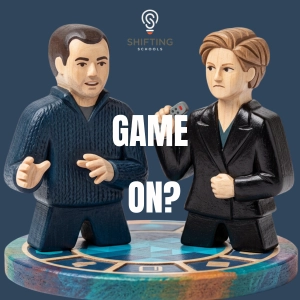
Game Design Could Transform Assessment in the AI Era [not-audio_url] [/not-audio_url]

Duration: 49:54
What if students didn't simply complete an assessment—but designed an experience for someone else? In this episode of Shifting Schools, Tricia Friedman pitches Jeff Utecht a new approach to assessment for the AI era: inv…
What will be your anchor for wellness this school year? [not-audio_url] [/not-audio_url]

Duration: 44:31
The beginning of a school year often arrives with a familiar message: do more, organize more, and somehow become a brand-new person before the first bell rings. This episode offers a different invitation. Instead of atte…
Lisa Gardner on Creativity and Curiosity [not-audio_url] [/not-audio_url]

Duration: 27:31
What can ELA teachers learn from a bestselling suspense novelist who begins writing without knowing who the villain is? In this episode of Shifting Schools, Tricia Friedman speaks with Lisa Gardner about the habits, ques…
How to Raise a Reader from Birth with Sandra Magsamen [not-audio_url] [/not-audio_url]

Duration: 26:24
What can a board book offer a baby who cannot yet speak or even hold it independently? Award-winning author, illustrator, and art therapist Sandra Magsamen joins Tricia to discuss Hello, Baby, her new board book created…
Who Gets to Lead? Expanding Student Voice with Rachel Thrash [not-audio_url] [/not-audio_url]

Duration: 39:15
When schools picture a student leader, they often imagine the confident speaker, the high achiever, or the student who already understands how to succeed within existing systems. But what about the students who are rarel…
How Nolan's Odyssey and Cover Songs Help Us Talk About AI [not-audio_url] [/not-audio_url]

Duration: 13:27
Christopher Nolan's Odyssey just earned nearly $300 million retelling a 3,000-year-old story — so what actually separates imitation from transformative interpretation? In this episode, Tricia makes the case that cover so…