AI Agents & the Future of Human Experience + Always On AI Wearables + Artificiality Updates for 2025

AI Agents & the Future of Human Experience + Always On AI Wearables + Artificiality Updates for 2025

Author: Helen and Dave Edwards January 17, 2025 Duration: 27:14

Science Briefing: What AI Agents Tell Us About the Future of Human Experience * What These Papers Highlight - AI agents are improving but far from capable of replacing human tasks. Even the best models fail at simple things humans find intuitive, like handling social interactions or navigating pop-ups. - One paper benchmarks agent performance in workplace-like tasks, showing just 24% success on even simple tasks. The other argues that agents alone aren’t enough—we need a broader system to make them useful. * Why This Matters - Human Compatibility: Agents don’t just need to complete tasks—they need to work in ways that humans trust and find relatable. - New Ecosystems: Instead of relying on better agents alone, we might need personalized digital “Sims” that act as go-betweens, understanding us and adapting to our preferences. - Humor in Failure: From renaming a coworker to "solve" a problem to endlessly struggling with pop-ups, these failures highlight how far AI still is from grasping human context. * What’s Interesting - Humans vs. Machines: AI performs better on coding than on “easier” tasks like scheduling or teamwork. Why? It’s great at structure, bad at messiness. - Sims as a Bridge: The idea of digital versions of ourselves (Sims) managing agents for us could change how we relate to technology, making it feel less like a tool and more like a collaborator. - Impact on Trust: The future of agents will hinge on whether they can align with human values, privacy, and quirks—not just perform better technically. *What’s Next for Agents - Can agents learn to navigate our complexity, like social norms or context-sensitive decisions? - Will ecosystems with Sims and Assistants make AI feel more human—and less robotic? - How will trust and personalization shape whether people actually adopt these systems? Product Briefing: Always On AI Wearables * What’s new: - New AI wearables launched at CES 2025 that continuously listen. From earbuds (HumanPods) to wristbands (Bee Pioneer) to stick-it-to-your-head pods (Omi), these cheap hardware devices are attempting to be your always-listening assistants. * Why This Matters - From Wake Words to Always-On: These devices listen passively—no activation required—requiring the user to opt-out by muting rather than opting in. - Privacy? Pfft: Not only are these devices small enough to hide and record without anyone knowing. The Omi only turns on a light when it is not recording. - Razor-Razorblade Model: With hardware prices below $100, these devices are priced to all for easy experimentation—the value is in the software subscription. * What’s Interesting - Mind-reading?: Omi claims to detect brain signals, allowing users to think their commands instead of speaking. - It’s About Apps: The app store is back as a business model. But are these startups ready for the challenge? - Memory Prosthetics: These devices record, transcribe, and summarize everything—generating to do lists and more. * The Human Experience - AI as a Second Self?: These devices don’t just assist; they remember, organize, and anticipate—how will that reshape how we interact with and recall our own experiences? - Can We Still Forget?: If everything in our lives is logged and searchable, do we lose the ability to let go? - Context Collapse: AI may summarize what it hears, but can it understand the complexity of human relationships, emotions, and social cues?
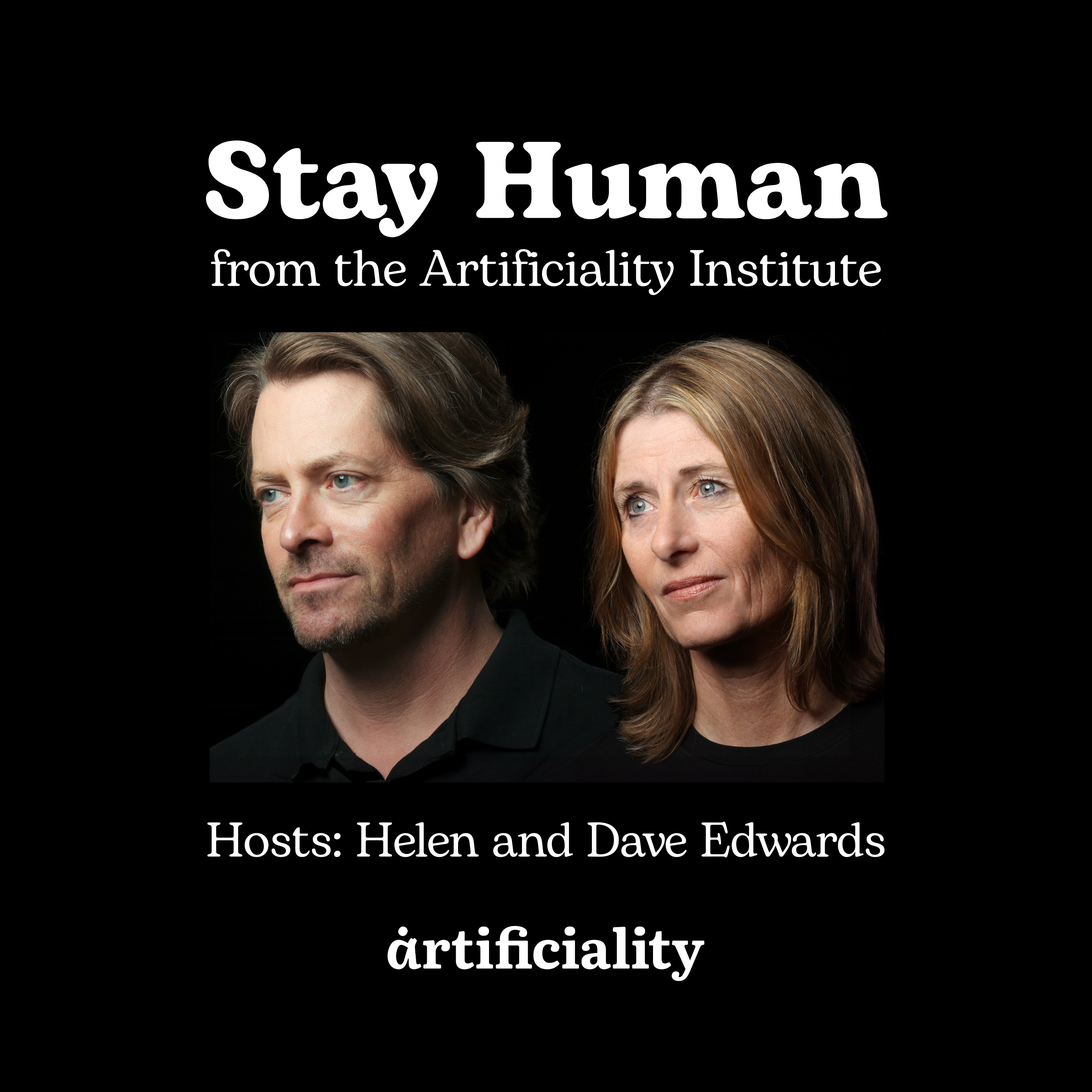

Hosted by Helen and Dave Edwards, Stay Human, from the Artificiality Institute is a conversation that lives in the messy, human space between our tools and our selves. Each episode digs into the subtle ways artificial intelligence is reshaping our daily decisions, our creative impulses, and even our sense of identity. This isn't a technical manual or a series of futuristic predictions; it's a grounded exploration of how we maintain our agency in a world increasingly mediated by algorithms. The podcast operates from a core belief: that our engagement with AI should be about more than just safety or efficiency-it needs to be meaningful and worthwhile. You'll hear discussions rooted in story-based research, where complex ideas about cognition and ethics are unpacked through relatable narratives and real-world examples. The goal is to provide a framework for thoughtful choice, helping each of us consciously design the relationship we want with the machines in our lives. Tuning in offers a chance to step back from the hype and consider how we can actively remain the authors of our own minds, preserving what makes us uniquely human even as the technology evolves. It's an essential listen for anyone curious about the personal and philosophical dimensions of our digital age.
Author: Language: en-us Episodes: 100

Stay Human, from the Artificiality Institute
Podcast Episodes
Don Norman: Design for a Better World [not-audio_url] [/not-audio_url]

Duration: 1:03:51
What role does design have in solving the world’s biggest problems? What can designers add? Some would say that designers played a role in getting us into our current mess. Can they also get us out of it? How can we desi…
Jamer Hunt: Not to Scale [not-audio_url] [/not-audio_url]

Duration: 1:08:32
What are the cause and effect of my actions? How do I know the effect of the small acts in my life? How can I identify opportunities to have impact that is much larger than myself? How can we make problems that seem over…
David Krakauer: Complexity [not-audio_url] [/not-audio_url]

Duration: 1:34:34
We’re always looking for new ideas from science that we can use in our work. Over the past few years, we have been researching new ways to handle increasing complexity in the world and how to solve complex problems. Why…
Generative AI: ChatGPT, DALL-E, Stable Diffusion, and the rest [not-audio_url] [/not-audio_url]

Duration: 29:43
Everyone’s talking about it so we will too. Generative AI is taking the world by storm. But is it a good storm or a scary storm? How should individuals think about what’s possible? What about companies? Our take: generat…
Kees Dorst: Frame Innovation [not-audio_url] [/not-audio_url]

Duration: 1:02:50
What can we learn from the practice of design? What might we learn if we had an insight into top designers’ minds? How might we apply the best practices of designers beyond the field of design itself? Most of our listene…
No-duhs and some surprises [not-audio_url] [/not-audio_url]

Duration: 26:37
The latest Big Ideas report from MIT Sloan and BCG makes for an interesting read but contains flaws, obvious conclusions, and raises more questions than it answers.We discuss this report and make some suggestions about h…
Elon's error calculation at Twitter [not-audio_url] [/not-audio_url]

Duration: 27:29
Twitter as we knew is gone. Elon has fired half the full time employees and 80 percent of the contractors. It’s a brutal way to trim excess fat, reset the culture, and establish a loyal band. But is it a good decision? H…
Marina Nitze and Nick Sinai: Hack Your Bureaucracy [not-audio_url] [/not-audio_url]

Duration: 56:50
We all likely want to improve the organizations we work in. We might want to improve the employee experience, improve the customer experience, or be more efficient and effective. But we all likely have had the experience…
Tom Davenport and Steve Miller: Working with AI [not-audio_url] [/not-audio_url]

Duration: 52:38
How will AI change our jobs? Will it replace humans and eliminate jobs? Will it help humans get things done? Will it create new opportunities for new jobs? People often speculate on these topics, doing their best to pred…
