Benjamin Bratton: The Platypus and the Planetary

Benjamin Bratton: The Platypus and the Planetary

Author: Helen and Dave Edwards June 8, 2025 Duration: 1:04:29

In this wide-ranging conversation, we explore the implications of planetary-scale computation with Benjamin Bratton, Director of the Antikythera program at the Berggruen Institute and Professor at UC San Diego. Benjamin describes his interdisciplinary work as appearing like a "platypus" to others—an odd creature combining seemingly incompatible parts that somehow works as a coherent whole.

At the heart of our discussion is Benjamin's framework for understanding how computational technology literally evolves, not metaphorically but through the same mechanisms that drive biological evolution: scaffolding, symbiogenesis, niche construction, and what he calls "allopoiesis"—the process by which organisms transform their external environment to capture more energy and information.

Key themes we explore:

  • Computational Evolution: How artificial computation has become the primary mechanism for human "allopoietic virtuosity"—our ability to reshape our environment to sustain larger populations
  • The Embodiment Question: Moving beyond anthropomorphic assumptions about AI embodiment to imagine synthetic intelligence with radically different spatial capabilities and sensory arrangements
  • Agentic Multiplication: How the explosion of AI agents (potentially reaching hundreds of billions) will fundamentally alter human agency and subjectivity, creating "parasocial relationships with ourselves"
  • Planetary Intelligence: Understanding Earth itself as having evolved a computational sensory layer through satellites, fiber optic networks, and distributed sensing systems
  • The Paradox of Intelligence: Whether complex intelligence is ultimately evolutionarily adaptive, given that our computational enlightenment has revealed our own role in potentially destroying the substrate we depend on

Benjamin challenges us to think beyond conventional categories of life, intelligence, and technology, arguing that these distinctions are converging into something more fundamental. As he puts it: "Agency precedes subjectivity"—we've been transforming our world at terraforming scales long before we were conscious of doing so.

The conversation culminates in what Benjamin calls "the paradox of intelligence": What are the preconditions necessary to ensure that complex intelligence remains evolutionarily adaptive rather than self-destructive? As he notes, we became aware of our terraforming-scale agency precisely at the moment we discovered it might be destroying the substrate we depend on. It's a question that becomes increasingly urgent as we stand at the threshold of what could be either a viable planetary civilization or civilizational collapse—what Benjamin sees as requiring us to fundamentally rethink "what planetary scale computation is for."

About Benjamin Bratton: Benjamin Bratton is a philosopher of technology, Professor of Philosophy of Technology and Speculative Design at UC San Diego, and Director of Antikythera, a think tank researching planetary computation at the Berggruen Institute. Beginning in 2024, he also serves as Visiting Faculty Researcher at Google's Paradigms of Intelligence group, conducting fundamental research on the artificialization of intelligence.

His influential book The Stack: On Software and Sovereignty (MIT Press, 2015) develops a comprehensive framework for understanding planetary computation through six modular layers: Earth, Cloud, City, Address, Interface, and User. Other recent works include Accept All Cookies (Berggruen Press), written in conjunction with his co-curation of "The Next Earth: Computation, Crisis, Cosmology" at the 2025 Venice Architecture Biennale, and The Terraforming (Strelka), a manifesto arguing for embracing anthropogenic artificiality to compose a planet sustaining diverse life.
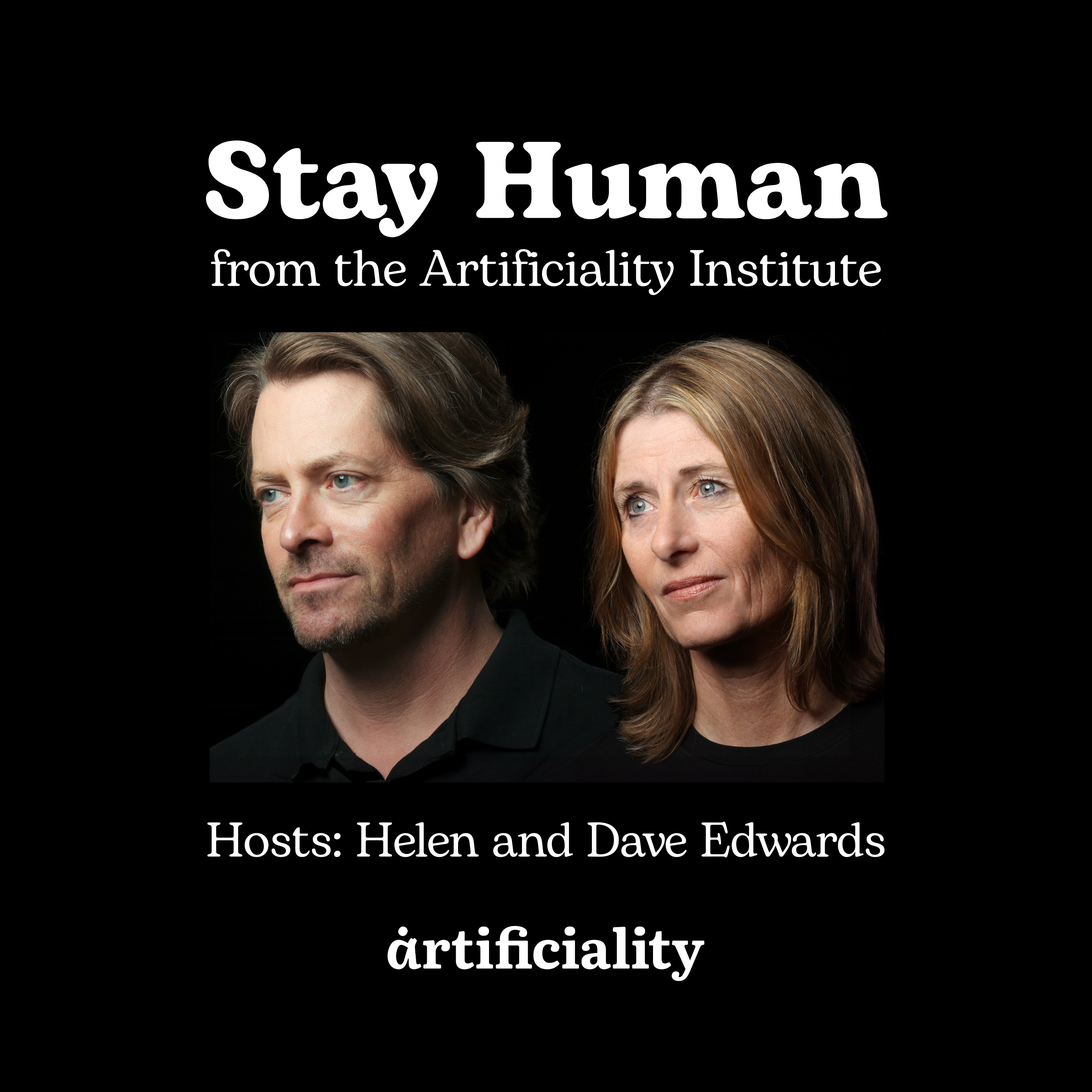

Hosted by Helen and Dave Edwards, Stay Human, from the Artificiality Institute is a conversation that lives in the messy, human space between our tools and our selves. Each episode digs into the subtle ways artificial intelligence is reshaping our daily decisions, our creative impulses, and even our sense of identity. This isn't a technical manual or a series of futuristic predictions; it's a grounded exploration of how we maintain our agency in a world increasingly mediated by algorithms. The podcast operates from a core belief: that our engagement with AI should be about more than just safety or efficiency-it needs to be meaningful and worthwhile. You'll hear discussions rooted in story-based research, where complex ideas about cognition and ethics are unpacked through relatable narratives and real-world examples. The goal is to provide a framework for thoughtful choice, helping each of us consciously design the relationship we want with the machines in our lives. Tuning in offers a chance to step back from the hype and consider how we can actively remain the authors of our own minds, preserving what makes us uniquely human even as the technology evolves. It's an essential listen for anyone curious about the personal and philosophical dimensions of our digital age.
Author: Language: en-us Episodes: 100

Stay Human, from the Artificiality Institute
Podcast Episodes
Don Norman: Design for a Better World [not-audio_url] [/not-audio_url]

Duration: 1:03:51
What role does design have in solving the world’s biggest problems? What can designers add? Some would say that designers played a role in getting us into our current mess. Can they also get us out of it? How can we desi…
Jamer Hunt: Not to Scale [not-audio_url] [/not-audio_url]

Duration: 1:08:32
What are the cause and effect of my actions? How do I know the effect of the small acts in my life? How can I identify opportunities to have impact that is much larger than myself? How can we make problems that seem over…
David Krakauer: Complexity [not-audio_url] [/not-audio_url]

Duration: 1:34:34
We’re always looking for new ideas from science that we can use in our work. Over the past few years, we have been researching new ways to handle increasing complexity in the world and how to solve complex problems. Why…
Generative AI: ChatGPT, DALL-E, Stable Diffusion, and the rest [not-audio_url] [/not-audio_url]

Duration: 29:43
Everyone’s talking about it so we will too. Generative AI is taking the world by storm. But is it a good storm or a scary storm? How should individuals think about what’s possible? What about companies? Our take: generat…
Kees Dorst: Frame Innovation [not-audio_url] [/not-audio_url]

Duration: 1:02:50
What can we learn from the practice of design? What might we learn if we had an insight into top designers’ minds? How might we apply the best practices of designers beyond the field of design itself? Most of our listene…
No-duhs and some surprises [not-audio_url] [/not-audio_url]

Duration: 26:37
The latest Big Ideas report from MIT Sloan and BCG makes for an interesting read but contains flaws, obvious conclusions, and raises more questions than it answers.We discuss this report and make some suggestions about h…
Elon's error calculation at Twitter [not-audio_url] [/not-audio_url]

Duration: 27:29
Twitter as we knew is gone. Elon has fired half the full time employees and 80 percent of the contractors. It’s a brutal way to trim excess fat, reset the culture, and establish a loyal band. But is it a good decision? H…
Marina Nitze and Nick Sinai: Hack Your Bureaucracy [not-audio_url] [/not-audio_url]

Duration: 56:50
We all likely want to improve the organizations we work in. We might want to improve the employee experience, improve the customer experience, or be more efficient and effective. But we all likely have had the experience…
Tom Davenport and Steve Miller: Working with AI [not-audio_url] [/not-audio_url]

Duration: 52:38
How will AI change our jobs? Will it replace humans and eliminate jobs? Will it help humans get things done? Will it create new opportunities for new jobs? People often speculate on these topics, doing their best to pred…
