Best of: Barbara Tversky & Spacial Cognition

Best of: Barbara Tversky & Spacial Cognition

Author: Helen and Dave Edwards January 11, 2024 Duration: 1:06:19

One of our long-time subscribers recently said to us: “What I love about you is that you’re regularly talking about things three years ahead of everyone else.” That inspired us to look back through our catalog of conversations to see which ones we think are most relevant now.

Today, we're revisiting one of our most thought-provoking episodes, originally recorded in April 2022, featuring Barbara Tversky, the author of "Mind in Motion: How Action Shapes Thought." This episode is great way to start 2024 because we are all about to experience what are known as Large Multimodal Models or LMMs, models which go beyond text and bring in more sensory modalities including spatial information.

Tversky's insights into spatial reasoning and embodied cognition are more relevant than ever in the era of multimodal models in AI. These models, which combine text, images, and other data types, mirror our human ability to process information across various sensory inputs.

The parallels between Tversky's research and Large Multimodal Models (LMMs) in AI are striking. Just as our physical interactions with the world shape our cognitive processes, these AI models learn and adapt by integrating diverse data types, offering a more holistic understanding of the world.

Her work sheds light on how we might improve AI's ability to 'think' and 'reason' spatially, enhancing its application in fields ranging from navigation systems to virtual reality.

As we revisit our interview with Tversky, we're reminded of the importance of considering human-like spatial reasoning and embodied cognition in advancing AI technology.

Join us as we explore these intriguing concepts with Barbara Tversky, uncovering the essential role of spatial reasoning in both human cognition and artificial intelligence.

Barbara Tversky is an emerita professor of psychology at Stanford University and a professor of psychology at Teachers College at Columbia University. She is also the President of the Association for Psychological Science. Barbara has published over 200 scholarly articles about memory, spatial thinking, design, and creativity, and regularly speaks about embodied cognition at interdisciplinary conferences and workshops around the world. She lives in New York.


About Artficiality from Helen & Dave Edwards:

Artificiality is a research and services business founded in 2019 to help people make sense of artificial intelligence and complex change. Our weekly publication provides thought-provoking ideas, science reviews, and market research and our monthly research releases provides leaders with actionable intelligence and insights for applying AI in their organizations. We provide research-based and expert-led AI strategy and complex change management services to organizations around the world.

We are artificial philosophers and meta-researchers who aim to make the philosophical more practical and the practical more philosophical. We believe that understanding AI requires synthesizing research across disciplines: behavioral economics, cognitive science, complexity science, computer science, decision science, design, neuroscience, philosophy, and psychology. We are dedicated to unraveling the profound impact of AI on our society, communities, workplaces, and personal lives. 

Subscribe for free at https://www.artificiality.world.

If you enjoy our podcasts, please subscribe and leave a positive rating or comment. Sharing your positive feedback helps us reach more people and connect them with the world’s great minds.

Learn more about ⁠⁠Sonder Studio⁠⁠

Subscribe to get ⁠⁠Artificiality⁠⁠ delivered to your email

Learn about our book ⁠⁠Make Better Decisions⁠⁠ and buy it on ⁠⁠Amazon⁠⁠

Thanks to ⁠⁠Jonathan Coulton⁠⁠ for our music

This is a public episode. If you would like to discuss this with other subscribers or get access to bonus episodes, visit www.artificiality.world.

#ai #artificialintelligence #generativeai #airesearch #complexity #futureofai 
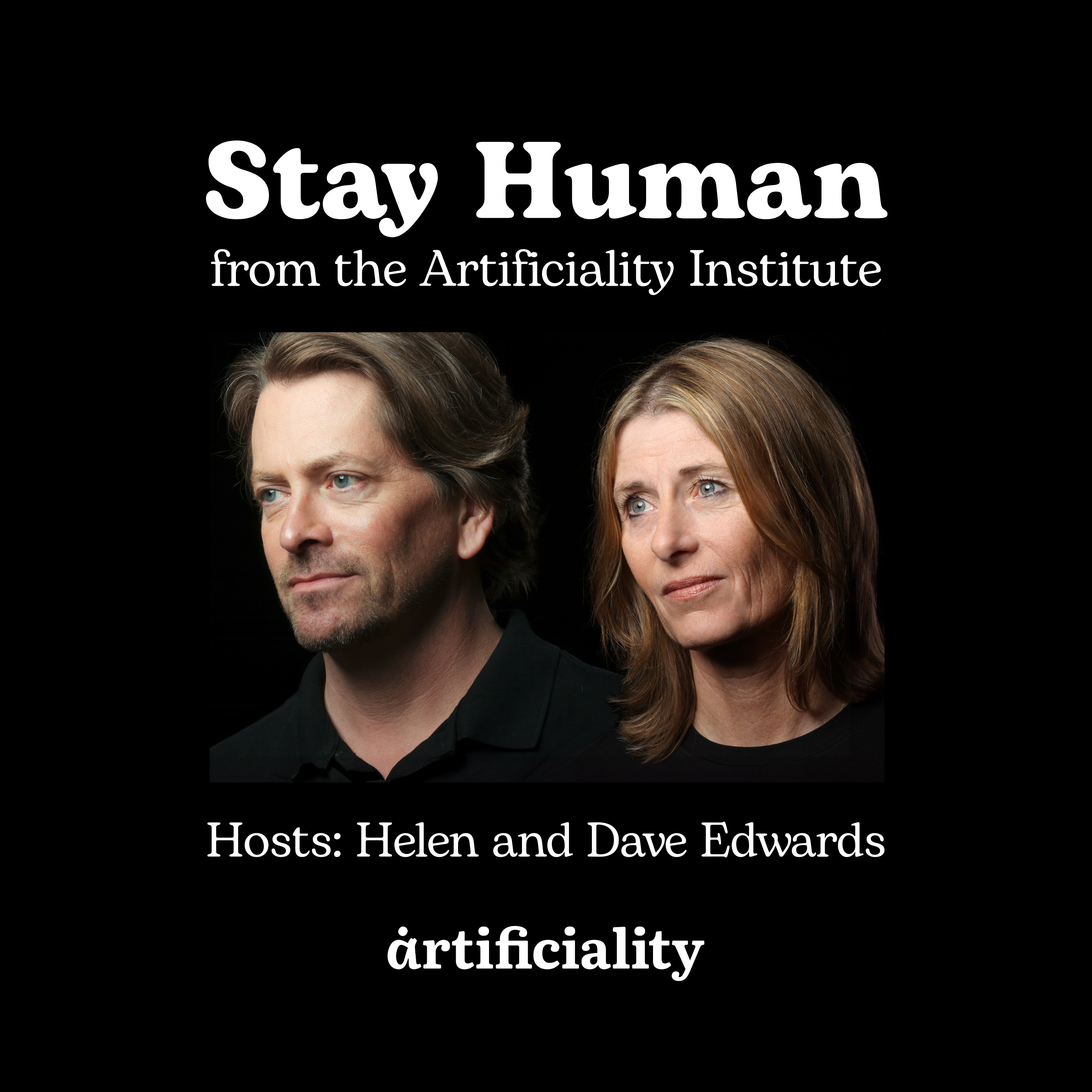


Hosted by Helen and Dave Edwards, Stay Human, from the Artificiality Institute is a conversation that lives in the messy, human space between our tools and our selves. Each episode digs into the subtle ways artificial intelligence is reshaping our daily decisions, our creative impulses, and even our sense of identity. This isn't a technical manual or a series of futuristic predictions; it's a grounded exploration of how we maintain our agency in a world increasingly mediated by algorithms. The podcast operates from a core belief: that our engagement with AI should be about more than just safety or efficiency-it needs to be meaningful and worthwhile. You'll hear discussions rooted in story-based research, where complex ideas about cognition and ethics are unpacked through relatable narratives and real-world examples. The goal is to provide a framework for thoughtful choice, helping each of us consciously design the relationship we want with the machines in our lives. Tuning in offers a chance to step back from the hype and consider how we can actively remain the authors of our own minds, preserving what makes us uniquely human even as the technology evolves. It's an essential listen for anyone curious about the personal and philosophical dimensions of our digital age.
Author: Language: en-us Episodes: 100

Stay Human, from the Artificiality Institute
Podcast Episodes
Don Norman: Design for a Better World [not-audio_url] [/not-audio_url]

Duration: 1:03:51
What role does design have in solving the world’s biggest problems? What can designers add? Some would say that designers played a role in getting us into our current mess. Can they also get us out of it? How can we desi…
Jamer Hunt: Not to Scale [not-audio_url] [/not-audio_url]

Duration: 1:08:32
What are the cause and effect of my actions? How do I know the effect of the small acts in my life? How can I identify opportunities to have impact that is much larger than myself? How can we make problems that seem over…
David Krakauer: Complexity [not-audio_url] [/not-audio_url]

Duration: 1:34:34
We’re always looking for new ideas from science that we can use in our work. Over the past few years, we have been researching new ways to handle increasing complexity in the world and how to solve complex problems. Why…
Generative AI: ChatGPT, DALL-E, Stable Diffusion, and the rest [not-audio_url] [/not-audio_url]

Duration: 29:43
Everyone’s talking about it so we will too. Generative AI is taking the world by storm. But is it a good storm or a scary storm? How should individuals think about what’s possible? What about companies? Our take: generat…
Kees Dorst: Frame Innovation [not-audio_url] [/not-audio_url]

Duration: 1:02:50
What can we learn from the practice of design? What might we learn if we had an insight into top designers’ minds? How might we apply the best practices of designers beyond the field of design itself? Most of our listene…
No-duhs and some surprises [not-audio_url] [/not-audio_url]

Duration: 26:37
The latest Big Ideas report from MIT Sloan and BCG makes for an interesting read but contains flaws, obvious conclusions, and raises more questions than it answers.We discuss this report and make some suggestions about h…
Elon's error calculation at Twitter [not-audio_url] [/not-audio_url]

Duration: 27:29
Twitter as we knew is gone. Elon has fired half the full time employees and 80 percent of the contractors. It’s a brutal way to trim excess fat, reset the culture, and establish a loyal band. But is it a good decision? H…
Marina Nitze and Nick Sinai: Hack Your Bureaucracy [not-audio_url] [/not-audio_url]

Duration: 56:50
We all likely want to improve the organizations we work in. We might want to improve the employee experience, improve the customer experience, or be more efficient and effective. But we all likely have had the experience…
Tom Davenport and Steve Miller: Working with AI [not-audio_url] [/not-audio_url]

Duration: 52:38
How will AI change our jobs? Will it replace humans and eliminate jobs? Will it help humans get things done? Will it create new opportunities for new jobs? People often speculate on these topics, doing their best to pred…
