Beth Rudden: AI, Trust, and Bast AI

Beth Rudden: AI, Trust, and Bast AI

Author: Helen and Dave Edwards August 17, 2025 Duration: 36:34

Join Beth Rudden at the Artificiality Summit in Bend, Oregon—October 23-25, 2025—to imagine a meaningful life with synthetic intelligence for me, we and us. Learn more here: www.artificialityinstitute.org/summit

In this thought-provoking conversation, we explore the intersection of archaeological thinking and artificial intelligence with Beth Rudden, former IBM Distinguished Engineer and CEO of Bast AI. Beth brings a unique interdisciplinary perspective—combining her training as an archaeologist with over 20 years of enterprise AI experience—to challenge fundamental assumptions about how we build and deploy artificial intelligence systems.

Beth describes her work as creating "the trust layer for civilization," arguing that current AI systems reflect what Hannah Arendt called the "banality of evil"—not malicious intent, but thoughtlessness embedded at scale. As she puts it, "AI is an excavation tool, not a villain," surfacing patterns and biases that humanity has already normalized in our data and language.

Key themes we explore:

  • Archaeological AI: How treating AI as an excavation tool reveals embedded human thoughtlessness, and why scraping random internet data fundamentally misunderstands the nature of knowledge and context
  • Ontological Scaffolding: Beth's approach to building AI systems using formal knowledge graphs and ontologies—giving AI the scaffolding to understand context rather than relying on statistical pattern matching divorced from meaning
  • Data Sovereignty in Healthcare: A detailed exploration of Bast AI's platform for explainable healthcare AI, where patients control their data and can trace every decision back to its source—from emergency logistics to clinical communication
  • The Economics of Expertise: Moving beyond the "humans as resources" paradigm to imagine economic models that compete to support and amplify human expertise rather than eliminate it
  • Embodied Knowledge and Community: Why certain forms of knowledge—surgical skill, caregiving, craftsmanship—are irreducibly embodied, and how AI should scale this expertise rather than replace it
  • Hopeful Rage: Beth's vision for reclaiming humanist spaces and community healing as essential infrastructure for navigating technological transformation


Beth challenges the dominant narrative that AI will simply replace human workers, instead proposing systems designed to "augment and amplify human expertise." Her work at Bast AI demonstrates how explainable AI can maintain full provenance and transparency while reducing cognitive load—allowing healthcare providers to spend more time truly listening to patients rather than wrestling with bureaucratic systems.

The conversation reveals how archaeological thinking—with its attention to context, layers of meaning, and long-term patterns—offers essential insights for building trustworthy AI systems. As Beth notes, "You can fake reading. You cannot fake swimming"—certain forms of embodied knowledge remain irreplaceable and should be the foundation for human-AI collaboration.

About Beth Rudden: Beth Rudden is CEO and Chairwoman of Bast AI, building explainable artificial intelligence systems with full provenance and data sovereignty. A former IBM Distinguished Engineer and Chief Data Officer, she's been recognized as one of the 100 most brilliant leaders in AI Ethics. With her background spanning archaeology, cognitive science, and decades of enterprise AI development, Beth offers a grounded perspective on technology that serves human flourishing rather than replacing it.

This interview was recorded as part of the lead-up to the Artificiality Summit 2025 (October 23-25 in Bend, Oregon), where Beth will be speaking about the future of trustworthy AI.
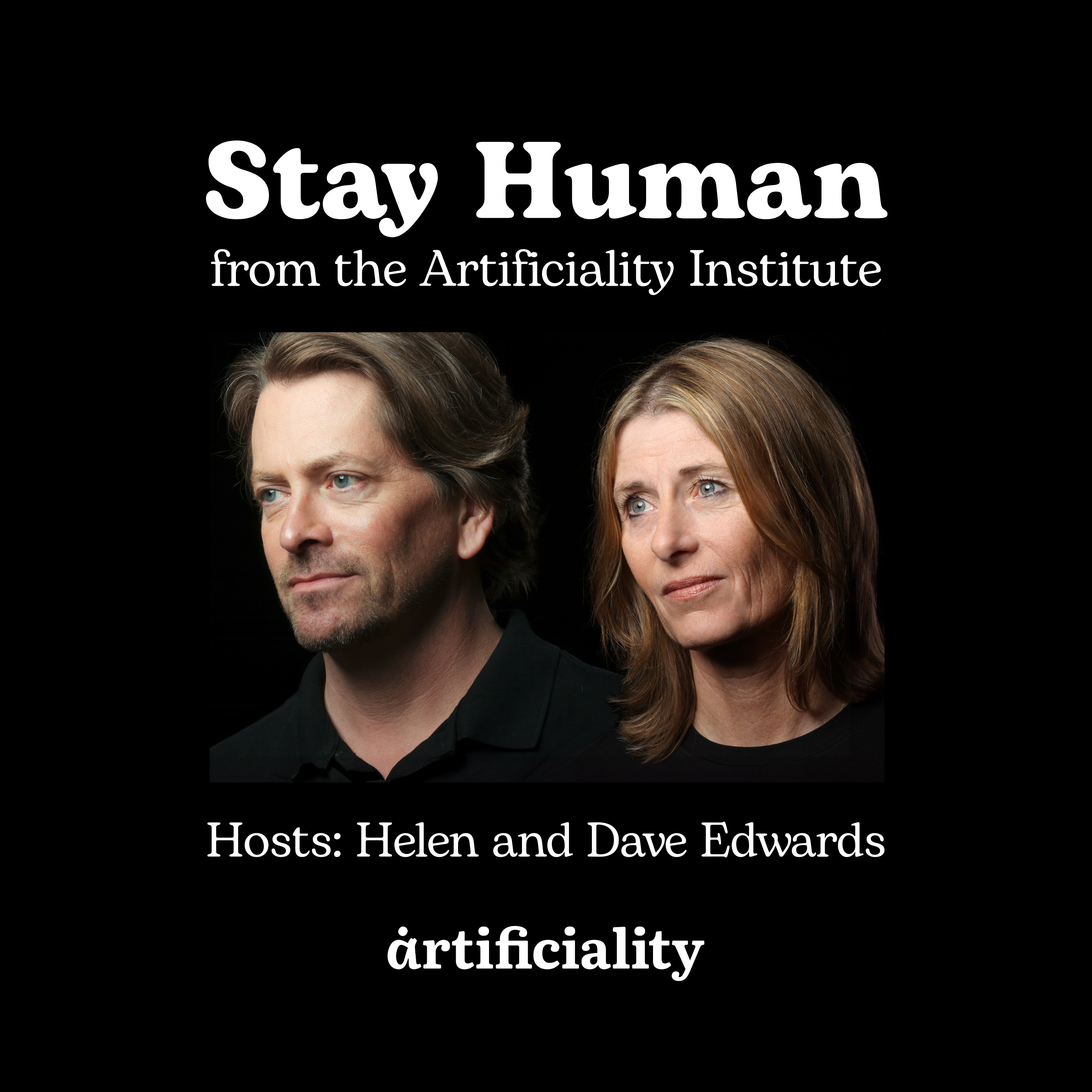

Hosted by Helen and Dave Edwards, Stay Human, from the Artificiality Institute is a conversation that lives in the messy, human space between our tools and our selves. Each episode digs into the subtle ways artificial intelligence is reshaping our daily decisions, our creative impulses, and even our sense of identity. This isn't a technical manual or a series of futuristic predictions; it's a grounded exploration of how we maintain our agency in a world increasingly mediated by algorithms. The podcast operates from a core belief: that our engagement with AI should be about more than just safety or efficiency-it needs to be meaningful and worthwhile. You'll hear discussions rooted in story-based research, where complex ideas about cognition and ethics are unpacked through relatable narratives and real-world examples. The goal is to provide a framework for thoughtful choice, helping each of us consciously design the relationship we want with the machines in our lives. Tuning in offers a chance to step back from the hype and consider how we can actively remain the authors of our own minds, preserving what makes us uniquely human even as the technology evolves. It's an essential listen for anyone curious about the personal and philosophical dimensions of our digital age.
Author: Language: en-us Episodes: 100

Stay Human, from the Artificiality Institute
Podcast Episodes
Don Norman: Design for a Better World [not-audio_url] [/not-audio_url]

Duration: 1:03:51
What role does design have in solving the world’s biggest problems? What can designers add? Some would say that designers played a role in getting us into our current mess. Can they also get us out of it? How can we desi…
Jamer Hunt: Not to Scale [not-audio_url] [/not-audio_url]

Duration: 1:08:32
What are the cause and effect of my actions? How do I know the effect of the small acts in my life? How can I identify opportunities to have impact that is much larger than myself? How can we make problems that seem over…
David Krakauer: Complexity [not-audio_url] [/not-audio_url]

Duration: 1:34:34
We’re always looking for new ideas from science that we can use in our work. Over the past few years, we have been researching new ways to handle increasing complexity in the world and how to solve complex problems. Why…
Generative AI: ChatGPT, DALL-E, Stable Diffusion, and the rest [not-audio_url] [/not-audio_url]

Duration: 29:43
Everyone’s talking about it so we will too. Generative AI is taking the world by storm. But is it a good storm or a scary storm? How should individuals think about what’s possible? What about companies? Our take: generat…
Kees Dorst: Frame Innovation [not-audio_url] [/not-audio_url]

Duration: 1:02:50
What can we learn from the practice of design? What might we learn if we had an insight into top designers’ minds? How might we apply the best practices of designers beyond the field of design itself? Most of our listene…
No-duhs and some surprises [not-audio_url] [/not-audio_url]

Duration: 26:37
The latest Big Ideas report from MIT Sloan and BCG makes for an interesting read but contains flaws, obvious conclusions, and raises more questions than it answers.We discuss this report and make some suggestions about h…
Elon's error calculation at Twitter [not-audio_url] [/not-audio_url]

Duration: 27:29
Twitter as we knew is gone. Elon has fired half the full time employees and 80 percent of the contractors. It’s a brutal way to trim excess fat, reset the culture, and establish a loyal band. But is it a good decision? H…
Marina Nitze and Nick Sinai: Hack Your Bureaucracy [not-audio_url] [/not-audio_url]

Duration: 56:50
We all likely want to improve the organizations we work in. We might want to improve the employee experience, improve the customer experience, or be more efficient and effective. But we all likely have had the experience…
Tom Davenport and Steve Miller: Working with AI [not-audio_url] [/not-audio_url]

Duration: 52:38
How will AI change our jobs? Will it replace humans and eliminate jobs? Will it help humans get things done? Will it create new opportunities for new jobs? People often speculate on these topics, doing their best to pred…
